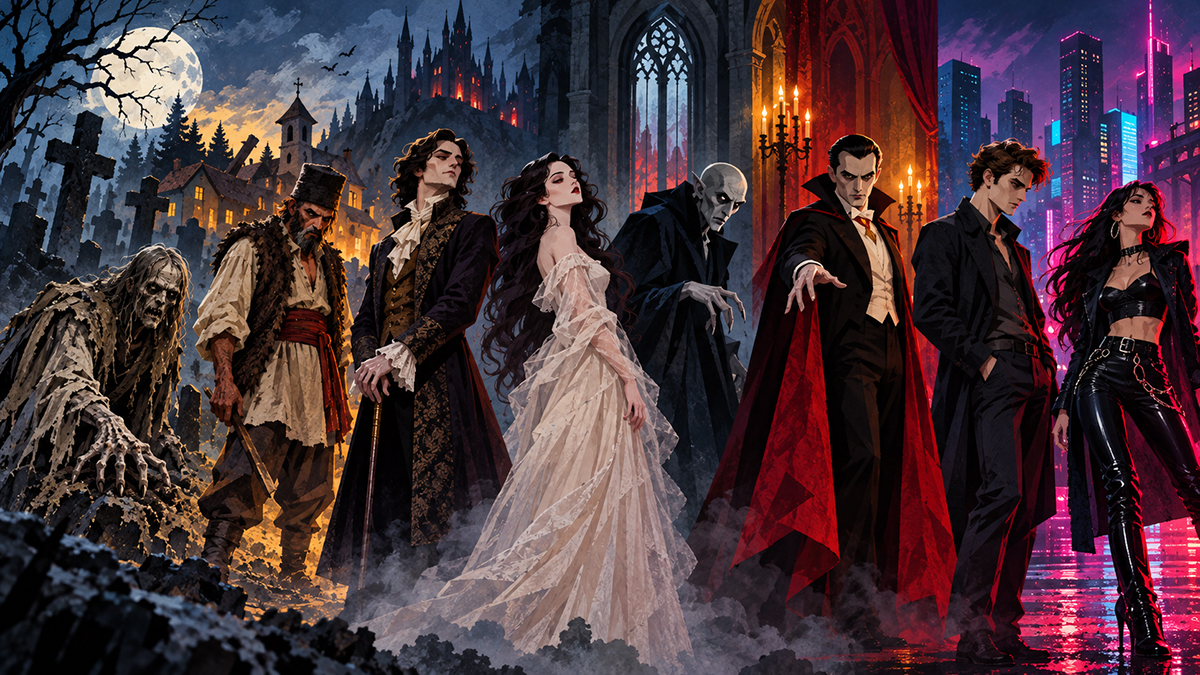
If someone talks about vampires today, most of us probably picture roughly the same figure. Pale skin, pointed fangs, active at night, burned to ashes by sunlight, not particularly fond of garlic, holy water or crosses, perhaps wearing a cape, elegant and dangerously attractive. Oh, and immortal. And living on blood.
The image feels so self-evident that it is easy to assume vampires have always looked like this. But they haven’t. In fact, some of their most characteristic traits were invented barely a century ago.
The modern vampire was assembled from different eras, countries, beliefs, novels, stage tricks, films and creative decisions. Some characteristics disappeared, some were added later, and some were fixed so powerfully by a single successful work that today we tend to assume they had always been there.
That makes the vampire more than a peculiar supernatural creature. It is also a surprisingly useful tracer for following how Worldinterflow moves and changes.
BV (Before Vampire)
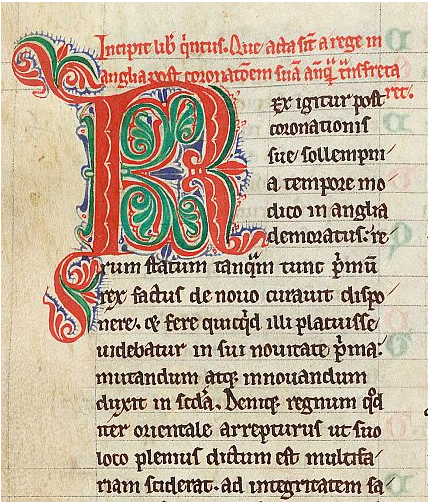
Long before the word “vampire” became widespread in Europe, people were already telling stories about dead bodies that refused to stay quietly underground. William of Newburgh’s English chronicle Historia rerum Anglicarum, written around 1198, contains four separate accounts of corpses returning bodily from the grave, tormenting the living and, in one case, being associated with an epidemic-like outbreak of illness. One of the bodies is dug up, its heart removed and burned.
And those are only the stories that happened to be written down. Countless rumours and legends almost certainly circulated alongside them.
It would be a mistake, however, to retroactively classify all such phenomena as vampires. Older traditions contained many different kinds of restless dead and returning revenants. They did not follow a single rulebook, they did not necessarily drink blood, and they did not form a unified “species” resembling what we now imagine a vampire to be. The later vampire gradually began separating itself from this much broader field of motifs.
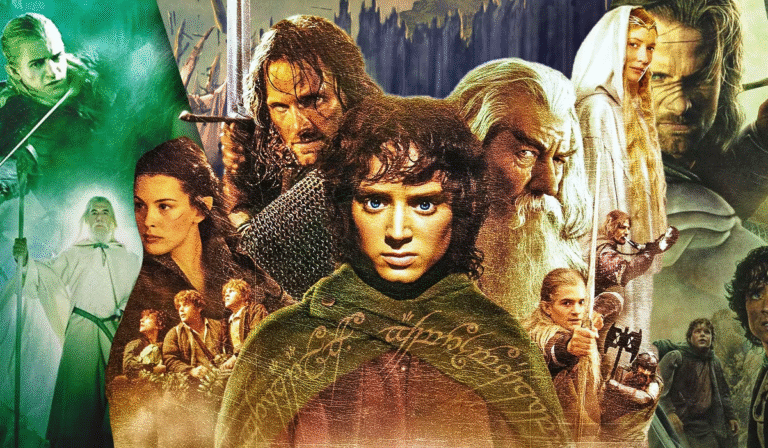
That is an interesting Worldinterflow phenomenon in itself. It is not always a finished piece of information that continues changing. Sometimes a new pattern gradually emerges from many partly independent pieces of information. We have already seen something similar with mythology: in our article about Tolkien’s world, different stories, creatures and traditions eventually became organised into coherent systems that we are now tempted to project back onto the past.
With the vampire, we seem to be looking at a smaller-scale version of the same process: out of many different kinds of restless dead, “the vampire” slowly begins to emerge.
(It would be easy to extend the history of the vampire much further back and much farther across the world. Many cultures contain returning dead, blood-drinking demons or beings that drain the life force of the living. But these are not necessarily parts of the same historical flow. In many cases, they are independently developed cultural solutions that were only later grouped together under a common, Western-derived category of “vampire”.)
A Village Corpse Becomes European News
The first spectacular leap came in the eighteenth century. In 1725, a man named Petar Blagojević died in the Serbian village of Kisiljevo, which had recently come under Habsburg rule. Soon afterwards, several other villagers died, and local people claimed that Blagojević had been returning to visit them. His body was exhumed.
According to the report written by the imperial official Frombald, the corpse appeared unusually well preserved. Some of the old skin had peeled away and what looked like “new skin” could be seen beneath it; the hair, beard and nails appeared to have grown; and there seemed to be fresh blood in the mouth. Or, more precisely, something the observers interpreted as fresh blood. The villagers concluded that he had sucked it from his victims.
So they decided not to take any chances. A sharpened stake was driven into the corpse’s heart. According to the report, blood then flowed from its mouth and ears, which was taken as further evidence. Finally, the body was burned. Frombald stressed that the villagers insisted on carrying out the procedure according to their own customs because they feared the entire community would otherwise be in danger.
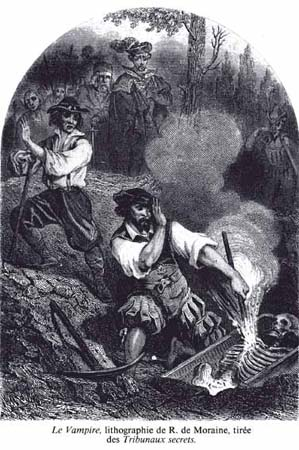
Similar things may well have happened in cemeteries before, not only in Kisiljevo but elsewhere too. What made this case exceptional was the presence of an official, which meant the story entered an administrative report.
In 1731, another wave of deaths around Medveđa in Serbia was linked to a man named Arnold Paole, who had died years earlier. According to the villagers, Paole had claimed during his lifetime that he had been attacked by a vampire, and after his own death he supposedly began returning as one himself. Following the customary procedure, they exhumed him, drove a stake through his heart, decapitated him and burned the body.
When more people began dying years later, Habsburg military authorities sent an official investigative commission to the area. The commissioners exhumed several bodies and produced a detailed report, which then began circulating across Europe. Copies reached scholars and newspapers and were reprinted and debated in several countries. The reports played an important role in turning the vampire from a local belief into an international subject.
Something had changed. A local belief had left its place of origin and begun to travel.
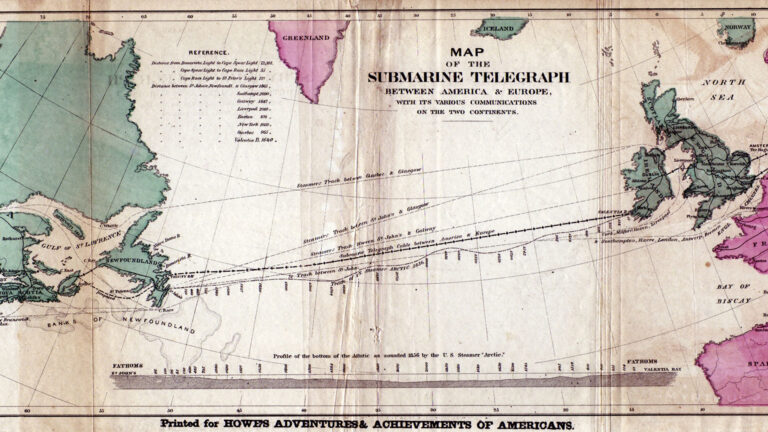
As we saw earlier in our article about information networks, the spread of information depends not only on its content but also on the infrastructure through which it can move. Eighteenth-century Europe already possessed administrative, postal, scholarly and press networks capable of extracting an event from a Serbian village and making it part of the information environment of people living across the continent.
The development of information infrastructure can change the scale of a phenomenon.
The Literary Vampire
One of the earliest known forms of the English word vampire was vampyre, which appeared in 1732 precisely in reports about the Eastern European vampire cases. The deeper origin of the word remains uncertain. The Slavic vampir and related forms already referred to the supernatural being, but we do not know for certain where the term itself originally came from. Its earliest layer of meaning has probably been lost somewhere in the past.
The name therefore travelled together with the belief, adapting itself to the languages through which it passed. And after travelling through newspapers and scholarly debates, the vampire eventually found itself on the shore of Lake Geneva.
In 1816, on a rainy summer evening at Villa Diodati, a group of people were reading Fantasmagoriana, a French collection of German ghost stories. Then one of them suggested that, since they were all gathered there anyway, perhaps they should invent horror stories of their own. The person who proposed the idea was George Gordon, Lord Byron. The others included Percy Bysshe Shelley, Mary Godwin – later Mary Shelley – Claire Clairmont and Byron’s physician, John William Polidori.
That evening produced the basic idea for Frankenstein, as well as Byron’s unfinished vampire story, which Polidori would later develop further. He combined earlier vampire traditions with his own far from uncomplicated relationship with Byron.
The evening itself is a fascinating Worldinterflow node. At least two works began there that would still be fundamental parts of popular culture more than two centuries later.
The Corpse Puts on Evening Dress
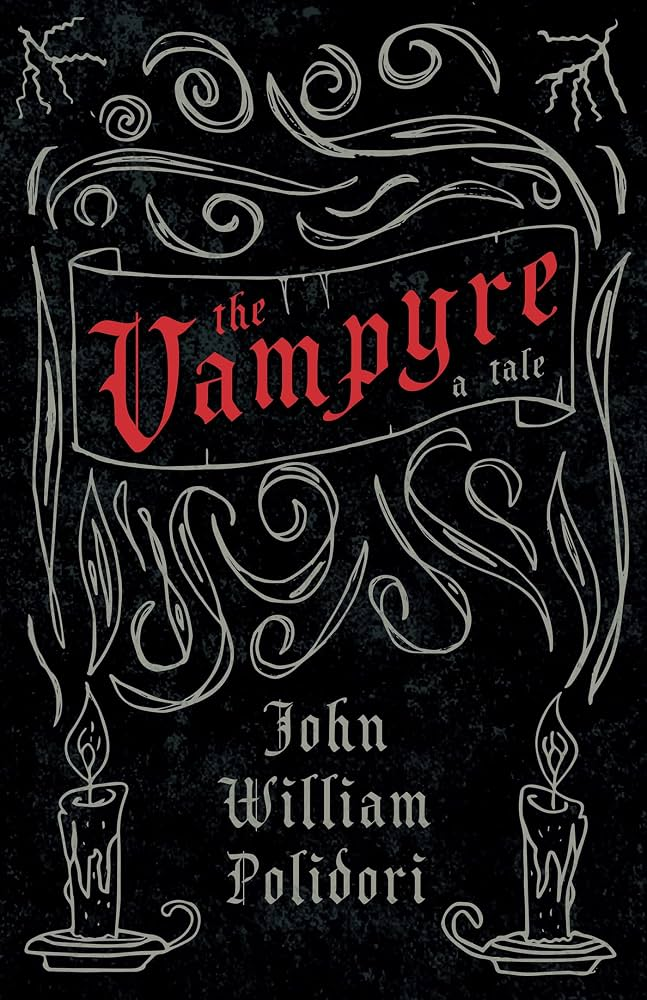
John Polidori’s The Vampyre appeared in 1819, with Lord Ruthven at its centre. Suddenly we had moved from corpses dug up in village cemeteries to a wealthy, mysterious and socially active immortal aristocrat. How did that happen?
Several currents came together in Polidori. Vampire motifs had already appeared in English literature – including, for example, Byron’s The Giaour. At the same time, one of the most powerful figures in Romantic culture was Byron himself: scandalous, famous, attractive, aristocratic and widely regarded as dangerous, with a personal image that circulated around Europe almost as a cultural product in its own right. Polidori, as we have seen, knew him very closely, having served as Byron’s personal physician and travelling companion.
Lord Ruthven was therefore not simply a folkloric revenant dressed in better clothes. Earlier vampire material met Byron’s personality, the literary figure of the “Byronic hero”, contemporary ideas about the aristocratic seducer and Polidori’s own often tense experiences with Byron. Polidori’s importance lies partly in the way he organised all of this inherited and newly added material into a highly successful literary form.
He received different kinds of information, selected among them, mixed them with his own experience, transformed them, and passed them on.
Even that transmission contained an error, however. When The Vampyre first appeared, Byron was mistakenly listed as its author. Both Byron and Polidori objected – but Byron’s name probably helped the story spread quite considerably in the meantime. Goethe reportedly regarded it as one of Byron’s finest works.
Except Byron had not written it.
Information does not necessarily spread well because it is accurate. Sometimes quite the opposite.
The First Major Branch
Only a few months after Polidori’s story appeared, The Black Vampyre: A Legend of St. Domingo was published in New York in June 1819. Researchers see a clear relationship between the works: the American story emerged under the influence of Polidori’s newly published vampire tale, which at the time was still being attributed to Byron.
But it did something very different with it.
The central figure of The Black Vampyre begins as a Black child enslaved and transported from Africa, whom his owner attempts to kill. He returns as a vampire and eventually takes revenge. Polidori’s aristocratic predator therefore branches almost immediately into something else: in the American version, the vampire no longer attacks downward from the social elite, but emerges from the oppressed as a figure endowed with supernatural power. The story places the vampire motif in the context of slavery, the Haitian Revolution and rebellion.
Within only a few months, the same new cultural figure had acquired a radically different meaning in a different social environment.
This is not simple continuation. It is branching. And the phenomenon is probably more important in general than we can fully explore in an article about vampires: when information enters two different environments, the two branches do not necessarily continue developing in the same direction.
The Vampire Becomes a Serial Character – and Grows Fangs
In the 1840s, the phenomenon entered yet another medium, which transformed it again. Varney the Vampire; or, the Feast of Blood originally appeared as a weekly serial in cheap pamphlets, part of the culture of the so-called penny dreadful.
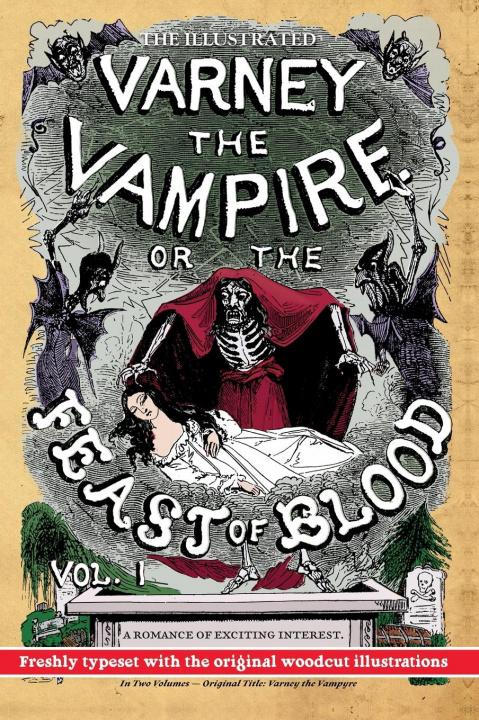
Think of it as the Victorian equivalent of cheap serialised mass entertainment: inexpensive episodes, spectacular twists, cliffhangers and constant pressure to make sure readers bought the next instalment the following week. Bingeing, in other words, is not an invention of the streaming era.
Between 1845 and 1847, Varney grew to 232 chapters and almost 667,000 words.
That is a lot of words.
The sheer length already tells us something. It is not only the writer who shapes information – or the demand for it – but also the economic model and the form of distribution. A self-contained short story and a serial that must keep generating revenue for years produce different kinds of narrative. A serial needs more twists, more danger, more returns and more immediately recognisable features.
One of Varney’s features proved particularly successful. At one point, the story describes a victim caught between “fang-like teeth”. The pointed vampire fang, which we now tend to think of almost as a biological feature of the species, was not a universal characteristic of old European vampire traditions. Popular serial fiction helped add it.
Carmilla – The Same Creature Can Be Used for Something Else
Sheridan Le Fanu’s Carmilla, published in 1871–72, sends the figure in another direction. This time the vampire is a woman, her victim is also a woman, and their relationship carries an erotic and emotional tension that is difficult to separate from the sexual norms of the Victorian period.
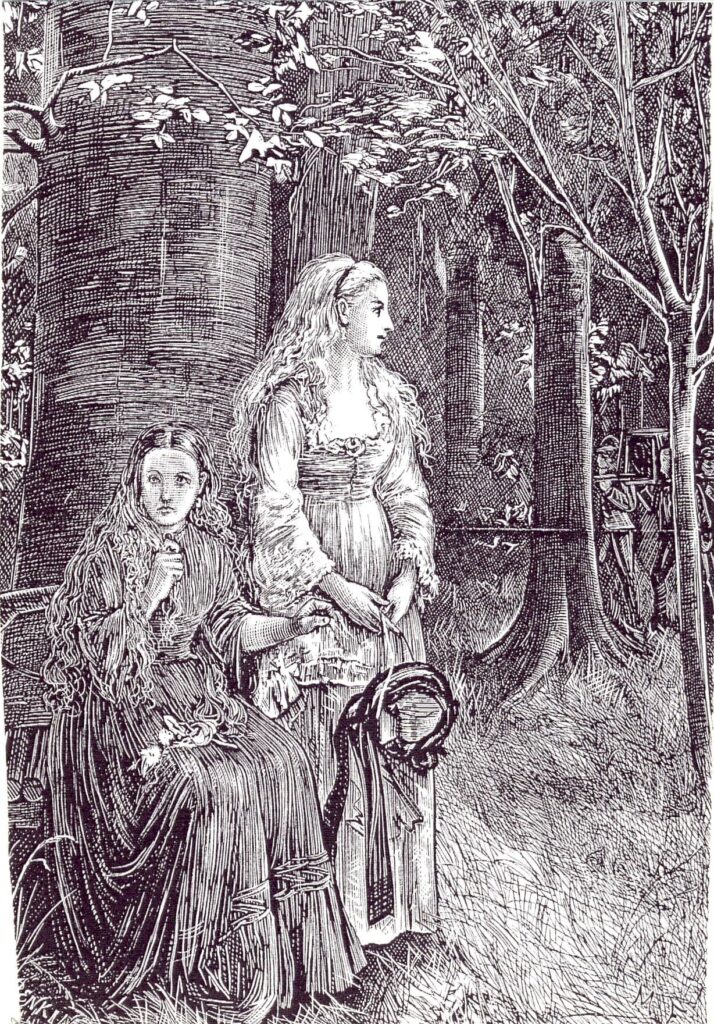
Laura lives in an isolated castle in Styria when, following a carriage accident, a mysterious young woman named Carmilla is taken into the household. An extraordinarily intimate relationship rapidly develops between the two women, at once attractive and unsettling. Meanwhile, young women in the surrounding area begin dying, and Laura herself gradually grows weaker. Eventually, Carmilla is revealed to be Mircalla Karnstein, a centuries-old vampire who repeatedly returns under different names and chooses young women as her victims.
At this branch in the story, the vampire becomes a way of expressing things that would have been far more difficult to discuss directly in that period. The supernatural figure can absorb desires, fears and even violations of social norms.
Trying to assign each individual element to a precise social cause would already take us into interpretation rather than straightforward historical fact. But the process itself is visible: in a new environment, the same cultural figure can become the carrier of new questions.
Dracula – When a New Foundation Takes Shape
Then, in 1897, Bram Stoker’s Dracula appeared.
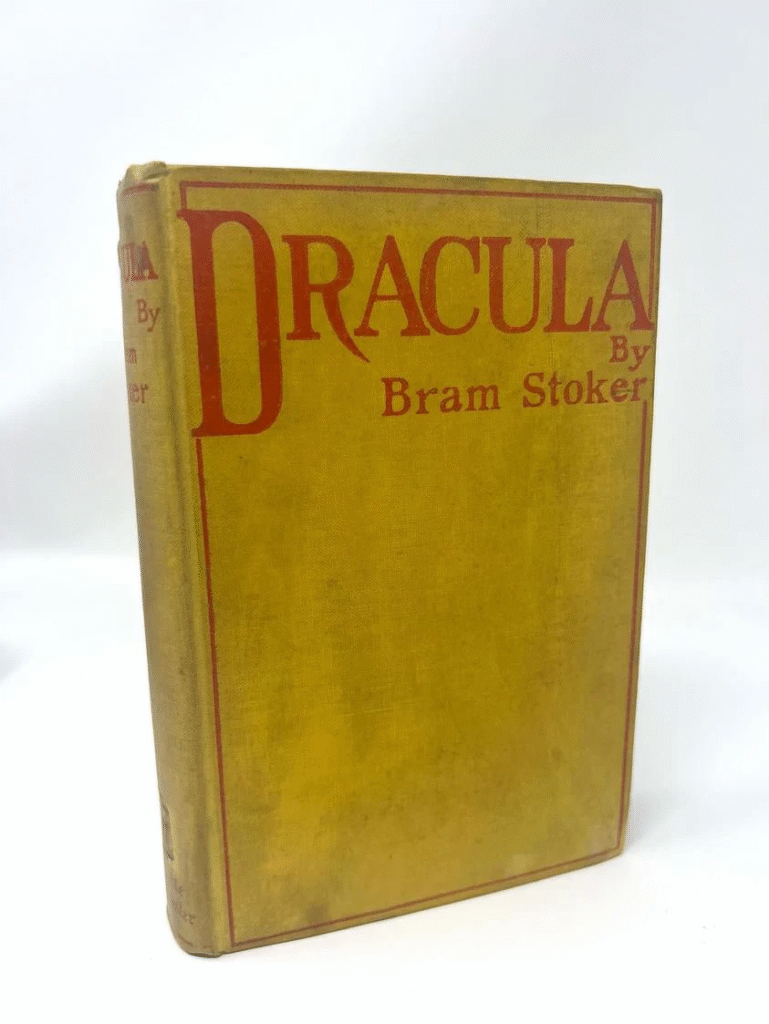
From Stoker’s research notes, we know that he consulted a wide range of sources, including Emily Gerard’s writings on Transylvanian superstitions and the work of Sabine Baring-Gould. Behind him there was already an established body of vampire literature containing Polidori, Varney, Carmilla and many other works.
Interestingly, although popular culture later greatly amplified the connection between Dracula and Vlad Țepeș, it does not seem to have played nearly as large a role in Stoker’s conception as we often assume. Stoker found a historical name, and to some extent a historical background, for a vampire character that was already taking shape. Later culture then strengthened this relatively thin connection so dramatically that Vlad Țepeș now appears almost to be Dracula’s historical equivalent.
It is an excellent example of fiction attaching itself to a historical figure, after which later audiences begin looking back at history through the fiction.
(Which does not mean that Vlad himself was likely to have been a particularly pleasant person.)
Stoker, then, did not really invent the vampire. From a Worldinterflow perspective, he became an integrating node – and, in a sense, a starting point for the vampire image that later periods inherited.
Several information currents that had previously travelled separately met in his work. Folklore, travel writing, Gothic literature, previous vampire stories, contemporary science and technology, religious ideas and Stoker’s own inventions were organised into one extraordinarily effective construction.
After that, something changed in the flow. Later creators no longer needed to return to Serbian villages, Gerard’s books, Polidori or the old folk traditions. They could simply return to Dracula.
This is very similar to what we saw with Tolkien’s influence on fantasy. A large number of earlier information streams converge in an exceptionally successful node, which reorganises them into a new system. That system then becomes such a powerful reference point that a significant proportion of everything that comes later begins from there.
It is almost as though the flow narrows at this point. That does not mean less information is created afterwards – quite the opposite, there is vastly more of it – but some earlier routes become less important. The intermediary node itself begins to occupy the position of the source.
A few generations later, it becomes easy to look backwards and imagine that everything had always started there.
The True Story of the Vampire and the Bat
Meanwhile, an almost textbook feedback loop took place.
Vampire beliefs existed before Europeans encountered blood-feeding bats in the Americas. But when these animals were observed and classified, a cultural metaphor was already available: the blood-feeding bats began to be named after vampires. The eighteenth-century French naturalist Buffon was already using the word vampire for a blood-feeding bat.
Then the direction of influence reversed. The image of the real animal flowed back into fiction. In Stoker’s novel, Dracula can transform himself into a bat.
Culture gives a name to something in nature, and then an image returned from nature changes the culture that named it.
It is difficult to find a cleaner information loop than that.
Film Invents an Ancient Rule
In 1922, F. W. Murnau made Nosferatu: Eine Symphonie des Grauens. Legally, this was a problematic undertaking: it was an unauthorised adaptation of Stoker’s novel. Florence Stoker, the author’s widow, sued the production, won, and obtained an order requiring copies of the film to be destroyed.
By the time the judgment was reached, however, prints had already travelled to several countries, and some had escaped both German jurisdiction and the control of the Stoker estate.
Nosferatu therefore survived quite literally because the information had already become dispersed across the network.
(The same phenomenon is much easier to observe today. Once something reaches the internet and people begin sharing it, it becomes difficult to erase it, eliminate it or make it as though it had never existed. The other side of the same process is that its impact may also become smaller: new content and new shares arrive every second, burying what came before.)
The film therefore came close to disappearing from the information system altogether, yet instead became one of the most influential vampire films ever made. And it added a rule that today, just like the fangs, we often mistakenly imagine to belong to ancient folklore: lethal sunlight.
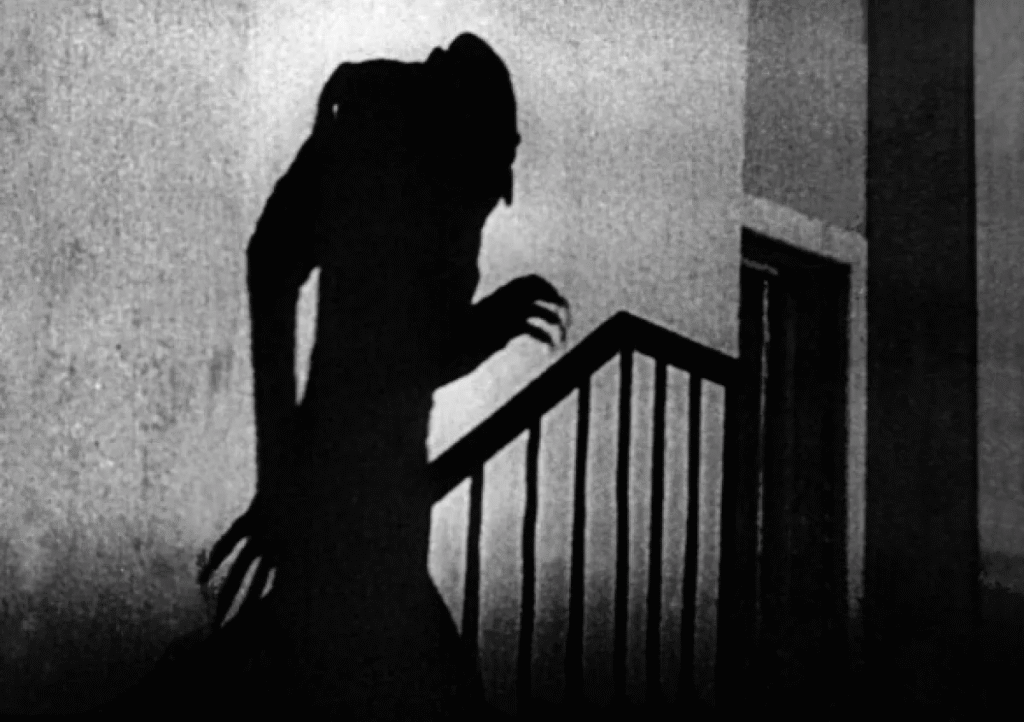
Stoker’s Dracula is more limited during the daytime and has less power, but sunlight does not burn him to ashes. Count Orlok in Nosferatu, however, is destroyed by the rising sun. Film histories generally treat this as the decisive introduction of sunlight as something fatal to vampires.
Later works repeated the idea so many times that it became a basic cultural rule.
A cinematic invention became, retroactively, a “vampire trait”.
Dracula Puts on a Cape
Something even stranger happened two years later. In 1924, Hamilton Deane adapted Dracula for the stage. He had to turn a long epistolary novel moving through numerous locations into a practical theatre production, so he removed much of the Transylvanian material, brought Dracula into English society sooner and transformed him into a more elegant, urban figure.
He was given evening dress and a high-collared cape. The cape also had a very practical theatrical function: the actor could disappear behind it through a trapdoor while the cape remained visible for another moment, creating the impression that Dracula himself had simply vanished.
The idea travelled onwards to Broadway, where Bela Lugosi played Dracula in the American production. That stage version then became the basis of Universal’s 1931 film, again starring Lugosi.
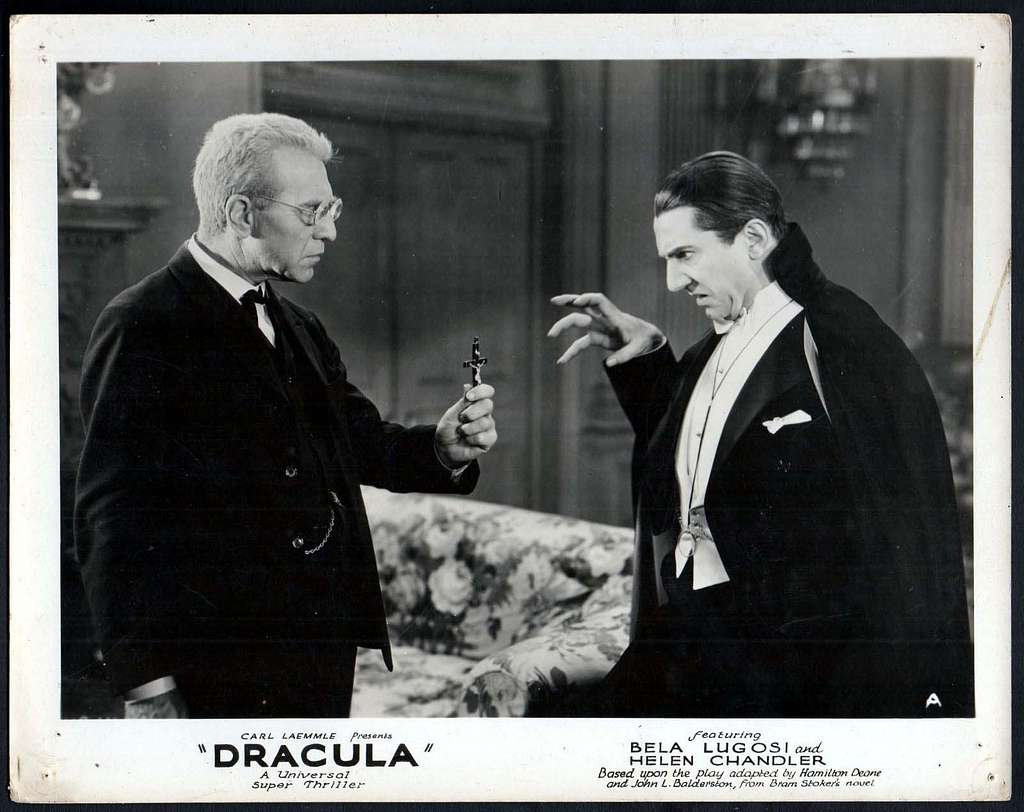
We know what happened next. Every Halloween, hundreds of thousands of children put on high-collared black capes because that is what vampires look like. Except one reason vampires look like that is that, a century ago, a theatre director needed to solve the practical problem of making an actor disappear from a stage.
In other words, the physical properties of the medium – together with professional ingenuity – altered the information itself.
Lugosi’s 1931 Dracula then created such a powerful visual foundation that it defined the figure for decades. Later Hammer films and Christopher Lee changed it again: the physical threat became stronger, the blood more visible, the erotic element more pronounced, and the fangs more conspicuous.
We will not attempt to trace every vampire film from that point onwards. That would turn this into a very long account indeed. What matters more is that by this stage the vampire possessed an entire collection of rules and visual signals, which meant later creators could freely select among them.
What If We Ask the Vampire?
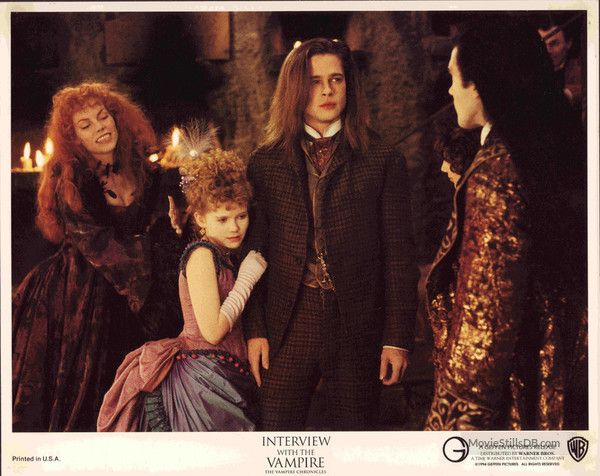
One of the major changes introduced by Anne Rice’s 1976 novel Interview with the Vampire is a shift in perspective. It asks the bloodsucker a rather different question: what does it actually feel like to be a vampire?
Louis is no longer merely an external threat we observe from a distance. He tells his own life story and struggles with moral responsibility, loneliness, identity, immortality, guilt and the difficult problem of what makes life meaningful.
The vampire therefore acquires another function. It becomes a way of exploring questions that previously existed mostly in the background but resonate deeply with problems in our own human lives. What does it mean to live – forever? What does loss do to a person, or a vampire? Where does moral responsibility come from? What makes someone remain the same person across centuries? And what kind of life is endless life if there is nobody with whom to share it?
By Now, a Vampire Can Be Almost Anything
By the end of the twentieth century, the branching process accelerated.
In Buffy the Vampire Slayer, the vampire can remain a traditional monster, become a romantic partner or develop into a morally ambiguous character who changes across entire seasons. With Angel and Spike, the earlier tradition of the “sympathetic vampire” continues over long character arcs, while audiences and fan culture themselves participate in constructing new meanings around the characters.
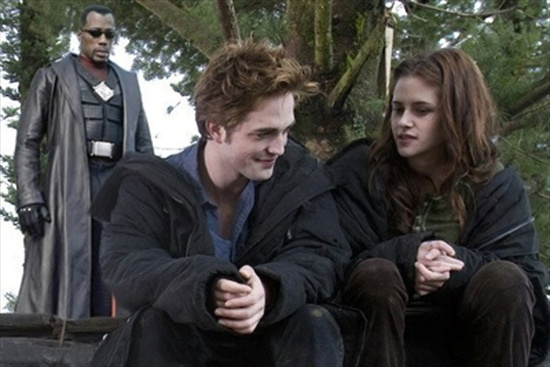
Blade strengthened another branch in 1998. A vampire no longer had to be only a horror figure or a romantic one: it could become an action hero. Blade is half human and half vampire, retaining the vampires’ powers while hunting them. Characteristics that once marked the monster can now be used as superpowers.
Then Twilight performs another selection. It keeps immortality, blood, superhuman abilities, danger and attraction, while simply discarding or rewriting several traditional rules. Sunlight, for example, does not kill Edward Cullen.
It reveals him.
That only works because the old rule has already become shared cultural knowledge. The innovation assumes that we know what is being rewritten.
The Distorting Mirror Where Even a Vampire Has a Reflection
With What We Do in the Shadows, we reach another interesting stage. Taika Waititi and Jemaine Clement’s 2014 New Zealand vampire mockumentary follows a group of vampires sharing a house in Wellington, using documentary conventions to find humour in the fact that centuries-old supernatural creatures have flatmate problems, dating problems and everyday annoyances just like everyone else.
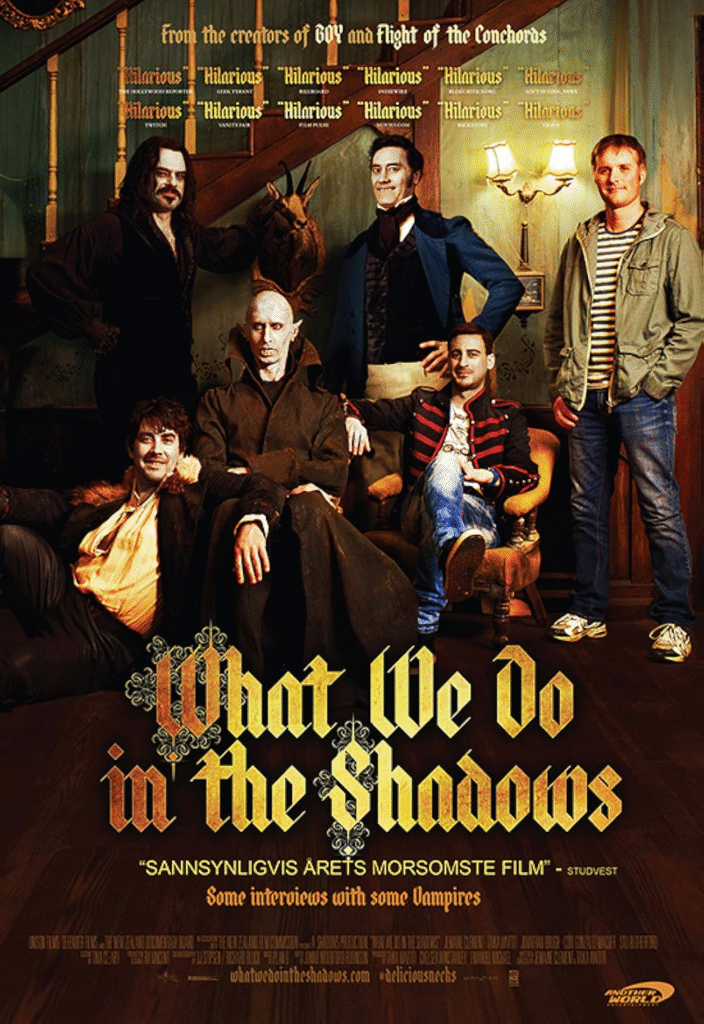
By this point, the vampire has transformed so many times that several historical versions of it can coexist inside the same work. An elegant aristocrat, a medieval monster, a romantic, an energy vampire and an ordinary loser can all share the same house. Much of the humour works because we already know the cultural database accumulated over the previous centuries.
The phenomenon therefore carries the memory of its earlier forms along with it. In capable hands, that makes it possible to parody those forms – and perhaps recognise something of ourselves in them as well.
What Was It That Flowed Through All This?
If we look back over the route we have travelled, it becomes difficult to say where exactly “the” vampire is located along it – or even what the vampire really is that has travelled all this way. It was one thing in the imagination of Serbian villagers and another in an official report; something else again in Carmilla’s desires or Stoker’s system. Bela Lugosi’s Dracula would probably look rather strangely at Edward Cullen’s sparkling skin and fashion choices while Blade approached both of them through the darkness carrying a katana.
So what happened along the way?
Different elements merged, creating new figures from materials with different origins. The flow branched, as the same information entered different cultural environments and travelled in different directions. Selection took place: some features continued spreading while others disappeared. New foundations emerged: creators could later return directly to Stoker or Lugosi while much of the material behind them became invisible.
The medium also altered the content. Serial publication, theatrical staging and the technical requirements of film did not merely transmit the vampire; they transformed it, adding some properties, dropping others and changing the figure itself. Feedback loops appeared too – as when the vampire gave its name to a real animal, the vampire bat, and the animal later returned a new characteristic to the fictional vampire.
So perhaps instead of asking “What is a vampire?”, a more useful question is: what is a vampire at a particular moment, under particular circumstances?
When we try to strip away the later layers, we do not necessarily discover one original version hiding underneath. What we find instead are routes and branches, people and technologies that transformed the figure, works that brought earlier elements together, and successful constructions that then became new starting points for what followed.
The vampire, of course, tells stories about our fears and desires, and about life and death.
But along the way, it also tells us something about how cultural memory itself works.
Sources and Further Reading
Sam George, Bill Hughes (eds.): The Legacy of John Polidori: The Romantic Vampire and Its Progeny
Manchester University Press, 2026.
On the creation of Polidori’s The Vampyre, Byron’s influence, the story-writing game at Villa Diodati, The Black Vampyre, and the later transformations of the literary vampire.
Cambridge Core – The Legacy of John Polidori
John William Polidori: The Diary of Dr John William Polidori, 1816
Polidori’s diary from the weeks he spent in Byron’s company. An important primary source for the story-writing game at Villa Diodati and the environment in which Frankenstein and the modern literary vampire emerged.
Cambridge University Press – Polidori’s diary
Dale Townshend: Romantic Gothic
On the 1816 story-writing game at Villa Diodati and its background: the group read the French Fantasmagoriana, a collection derived from German ghost stories, and from this environment emerged, among other works, Mary Shelley’s Frankenstein, Byron’s vampire fragment and Polidori’s The Vampyre.
Cambridge Core – Romantic Gothic
Bram Stoker: Dracula – Research Notes and Sources
Stoker drew on several works of folklore, travel writing and history. One important source was Emily Gerard’s Transylvanian Superstitions. His research illustrates how Stoker functioned less as the “inventor” of the vampire than as a node that brought several earlier information currents together.
MIT OpenCourseWare – Dracula Reading Guide
Christopher Frayling: Vampyres: Lord Byron to Count Dracula – Stoker’s Research Materials
An overview of Stoker’s surviving working notes and sources, including the story of how he encountered the name “Dracula”.
MIT OpenCourseWare – Frayling Reading Guide
F. W. Murnau: Nosferatu: Eine Symphonie des Grauens
1922.
An unauthorised film adaptation of Dracula. An important stage in the development of the grotesque cinematic vampire and the motif of lethal sunlight. Bram Stoker’s widow, Florence Stoker, successfully sued the production and obtained a court order requiring the prints to be destroyed, but several copies survived.
British Film Institute – Nosferatu
Sam George: Phantasmagoria: Polidori’s The Vampyre from theatricals to vampire-slaying kits
In: The Legacy of John Polidori, 2026.
On the way theatre continued transforming the vampire: dramatisation, theatrical spectacle, props and technical tricks did not simply transmit the figure but actively changed it.
Cambridge Core – Phantasmagoria
J. Sheridan Le Fanu: Carmilla
1871–1872.
One of the key works of vampire literature before Dracula, placing a female vampire, erotic attraction and an intimate relationship at the centre of the story.
Project Gutenberg – Carmilla
James Malcolm Rymer / Thomas Peckett Prest: Varney the Vampire; or, The Feast of Blood
1845–1847.
An enormous serialised penny dreadful that became an important stage in the vampire’s transformation into a mass-cultural figure and contains an early example of fang-like vampire teeth.
Google Books – Varney the Vampire
Anne Rice: Interview with the Vampire
1976.
One of the defining works of the modern vampire told from the inside: the vampire is no longer simply an external threat, but a character facing moral, existential and identity problems of their own.
Milly Williamson: Spike, Sex and Subtext: Intertextual Portrayals of the Sympathetic Vampire on Cult Television
European Journal of Cultural Studies, 2005.
On Buffy, Spike and the modern sympathetic vampire, as well as the role of fan culture in continuing to reshape the meaning of the vampire.
SAGE Journals – full study
Jammer: How Did The Lord of the Rings Change the Way We See the World?
On the organisation of different traditions into a coherent system, and on the process by which a later, highly influential system becomes a new cultural starting point and partly obscures the sources that came before it.
Jammer – full article
Jammer: The Message That Outran the Ship – When Information Became Connected
On the networks and infrastructures that allow information to spread – useful background for understanding how eighteenth-century local vampire cases could become news across Europe.
Jammer – full article