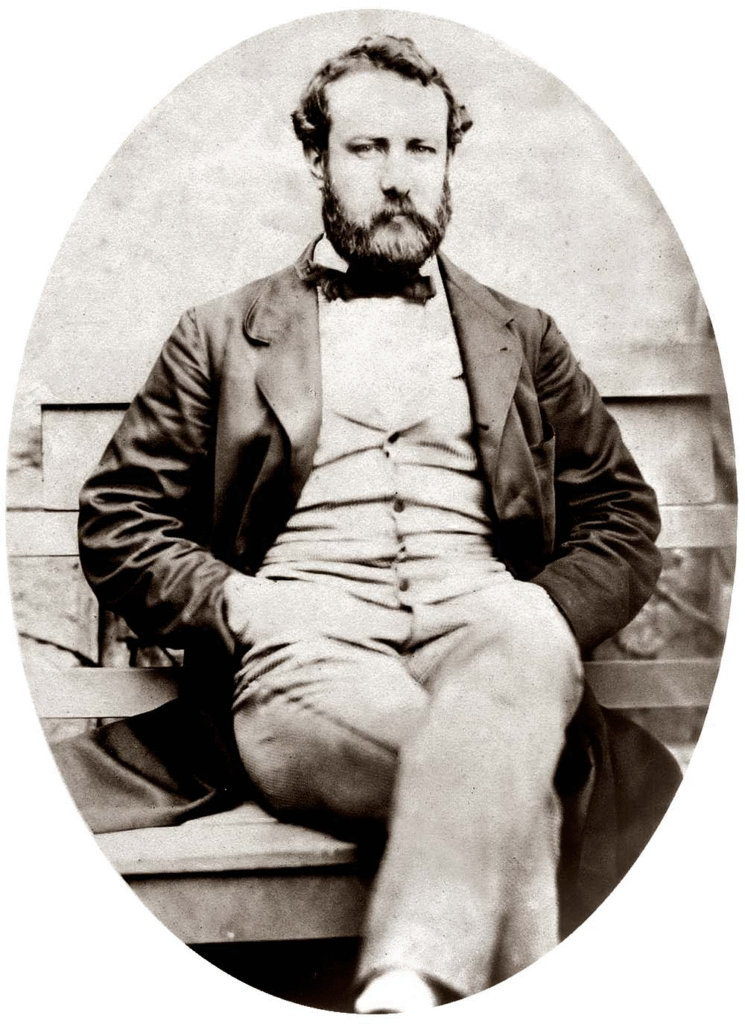
Verne is often described as one of the founders of science fiction, although the term itself emerged much later. In his stories, science and fiction were closely intertwined. Rather than inventing future technologies out of thin air, he drew on the scientific knowledge, engineering possibilities, and discoveries of his own time, then imagined where they might lead.
From the perspective of Worldinterflow, it is particularly interesting to see how different currents—science, technology, literature, and the human imagination—influenced one another. Science and technology provided material for literature, while literature used the imagination to explore new possibilities for what science might achieve. Verne’s works also inspired later engineers and explorers.
As would happen many times throughout the history of science fiction, a possibility first appeared in fiction, and science and technology gradually began to move towards it.
Verne was a prolific writer. His series, launched in 1863 and later known as Extraordinary Voyages (Voyages extraordinaires), comprised 54 novels. According to the Bibliothèque nationale de France, science was not merely decorative in Verne’s works, but one of the central driving forces behind his stories.
Around the World in Eighty Days was published as part of this series.
Those who grew up in the 1980s or 1990s may remember the animated series that adapted Phileas Fogg’s extraordinary adventures:
The novel, first published in instalments in 1872, has a simple premise. Phileas Fogg, a punctual and rather peculiar London gentleman, wagers £20,000 that he can travel around the world in eighty days.
There is one important difference between this story and Verne’s earlier adventures. Fogg does not descend into the Earth’s depths, travel inside a cannonball, or have a Nautilus at his disposal. In fact, he uses nothing extraordinary or futuristic by the standards of his time. He simply boards a train, takes a steamship, changes to another train, misses a connection, and tries to catch the next one.
Of course, he encounters exciting and dangerous adventures along the way. He has to improvise, people try to obstruct his journey, and so on. But this time, the fantastic element is not provided by science or technology.
It is the world itself.
More precisely, the possibility that the world has become traversable.
![New York City & Northern no. 02 [4-4-0] locomotive](https://jammer.hu/wp-content/uploads/2026/09/new-york-city-and-northern-no-02-4-4-0-6f357d.jpg)
From today’s perspective, it is difficult to imagine what life was like in the late nineteenth century, when travelling was nowhere near as straightforward as it is now. When the novel appeared, the world’s railways had a combined length of approximately 200,000 kilometres. For comparison, today they extend over more than a million kilometres. Most maritime transport still relied on sailing ships. Steamships already existed, but they accounted for less than 20% of the world’s merchant fleet carrying capacity. And, of course, air travel was not yet an option.
We were still many, many years away from the lifestyle of the digital nomad. Or from a world in which a Hungarian university student could casually spend a year in Portugal on an Erasmus scholarship and hop on a budget flight home to visit the family during the holidays. A journey from Budapest to Lisbon by train could have taken as long as a week, even with suitable connections, and the student would probably have needed to save their scholarship money for months to afford it.
For people living at the time, the space they personally travelled through and experienced was much smaller than it is for us today. For most, the farthest places they might reach were their birthplace and its surroundings, neighbouring villages, or regional centres—on foot, on horseback, by cart, or perhaps by train. Mobility was certainly not unknown, though: soldiers, labourers, merchants, servants, and pilgrims had been travelling long distances long before the nineteenth century.
For wealthier people, journeys of several thousand kilometres were more accessible, although they still required special arrangements. From the middle of the nineteenth century onwards, however, the rapid expansion of railways and steamship services began to change the world. Travel became less dependent on wealth or special connections.
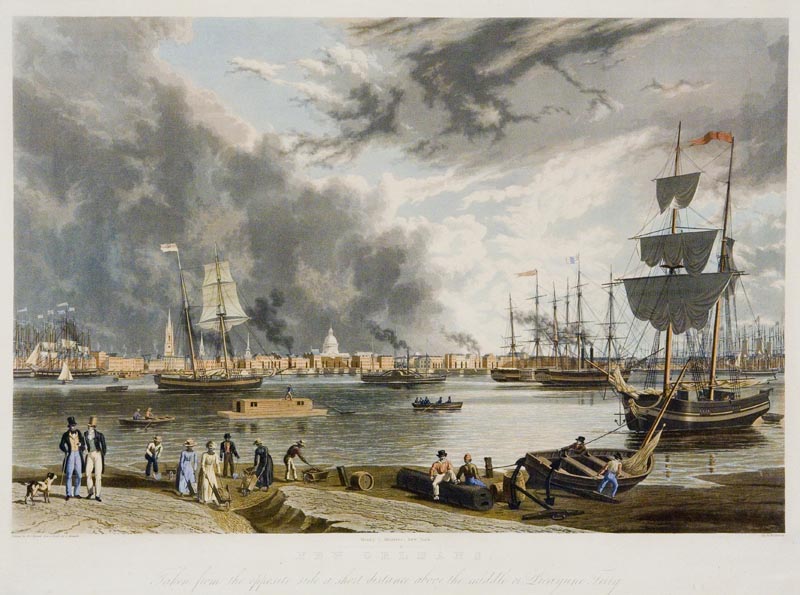
And something else interesting happened. Local transport networks gradually began to connect, forming the beginnings of a global network.
Verne turned this into a story, bringing a current of technological and economic development into literature. Railway lines, shipping services, and new routes—seasoned with the author’s imagination—became a fictional journey around the world.
Readers had already encountered travel writing, scientific, geographical, and anthropological accounts, and adventure stories describing distant lands. The idea of travelling around the world had also appeared years earlier. But we might say that it was through this adventure novel that large numbers of readers first encountered the possibility that London, Bombay, Hong Kong, Yokohama, and San Francisco were no longer merely distant points on a map. They could also become stops along a continuous route.
Changes in infrastructure first gave rise to practical calculations, then to literature, which in turn inspired further journeys in the real world.
When Fiction Flows Back into Reality
Seventeen years later, American journalist Nellie Bly decided to try what Verne had already played out in his novel.

Around the World in Eighty Days—and the real journey it inspired—became possible when it did because something fundamental had changed by the 1870s.
The Earth was still the same size, but an increasing number of distant locations were being connected by railway lines, steamship services, and other transport routes.
Verne’s hero and Nellie Bly were no longer setting off into an unknown wilderness.
They were studying timetables.
Nellie Bly, born Elizabeth Jane Cochran, was a journalist for the New York World. On November 14, 1889, she left New York to beat Phileas Fogg’s fictional record.
According to the Library of Congress, her journey took just over 72 days. To be precise, 72 days, 6 hours, 11 minutes, and 14 seconds.
She did not carry expedition equipment. She had no need for it. Nor did she have to arrange special shipping services or build a railway ahead of herself.
She used the existing system.
She crossed the Atlantic by steamship, travelled through Europe by train, sailed from Brindisi towards Asia, crossed the Pacific from Japan, and then travelled across the United States by rail from San Francisco.
During a detour to Amiens, she even met Jules Verne himself. She later devoted an entire chapter of her book to the visit.
She returned to Jersey City on January 25, 1890.
In less than two decades, a possibility imagined in a novel had become a journalistic feat. But perhaps the most interesting part of Bly’s story is not how fast she travelled.
It is that there was a network she could travel through in the first place.
Previously, people’s personal worlds had largely consisted of separate, relatively limited areas. For someone to travel from anywhere in Europe to America—or vice versa—even once in their lifetime was much more likely to remain a dream than become an achievable personal goal.
Now, however, that possibility was emerging.
A network of routes was taking shape. A person standing at one point in that network could see that Istanbul, Beijing, or Rio de Janeiro was another point within the same system. There was no longer an insurmountable obstacle between them and that distant city. If they wanted to, and had the necessary means, they could follow the route all the way there.
For people, the world was beginning to appear as a single, interconnected system.
Functional Distance
If we measure the distance between New York and San Francisco in kilometres, it was exactly the same in 1860 as it was in 1890. In fact, it has remained roughly the same ever since.
The time required to travel between them, however, is a very different matter.
The transport revolution of the nineteenth century is often described as a period when steam engines, railways, and steamships made travel increasingly fast. That is true, but it is only part of the story.
The decisive change was not simply that individual vehicles could travel faster. It was that separate routes and smaller transport hubs began to form a complete network.
If a train reaches a city where the tracks simply end, its speed matters, but only up to a point.
If, however, the railway station provides access to a port with regular shipping services to another continent, where another railway awaits on the other side, an entirely different kind of space comes into being.
The geographical distance remains unchanged. Accessibility does not.
The concept of functional distance is useful here.
We can think of it as a kind of practical distance: how quickly, how reliably, at what cost, with how much effort, and through how many connections we can get from A to B.
Two places may be close together on a map, but if the functional distance between them is great, getting from one to the other may not be easy at all.
From this perspective, the second half of the nineteenth century is not simply a story of increasing speed. It is a story of the reorganisation of space.
And there is one year that illustrates this particularly well.
1869
On May 10, 1869, at Promontory Summit in what is now Utah, the Union Pacific railroad, built from the east, met the Central Pacific railroad, which had been advancing from the west.
This established the first continuous transcontinental railway connection across the United States, linking the West Coast and the East Coast—more or less.
More precisely, it connected the Pacific region to the existing railway network of the eastern United States.
(This sounds rather impressive, and the people who built the railway are often portrayed as pioneers and heroes. But we should not forget that this was far from a peaceful exercise in network construction. The railway crossed lands where people already lived, and its construction was often accompanied by bloody conflicts.)
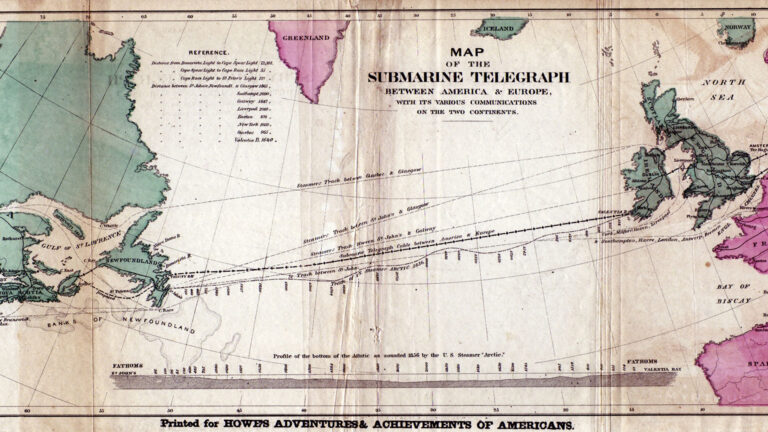
Less than seven months later, on November 17, 1869, the Suez Canal officially opened in Egypt, establishing a direct shipping connection between the Mediterranean Sea and the Red Sea.
The waters of the two seas had already met in August; the opening ceremony took place in November.
The two events occurred more than ten thousand kilometres apart. Although they were not part of a single global plan, they nevertheless moved the system in the same direction.
One cut across a continent; the other cut through an isthmus.
Both created new connections between places that had previously been much more difficult to link.
It was as though two new lines had been drawn on a vast map—except that these lines immediately became routes along which people, goods, money, news, and ideas could flow.
And they probably gave a French adventure novelist plenty to think about, too.
But something else happened at Promontory.
“DONE”
The ceremonial driving of the final golden spike in the transcontinental railroad was more than a local celebration.
Although, judging by the photographs, they certainly celebrated it quite thoroughly on the spot as well.
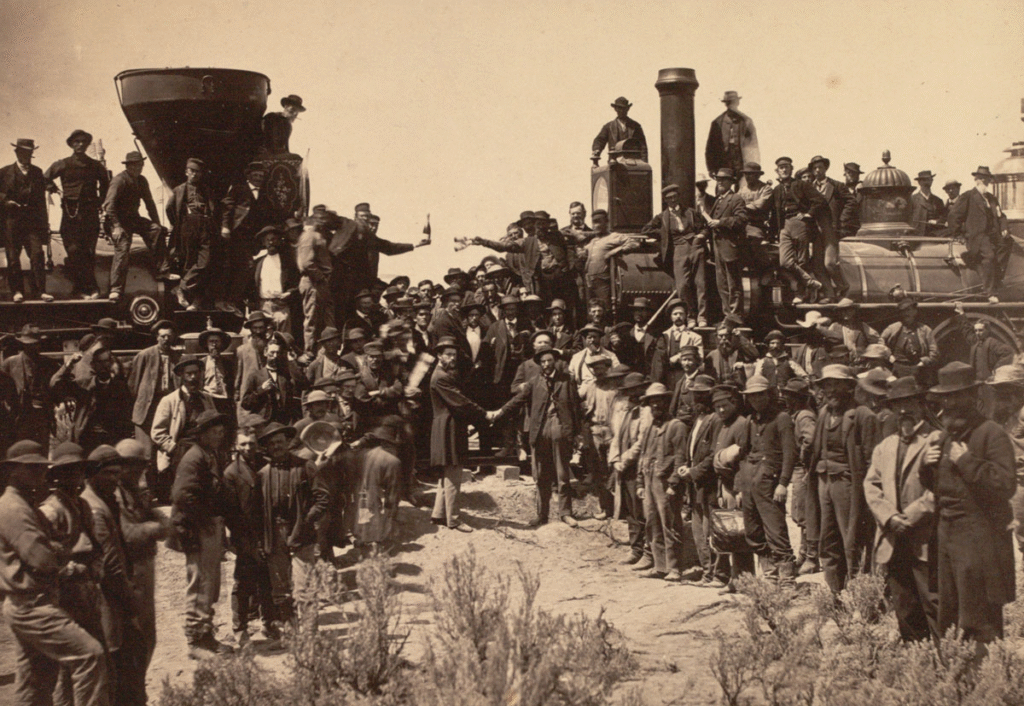
The term “golden spike” sounds impressive, but the precious-metal spike itself played a largely symbolic role in the ceremony.
An ordinary iron spike and a hammer, however, were connected to a telegraph circuit. When the hammer touched the spike, an electrical signal travelled along the wire.
This allowed people at distant telegraph stations to follow the final hammer blows almost live, in real time.
(Leland Stanford, co-founder of the Central Pacific, and Thomas Durant, a leading figure at the Union Pacific, both missed their blows. In the end, a railroad worker drove the final spike into place.)
Then, once everything was finally where it belonged, Western Union telegraph operator W. N. Shilling sent out the following four-letter message at 12:47 p.m.:
“D-O-N-E.”
The signal transmitted from Promontory Summit travelled across the country’s telegraph network, allowing people in several major cities to follow the final hammer blows live.
According to a contemporary Associated Press report, San Francisco, Chicago, St. Louis, New Orleans, New York, Boston, Philadelphia, and Plaister Cove were all connected, and the hammer blows were transmitted to these locations.
The event was also followed live at the War Department’s telegraph office in Washington.
According to a contemporary report in The New York Times, the “Done” message arrived there at 2:47 p.m., and those present knew almost immediately that the railroad had been completed.
This moment is almost suspiciously perfect for our story.
In one network—the transport network—it had become possible to travel across the continent.
Through another network, information that this had happened travelled across the country almost instantly.
The physical integration of space and the communicative integration of information came together in the same event.
Let’s make a note of that for now. We will probably return to it when we explore the story of how information became connected.
Not One Great Route, but Many Smaller Ones
If we look at Nellie Bly’s journey on a world map today, we see a single line.
In reality, however, she did not travel along one enormous global highway. Instead, she passed from one smaller system to another.
A railway took her to a port. A shipping service carried her on to another continent. There, another local or regional transport network took over. At the next port, she boarded another ship.
This way of operating may sound familiar in the age of the internet.
In technical terms, the internet is also a network of networks. It is not a direct connection to every destination, nor is it a homogeneous system in which every computer is connected to every other computer in the same way.
As the Internet Society explains, independent networks connect to one another, collectively providing the global internet.
In neither case does global accessibility require a single network that reaches every destination directly.
It is enough for smaller systems to be able to connect to one another, and for something to pass between them.
On the internet, that something is a data packet. In a transport network, it is a person or a shipment of goods.
In 1889, Nellie Bly was effectively travelling through networks of this kind.
The world became traversable as a single system because local systems had become capable of passing the flow from one to another.
A Hub Can Matter More Than a Kilometre
This gives space a rather peculiar characteristic.
The proximity of two places no longer depends solely on the actual physical distance between them. Their position within the network also begins to matter.
Is there a railway station? Is there a port? Does the express train stop there? Is there a direct service? How frequently does it run? And where can you travel on to from there?
Networking does not, therefore, compress space. It reorganises it.
A geographically closer location may become functionally more distant if it is poorly connected to the network, while a much more distant major city may become easily accessible through a direct connection.
We should be careful with the familiar image of the transport revolution simply “shrinking the world”.
It did not shrink everywhere to the same extent, or in the same way for everyone.
Networks create hubs, and in doing so, they inevitably create differences as well. This remains part of everyday life today.
A city thousands of kilometres away, accessible by a direct flight, may in certain practical situations be closer to us than a town only a few hundred kilometres away that requires several transfers and half a day’s travel.
People living in less-developed regions may struggle to reach even nearby major cities where they could find employment.
In some transit countries, motorways built for traffic passing through are of much higher quality than the road networks used by local people every day.
A city situated along a railway line may move closer to economic and cultural currents.
A settlement bypassed by the network may become relatively more distant.
A major port may gain importance, while an older route may lose its significance.
Researchers studying transport history therefore also caution against taking the nineteenth-century “shrinking of space” too literally.
Physical, temporal, economic, and experienced distance do not necessarily change together.
The world did not become smaller. Its structure changed.
And the consequences were not merely technological.
The history of the Suez Canal was closely intertwined with European commercial and imperial interests.
The American transcontinental railroad not only connected the eastern and western parts of the continent but also contributed to the acceleration of westward expansion and the profound disruption of Indigenous communities and their ways of life.
It was not simply “humanity” that began moving more freely along the new routes.
Specific people, goods, money, armies, ideas, and much else began flowing more rapidly.
Every new connection also raises the question of what begins to move along it, whose interests it serves, who is disadvantaged by it—and, ultimately, what it changes within the network and among those who use it.
The Integration of Space
By the end of Nellie Bly’s journey, we have returned to where Verne began: a human being can travel all the way around the Earth.
But along the way, we have discovered that even the idea of travelling “all the way around” is not quite as straightforward as it seems.
For thousands of years, people had known that distant continents existed. Ships travelled between continents, and trade routes connected cultures separated by extraordinary distances.
By the end of the nineteenth century, however, something new was beginning to take shape.
Different routes and transport networks were becoming increasingly interconnected. Transfers became easier to plan, and an ever-larger part of the system could be mapped out in advance.
Verne turned this into a story.
Bly travelled through it.
The “coming together” of space does not mean the disappearance of distances, but the ability to overcome them through networks.
This is roughly what we mean by the historical integration of space.
The Earth did not become smaller. Instead, an increasing number of its locations became starting points from which people could travel on to other places.
And once local networks became sufficiently interconnected, something emerged that had not previously existed in quite this form:
A shared space that could be used on a planetary scale.
As is often the case, the possibility came first. The connections were in place, and people could, in principle, set off and travel almost anywhere. But that did not mean everyone immediately started travelling around the world.
For example, the surviving diary of a woman living in Cornwall in the 1880s records that she frequently walked around her local area and occasionally travelled by cart to a nearby town.
The nearest railway station was only about eight kilometres away.
Yet, according to her diary, she never once travelled by train.
Other people, however, arrived in her community by train.
In other words, the larger network was already physically present in her surroundings, but it had barely become part of her personal world.
And this was hardly an isolated case. Even today, countless people spend their entire lives in the same place where they were born.
Nevertheless, the possibility had emerged. It gradually became part of people’s thinking, and today most of us take it for granted.
An Increasingly Dense Network
Railway and steamship services initially connected transport hubs primarily through corridors.
People travelled from station to station, from port to port.
To enter the larger network, they first had to reach one of its hubs.
As car ownership became widespread, this, too, began to change.
Road networks could cover space much more densely. Smaller towns, villages, suburbs, and individual destinations could be connected more directly to the transport system.
Travel did not simply become faster. People could set off from an increasing number of locations and arrive directly at an increasing number of destinations.
Aviation then transformed travel on an entirely different scale.
Transport between continents was reduced from weeks to days, and eventually to hours.
Major cities thousands of kilometres apart became hubs within a single transport system.
So the story of the past century and a half is not simply that we have been travelling faster and faster.
It is also the story of a network becoming increasingly dense, connecting more and more locations on different scales.
And by now, this process has become so familiar that we often barely notice the network itself.
The world’s railway lines now extend over more than a million kilometres. More than a hundred thousand large commercial vessels form part of the global maritime transport system, and on an average day, around 100,000 commercial flights take place worldwide each day.
In Nellie Bly’s time, the emergence of a planetary transport network was a remarkable novelty.
We already live inside it.
But Something Is Still Missing
There is a problem, however.
Connecting distant parts of the world by rail, ship, or aircraft does not necessarily mean that the system can function together as a whole.
Nellie Bly’s journey was also a sequence of timetables.
If she missed her train in London, and the ship in Brindisi did not depart when she expected it to, the existence of the entire global network would be of little use to her.
She had to catch the train on time.
She needed to know when the ship was leaving.
The next connection had to be available when the previous one arrived.
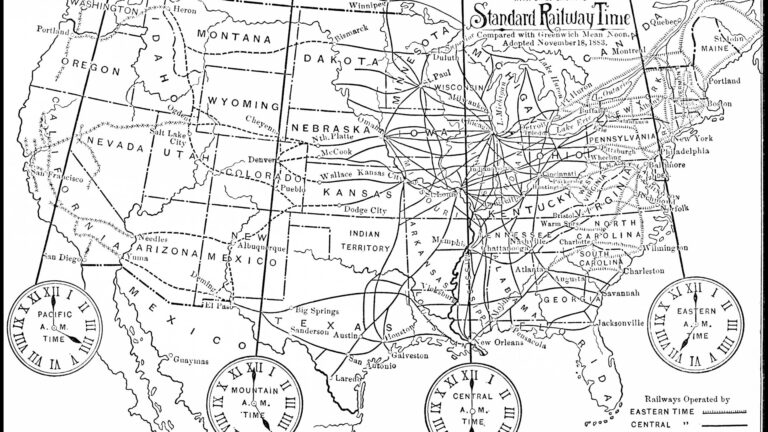
For this to work, having a route between two places was not enough. People also had to agree on when things would happen.
Today, this may seem rather obvious.
But there was a time (!) when it was anything but.
This is why the history of railways is, rather surprisingly, not just part of the history of space.
As railways connected ever-larger areas, an old problem that had previously been relatively easy to manage suddenly became increasingly troublesome:
Clocks in different cities did not necessarily show the same time.
And the great transport network needed a common time.
Meanwhile, another network was developing at an increasingly rapid pace.
For a system made up of distant locations to function, information also had to flow between them.
Where was the train? When would the ship arrive? What had happened in the next city? Which routes were available?
Connecting space therefore brought two further processes with it: the synchronisation of time and the acceleration of information flow.
At this point, the histories of space, time, and information begin to become particularly difficult to separate.
But for now, we will stick to this order.
Having connected the world in space, our next question will be:
How did we manage to synchronise time?
…But that’s another story.
Sources and Further Reading
Bibliothèque nationale de France: Littérature et voyages – Jules Verne
Sciences pour tous 1850–1900
An overview of Verne’s scientific novels and the relationship between science, technology, and literary storytelling.
Bibliothèque nationale de France – Read the article
Nellie Bly: Around the World in Seventy-Two Days
1890.
Bly’s own account of her journey around the world, including her visit to Jules Verne in Amiens and the various stages of her travels.
University of Pennsylvania – Read the complete book
Library of Congress: Nellie Bly – A Resource Guide
An overview of Bly’s life and her 72-day journey around the world, including contemporary photographs, newspaper reports, and additional primary sources.
Library of Congress – Resource guide
National Park Service: Four Special Spikes
Golden Spike National Historical Park
An account of the completion of the American transcontinental railroad on May 10, 1869, the final spikes, and the telegraph circuit that allowed people across the country to follow the final hammer blows and receive the “D-O-N-E” message.
National Park Service – Read the article
Suez Canal Authority: Canal History
The official history of the construction and opening of the Suez Canal on November 17, 1869. Excavation was completed on August 18, 1869, when the waters of the two seas met.
Suez Canal Authority – Canal History
Hilde Greefs and Anne Winter: The Democratization of Long-Distance Migration: Trajectories and Flows during the “Mobility Transition,” 1850–1910
Social Science History, 2024.
Using data on more than 5,000 international migrants, the study examines how long-distance migration gradually became accessible to broader sections of society during the second half of the nineteenth century.
Cambridge University Press – Read the study
Colin G. Pooley and Marilyn E. Pooley: Young Women on the Move: Britain circa 1880–1950
Social Science History, 2021.
A study of everyday mobility based on the contemporary diaries of nine women. It includes the example of Mary Anne Prout, who lived approximately eight kilometres from a railway station but recorded no train journeys of her own in her surviving diary.
Cambridge University Press – Read the study
Internet Society: Glossary of Internet Terms
An accessible introduction to the terminology of the internet. The Internet Society defines the internet as a network of networks: almost 70,000 independent networks interconnected through common protocols.
Internet Society – Glossary of Internet Terms
International Union of Railways (UIC): 2024 Global Rail Sustainability Report
A comprehensive overview of the global railway system. According to the report, the world’s rail network had a total length of approximately 1.17 million kilometres in 2023.
UN Trade and Development (UNCTAD): Data Insights – Maritime Transport
Data on global commercial shipping. At the beginning of 2026, the world’s merchant fleet comprised approximately 116,000 vessels of at least 100 gross tons.
UNCTAD – Maritime transport data
International Air Transport Association (IATA): 2025 Annual Safety Report
2026.
Annual data on global commercial aviation. In 2025, 38.7 million commercial flights were recorded worldwide, equivalent to an average of approximately 106,000 flights per day.