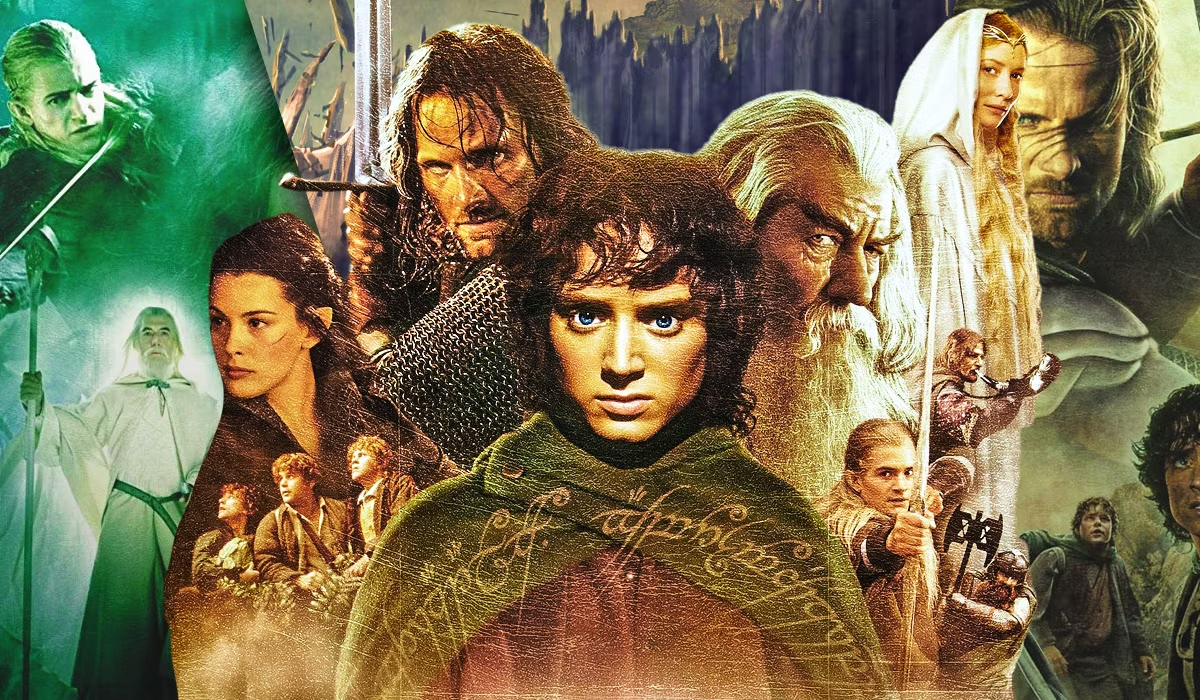
When we hear or read an old myth today, it is easy to imagine it as one story belonging to a larger, complete world. In fact, it is quite difficult to imagine it any other way. If Thor appears, somewhere behind him we instinctively sense Odin, Loki, Asgard, the world tree Yggdrasil and Ragnarök. If a slender, pointy-eared, ethereal creature appears, we know it is an elf, probably several hundred years old and almost certainly carrying a bow – and we assume that somewhere nearby there must also be dwarves and orcs.
When dragons are involved, we assume they hatched from eggs, and we want to know whether they are friendly, whether they can speak, whether they bond with human riders or live according to rules of their own. But the idea that these creatures and phenomena belong to a unified, complex system, governed by certain rules and fitting into the world as a whole, barely even needs to be stated.
This way of thinking is partly a legacy of modern fantasy. We have become used to the idea that behind stories there are worlds: histories, peoples, languages, maps, religions and interconnected systems of rules.
But people did not always think about stories in this way. What might a myth or story have been like for someone who encountered it long before such unified systems existed – say, many hundreds of years ago?
When the Story Was Still Moving
Someone living in 10th-century Scandinavia probably knew stories about gods, heroes, monsters and supernatural events. They may have heard poems and songs, listened to stories told by their parents or at communal gatherings, and encountered them through local traditions, festivals, customs and rituals.
But what they knew did not necessarily form a single, clearly organised system – a complex world operating according to consistent rules. In fact, the same stories could be told and believed differently in different regions. And when that person passed them on to their children, they may have changed them a little as well, weaving in their own experiences, things they had heard from others and things they invented themselves. They may not even have remembered exactly how the story had originally been told to them.
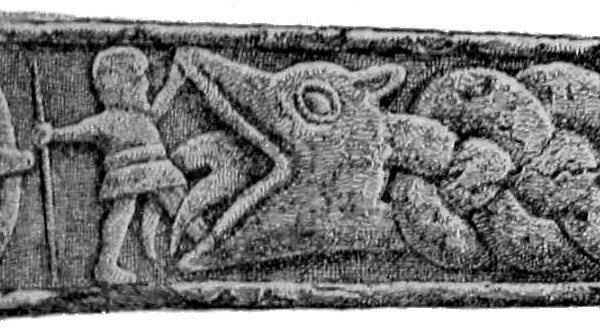
Depiction on the Gosforth Cross, Cumbria, England, erected by Scandinavian settlers in the 11th century AD.
Research into Old Norse mythology suggests that during the Viking Age these stories continued primarily through oral tradition. There was no single canonical text known and accepted by everyone against which every version could be checked, and stories could vary across time, place and performer. Much of the major written material through which we know them today was recorded considerably later, in Christian Iceland.
In such an environment, myth functioned much more like a process. A story was told, remembered, retold and transformed along the way. Some parts disappeared while new motifs became attached to it. A story could acquire a new function in a different setting; a character could turn up in another story; a plot development might be resolved differently – or lose its resolution altogether.
People at the time had not learned the rules of modern dramaturgy from cartoons and films, so those rules could not constrain how they passed stories on. If a plot development was insufficiently justified, if a character simply vanished and never returned, or if the story lacked a satisfying resolution at the end, it could still spread just as successfully as any other.
Nothing was set in stone. Myths flowed and changed in their own natural way.
Writing as a Snapshot
The appearance of writing fundamentally changed this. A written text necessarily fixes a particular state – that is, among other things, what writing was invented to do. The next performance of an oral story can differ from the previous one, while a manuscript preserves and passes on the same sentences.
This gives the story a chance to survive for longer and – especially after the spread of printing – to reach far more people. But it also means that it survives in a more stable form and reaches different people in much the same way.
Written texts are copied, edited, translated and interpreted. They can also become raw material or starting points for further texts. Yet a more stable node has now appeared, something against which later versions can position themselves.
Every act of writing is a snapshot. It captures one state of something large, moving and flowing – an oral tradition, a body of ideas, a changing world. From a certain perspective, we might even say that the moment something is written down it has already lost some of its reality, because the world itself did not stop; it kept flowing.
But perhaps a friendlier way to put it is that an organised package of information has been created, and that package has now itself become part of the flow.
For that matter, this article is a snapshot too. We are trying to pick out a few connections from a long, moving cultural process and fix them in place. By the time the text is finished, it will hopefully have a relatively stable form – but the process itself will not stop here. The world of fantasy will continue moving, and perhaps the information in this article will too. It may reach a reader, trigger new thoughts, inspire an idea. Anything can happen.
But back to myths. Let’s look at the story of the Kalevala.
The Kalevala: When Many Stories Become One Book
In the 19th century, Elias Lönnrot collected an enormous body of Finnish and Karelian oral poetry and used it to shape the epic we now know as the Kalevala. Of course, it was impossible to preserve every version that existed at the time, so he selected among different variants. But he did more than simply select: he connected stories, edited the language, and organised characters and events into a more unified structure.
The Kalevala therefore did not merely preserve the stories that were available. By arranging them, it also changed them. Oral stories became a book, and then the book itself began to flow onwards.
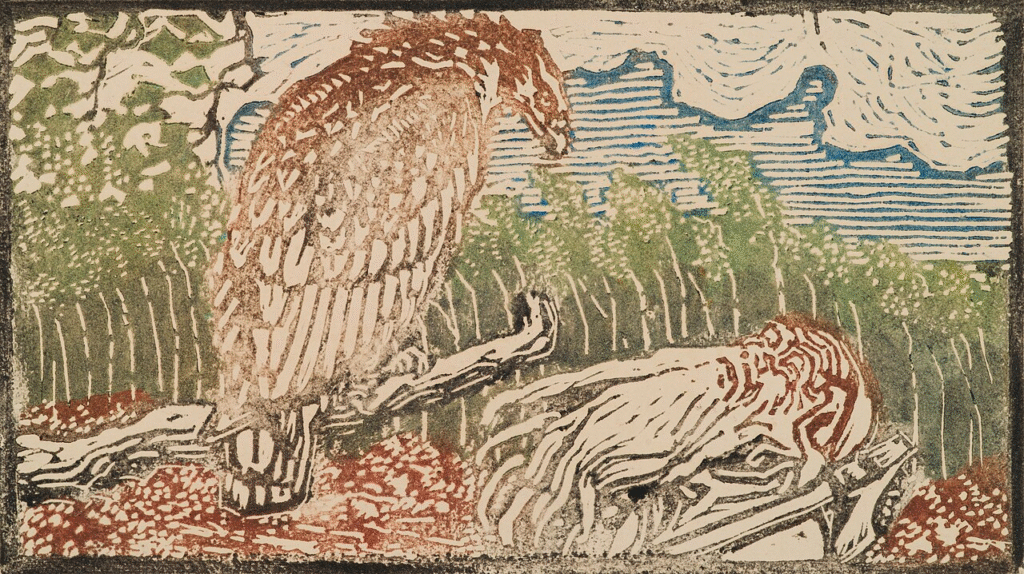
For the young J. R. R. Tolkien, the Kalevala was an important discovery. Perhaps its strongest influence came through the story of Kullervo. Kullervo survives the destruction of his family and experiences violence and humiliation from childhood. He becomes a slave, takes revenge on those who mistreat him, and later becomes involved with his own sister without either of them knowing that they are related. The tragedy eventually destroys them both.
The story had itself been assembled from several Karelian and Ingrian folk songs, and Lönnrot gave them a strong, coherent tragic arc in the Kalevala.
In the early 1910s, Tolkien began writing his own version under the title The Story of Kullervo. Decades later, he recalled that his reworking of this story had been one of the earliest seeds of his own legends. The motif later survived – heavily transformed – in the story of Túrin Turambar. Tolkien himself described the Kullervo tale as a germ of his developing legendarium.
Túrin is a tragic hero of Middle-earth’s First Age, a descendant of a family cursed by Morgoth and a formidable warrior whose life is marked by flight, mistakes and destructive decisions. He too marries his lost sister, Nienor, while neither recognises the other. When the truth is revealed, first Nienor and then Túrin take their own lives.
The basic situation from Kullervo therefore remains recognisable, but Tolkien placed it inside a much larger historical and mythological system. Túrin’s fate became part of the wars of Morgoth, Men and Elves, lost kingdoms and the history of Middle-earth unfolding across generations.
Here the path of information becomes especially clear: songs belonging to different communities were shaped into Lönnrot’s epic; that epic became Tolkien’s own Kullervo; and from there the story flowed into one of the fundamental tragedies of a new mythology.
Tolkien’s World Takes Shape
Of course, Middle-earth was not built solely from the Kalevala and the tragedy of Kullervo. Several very different traditions flowed into Tolkien at the same time.
Old Norse mythology and the Icelandic sagas contributed a sense of heroism, fate and a lost past. From Beowulf, Tolkien drew in particular on a technique by which the story constantly points towards a larger past that remains partly hidden: ancient kings, lost events and earlier legends that make the world feel far deeper than what we can directly see.
Sir Gawain and the Green Knight was one of the Middle English texts of chivalric and supernatural tradition that Tolkien directly studied, edited, taught and translated. We will return to it later.
The Finnish Kalevala influenced him not only through its stories but through the sound of the Finnish language, while Welsh and other Germanic languages played roles in shaping his own invented languages. The Arthurian tradition was another important reference point, even if Tolkien approached it critically.
Alongside all this came Christian thought – particularly questions of creation, fall, death, free will and power – as well as Tolkien’s own experience of the First World War, the loss of his generation, his relationship with the English landscape and his response to the transformations caused by industrialisation.
For Tolkien, these sources did not remain isolated motifs. Elements arriving from different periods, languages, religious traditions and historical experiences became connected within a new mythological system.
Tolkien the Philologist
Tolkien also had another kind of relationship with old stories. As a philologist, he worked with medieval texts, old languages and their historical transformations. One of the fundamental tasks of philology is to investigate how a language changes over time, what earlier forms may lie behind the surviving ones, and what historical relationships can be inferred from linguistic traces.
At first, that may seem far removed from Middle-earth. In fact, it brings us remarkably close to it.
Tolkien’s invented languages were not simply a collection of artificial languages placed next to one another. They had histories. They were related to each other, developed from common earlier forms, and then changed in different directions as their communities of speakers separated. Tolkien paid close attention to this process.
If two languages descend from a common ancestor, then the peoples who speak them may also once have shared a common past. If they later speak different languages, some historical process must have occurred in between: migration, separation, perhaps wars, long periods spent apart, or encounters with other communities.
So when a language changes and splits, the world around it must change as well. The evolution of languages follows the changing histories of peoples. It can tell us why, when and how two peoples separated; where and how they lived while they still spoke a common language; what they encountered afterwards; what they preserved from their shared past and what fell away along the way.
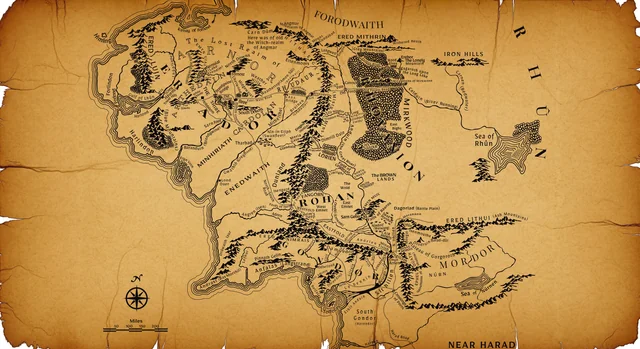
In Tolkien’s worldbuilding, language and history continually shaped each other. Carl Hostetter’s overview of Tolkien’s invented languages shows how a linguistic question in Tolkien’s notes could often lead into geography, history or even metaphysics. Middle-earth’s past therefore does not feel like simple background information. Its different layers – languages, histories, geography and more – connect as though they really had developed over long periods of time.
A World Appears Behind the Story
Tolkien also expressed this way of thinking on a theoretical level. In his essay On Fairy-stories, he wrote about creating a Secondary World. Such a world works when it is internally consistent. The reader accepts it not because every part is separately explained and broken down for them, but because the elements that come into contact with one another operate consistently within the world.
This is why Middle-earth creates such a powerful sense that there are further stories behind the story. Characters refer to ancient events. They sing songs about people who died long ago. Ruins stand beside roads. Place names preserve traces of older languages. A sword has a history. One people remembers the same event differently from another. The world extends not only through space, but through time.
Perhaps this is one of Tolkien’s most important contributions to the way we now imagine fantasy worlds: such a dense network of relationships develops around the story that the world appears to exist independently in its own right.
The stories of someone living in 10th-century Scandinavia would have been much more fluid and inconsistent. Even if some kind of worldview lay behind them, it may have been hazy and constantly changing.
Worldbuilding, of course, existed before The Lord of the Rings. E. R. Eddison’s The Worm Ouroboros and the later Zimiamvia books, for example, had their own geography, cultures and mythical historical space. Since Tolkien, countless other examples have appeared, from Terry Pratchett’s Discworld and C. S. Lewis’s Narnia to Frank Herbert’s Dune. There are also fictional universes that were constructed largely afterwards around a character or phenomenon – the Predator universe, for example.
In the case of Star Wars, the first film already suggests a complex world containing an Empire, a Republic, a Jedi Order, strange creatures, distinctive technologies, planets and a history. But the universe was really built out later – and is still being built – through sequels, series, animation and games.
From time to time, the people managing a franchise attempt to impose order on the huge quantity of material and stories that have accumulated. They decide what counts as official canon, what falls outside it, what needs to be rewritten and which logical leaps have to be repaired to keep the whole thing coherent.
When the World Becomes Playable
During the second half of the 20th century, Tolkien’s influence continued flowing into modern fantasy. Huge numbers of novels and short stories appeared containing orcs, wizards, rangers and other creatures shaped by mythological and Tolkienian traditions.
Then, helped by both its popularity and the consistency of its worlds, the current entered role-playing games. Dungeons & Dragons drew on many different sources, but Tolkien’s works formed an important part of the fantasy culture in which the game emerged.
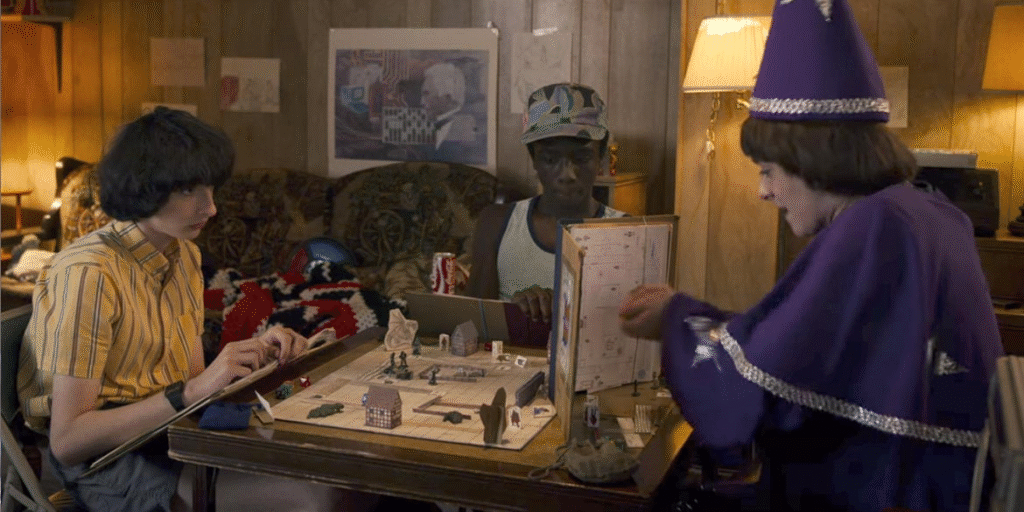
Role-playing games took the idea of the Secondary World another step further. It was no longer simply a setting in which stories were told: you could enter that other world. You could create a character, travel through it, make decisions and generate new stories.
The world no longer belonged solely to one author and one story. Large numbers of players began creating new stories inside it.
And in doing so, the story became a process again. Yet everything we now expect from a modern fantasy world remained in place: maps, histories, peoples, races, magic, religions, rules and interconnected background information.
This form then flowed onwards into computer role-playing games, video games, films and television series. For more and more people, it became natural to assume that behind a fantasy story lies a larger, organised world.
Looking Back into the Past
While ancient myths influenced Tolkien, Tolkien – and the fantasy culture that developed after him – may also influence how we now imagine those ancient myths.
When we speak of “Norse mythology” today, it is easy to picture a single world-system: families of gods, mappable locations, creatures, categories and a clear cosmology. And thanks to drawings, paintings and films, many of us imagine these elements in broadly similar visual forms.
But the system we know is itself the result of a long process of transmission. Oral stories became manuscripts. Manuscripts were edited and interpreted. Nineteenth-century philologists reorganised them. Artists created new versions, and all of this eventually entered the cultural circulation of modern fantasy.
So when we look backwards today, we are not looking from the same place as someone listening to a strange story a thousand years ago. We see it through the filter of everything that has happened since – and everything we ourselves have already consumed.
We probably cannot even imagine what, for example, a 14th-century boy thought and pictured when someone told him the story of the Green Knight.
The Green Knight and the Missing Rulebook
Sir Gawain and the Green Knight is a 14th-century Middle English chivalric poem. At Christmas, a mysterious Green Knight appears at King Arthur’s court and proposes a strange game: anyone may strike him once with his axe, provided that one year and one day later he is allowed to return exactly the same blow.
Gawain accepts the challenge and beheads him. But the Knight does not die – at least not in the conventional meaning of the word. He simply picks up his own head, reminds Gawain of his promise and rides away.
A year later, Gawain sets out to find him so that he can keep his word and allow the Knight to strike his neck in return. Along the way, he faces further moral and chivalric tests. The story is about honour, fear and temptation, but also about how much the rules we claim to believe in are worth when the stakes become real.
Only a single manuscript of the poem survives. Tolkien prepared a scholarly edition with E. V. Gordon, taught the text for many years, and later produced his own translation into modern English. The story was therefore directly part of the old literary world Tolkien encountered as a philologist.
David Lowery’s 2021 film The Green Knight transformed it further – and did so in a way that can feel quite unusual to viewers accustomed to modern fantasy.
Giants appear unexpectedly. A severed head speaks. A fox starts talking. We may be able to accept those things, even if our brains, trained on familiar rules of dramatic storytelling, sometimes find the strange events somewhat unexplained.
But the film is in no hurry to tell us what the Green Knight actually is, where he came from, what category of creature he belongs to or what rules govern him. Nor does it resolve several other questions for the audience. The ambiguity of the story remains. This is very much part of the way Lowery’s adaptation engages with the medieval poem.
That can create a strange experience, because modern fantasy often teaches us that the phenomena of its worlds have explanations. When something unusual happens, we assume there must be some background story, rule or system somewhere that explains it.
The Green Knight, however, allows the viewer to decide how to interpret what they see – or even to allow the mystery simply to remain a mystery.
Perhaps this gives us a faint taste of what storytelling could have felt like in a cultural environment where every element of a myth did not come with a complete encyclopedia – and where listeners did not expect one.
Even a Fixed World Keeps Moving
We said that written text captures a snapshot of a flow. But even here, the world of The Lord of the Rings contains a twist.
Middle-earth, which contributed so strongly to the ideal of the meticulously constructed fantasy world, was never completely fixed itself. Tolkien rewrote it throughout his life. He changed its languages, histories, family trees and his ideas about how the world worked. He reconsidered earlier solutions, and new problems generated new stories.
He even changed linguistic forms that had already appeared in print in later editions.
According to Carl Hostetter, Tolkien did not necessarily regard reaching a final state for his invented languages as a desirable goal. The world that looks from the outside like an almost monumentally fixed system was, from the inside, constantly moving.
And yet we can still think of Tolkien as a particular kind of node – itself in motion – within an information flow. A point where several currents that had previously travelled separately met, affected one another and then continued onwards in a new form. In Tolkien’s case, ancient myths, languages, medieval texts, philological research, religious ideas and personal experiences all converged.
From them emerged Middle-earth: a distinctive and extraordinarily coherent Secondary World with its own history, geography, peoples, languages and interlocking myths.
Later, it was no longer only Tolkien’s stories and characters that continued to influence others. The very form of this kind of worldbuilding became a model: the idea that behind a story there can be a much larger world that appears capable of functioning in its own right.
Its traces can be followed through later fantasy literature and other areas of fiction, into role-playing games, and then into the worldbuilding of video games and other media. Tolkien was not the sole origin of modern fantasy, but the scale of his influence on the genre is difficult to overstate.
So in this case, the node did not simply collect and transmit the information that reached it. From the meeting of several currents, a new and recognisable form emerged within it – worldbuilding – and later that form itself became part of what continued to flow onwards.
Perhaps this is also why the idea of the node is interesting within Worldinterflow. Not every node functions in the same way. Some may primarily preserve, transmit or amplify something. In other cases, however – as with Tolkien in this particular story – the currents that meet can form a new arrangement that itself becomes the starting point for further flows.
Perhaps nodes work this way more generally. Information temporarily becomes concentrated within them, is organised and enters new relationships, then branches out again. A book, an author, a work, a genre or even an entire era can become such a point in the flow.
And every stage along the way is only a temporary fixing of something. For a while, we give it form, name it, write it down, organise it into a system.
Then we pass it on.
And the moment we do, the story of the next version has already begun.
Sources and Further Reading
John Lindow: Old Norse Mythology
Oxford University Press, 2021.
On the oral tradition of Old Norse myths, their changing forms, and how they were transmitted into medieval written sources.
Oxford Academic – Old Norse Mythology
Suomalaisen Kirjallisuuden Seura / Finnish Literature Society: Kalevala – European Heritage Label
On the creation of the Kalevala, Elias Lönnrot’s work as a collector and editor, and how different folk songs were shaped into a more unified epic.
Finnish Literature Society – Kalevala
J. R. R. Tolkien: Letter to W. H. Auden, 7 June 1955
Tolkien’s own account of the influence of the Finnish and Welsh languages, the Kalevala, and the way language creation and storytelling became connected in his work.
The Tolkien Estate – Letter to W. H. Auden
J. R. R. Tolkien: Letter to Christopher Bretherton, 16 July 1964
Here Tolkien describes the tragedy of Kullervo as one of the early germs of his own legendarium, and discusses how the story later developed into the world of The Children of Húrin.
The Tolkien Estate – Letter to Christopher Bretherton
Carl F. Hostetter: Tolkien’s Invented Languages
On the development of Tolkien’s invented languages, their relationships with one another, and the way they became intertwined with the history, geography and mythology of Middle-earth.
The Tolkien Estate – Tolkien’s Invented Languages
Tom Shippey: The Monsters and the Critics and Other Essays
On Tolkien’s work on Beowulf and the sense of “historical depth” created when a story points towards a larger, partly unspoken past – a technique that later became important in The Lord of the Rings as well.
The Tolkien Estate – The Monsters and the Critics
Tom Shippey: Translations and scholarly editions of medieval texts
On Tolkien’s philological work on medieval texts, including the 1925 edition of Sir Gawain and the Green Knight prepared with E. V. Gordon, as well as Tolkien’s later translation.
The Tolkien Estate – Translations and scholarly editions
Verlyn Flieger: On Fairy-stories
On Tolkien’s concepts of “sub-creation” and the “Secondary World”: the idea that a fantasy author can create a secondary world governed by its own internal consistency.
The Tolkien Estate – On Fairy-stories
Edward James: Tolkien, Lewis and the explosion of genre fantasy
In: The Cambridge Companion to Fantasy Literature, Cambridge University Press, 2012.
On the role of Tolkien and C. S. Lewis in the development and widespread popularity of modern fantasy as a genre.
Cambridge University Press – Tolkien, Lewis and the explosion of genre fantasy
Amber Dunai: Adapting Ambiguity in David Lowery’s The Green Knight
Adaptation, Oxford University Press, 2022.
On the ambiguity of Sir Gawain and the Green Knight and the way David Lowery carried that ambiguity into his 2021 film adaptation.
Oxford Academic – Adapting Ambiguity in David Lowery’s The Green Knight