From messengers and letters to the telegraph and the internet: how did information go from being tied to physical locations to flowing through planetary networks?
In August 1858, Queen Victoria of Britain sent a message to US President James Buchanan. It was written in an extremely formal tone, which may well have been the equivalent of “telegraph style” between heads of state at the time. There would have been nothing particularly remarkable about that in itself. Ships were already regularly crossing the Atlantic, carrying letters, newspapers, diplomatic documents, and news between the two continents.
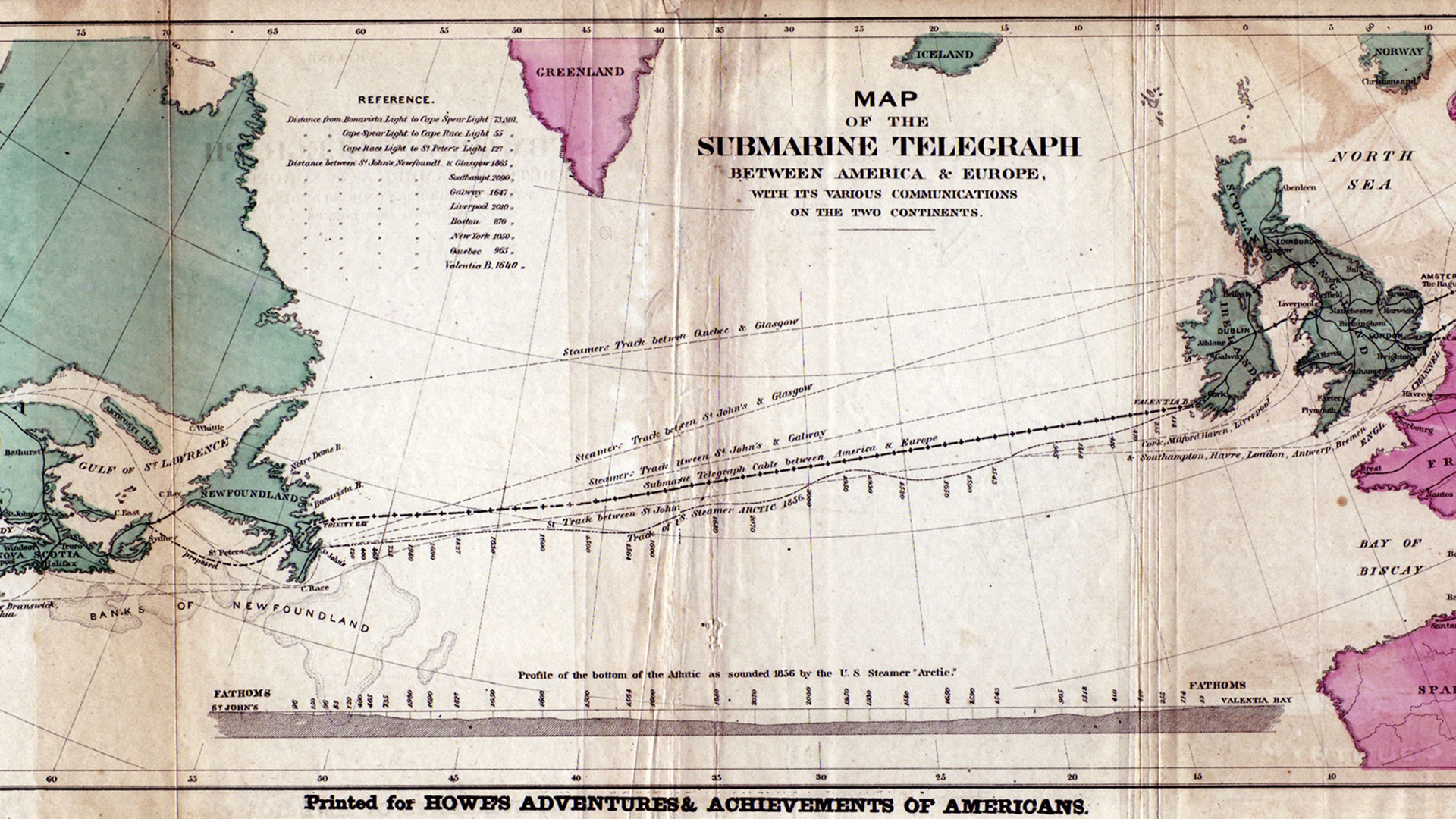
But this message did not board a ship. Instead, it reached America through a telegraph cable laid between Ireland and Newfoundland. And it was precisely this new communication channel that the message was about.
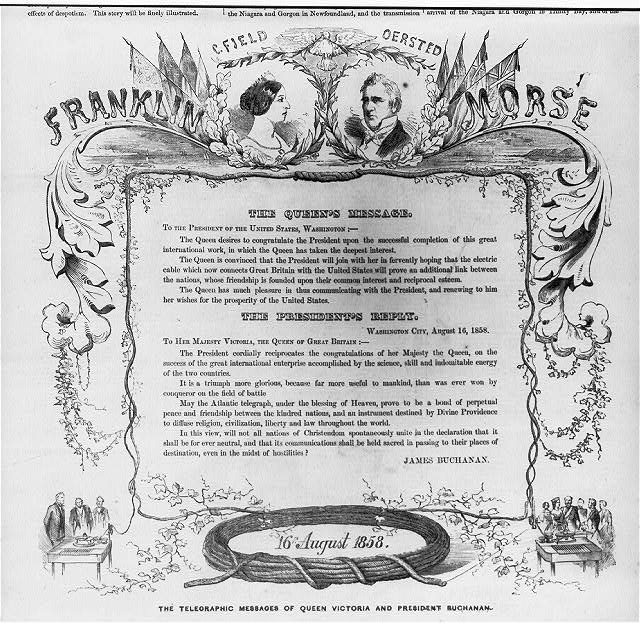
“The Queen desires to congratulate the President upon the successful completion of this great international work, in which the Queen has taken the deepest interest. The Queen is convinced that the President will join her in fervently hoping that the electric cable, which now connects Great Britain with the United States, will prove an additional link between the nations, whose friendship is founded upon their common interest and reciprocal esteem. The Queen has much pleasure in thus communicating with the President, and renewing to him her wishes for the prosperity of the United States.”
By today’s standards, transmitting the 98-word message was astonishingly slow: it took approximately sixteen and a half hours. The cable itself failed just a few weeks later. From a technical perspective, the first transatlantic telegraph connection was a rather short-lived success story.
Yet something had changed irreversibly. Information had crossed the Atlantic without a person, a letter, or a ship having to carry it all the way across.
Until then, the speed of information had largely depended on the speed of whatever carried it. One person told another; a messenger delivered a message; a letter travelled by mail coach; a newspaper was loaded onto a train or a ship; a pigeon flew off with a piece of paper attached to its leg. You could build better roads, change horses more frequently, use steamships or railways, or feed your carrier pigeons extra vitamins – but information always travelled together with something physical.
With the telegraph, that connection began to break apart.
When Messages Still Had to Travel
For most of human history, information was tied to physical locations and carriers. Information conveyed through speech could travel only as far as the sound itself. If it needed to reach somewhere farther away, someone had to remember it, travel there, and pass it on.
Writing made it possible for a message to become independent of its sender in a certain sense, perhaps even outlive them, and physically move away from them. But that still required moving whatever the message had been written on.
From this perspective, a letter was portable information. Organised postal networks represented an entirely different scale of communication. A message did not necessarily have to be carried all the way by a single messenger; instead, it could pass from one station, route, or relay point to another.
Printing brought another transformation: the same information could now be reproduced in large numbers and distributed to many people.
But the underlying principle remained unchanged. Something had to get from point A to point B.
If someone in London wanted to know what had happened in New York, some physical carrier first had to cross the Atlantic. The event had already taken place, but for London, it did not yet exist as news.
The world’s distant regions were therefore separated by more than geographical distance. In terms of information, they lived in different versions of the present.
Faster Than a Human Being
The first remarkable attempts to overcome this limitation did not involve electricity.
Long before electrical communication, humans were already trying to send messages faster than a messenger could travel: using smoke signals, signal fires, drums, flags, and optical telegraphs.
The common trick was that the object carrying the message did not have to travel the entire distance. Instead, the signal was passed from one point to another through a different channel, either visually or acoustically.
From the late eighteenth century onwards, semaphore-based optical telegraph networks were built in several parts of Europe.
A series of towers relayed visual signals to one another. Each station read the signal displayed by the previous tower, then reproduced it for the next one. In good weather, a message could travel much faster this way than any messenger could carry it.
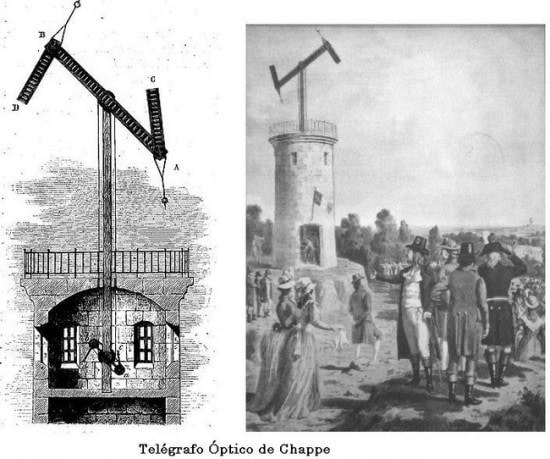
This was already an interesting change in how communication worked.
The same physical object did not travel the entire route. Instead, each station recreated the information and passed it on.
It is worth noting, however, that transmitting the signal required quite a large number of stations, and there were still limits to how far information could travel. The necessary infrastructure had to be built first.
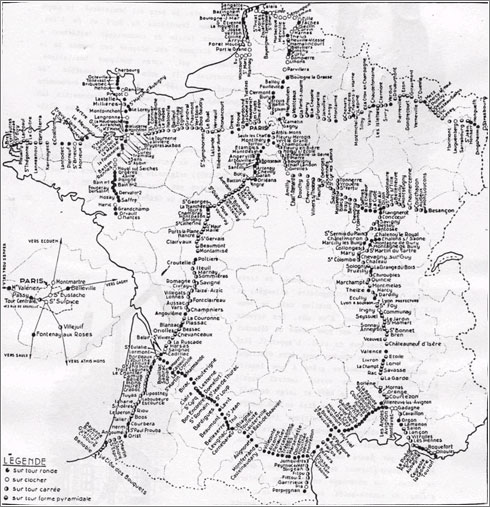
The electric telegraph made this process vastly faster and more flexible.
By the middle of the nineteenth century, telegraph wires were connecting an increasing number of cities. In the United States, more than fifty separate telegraph companies were operating in the early 1850s. Over the following decade, these gradually developed into larger systems.
In October 1861, the first American transcontinental telegraph line was completed.
From then on, a message could cover a continent in a fraction of the time it would have taken a rider or a mail coach.
The telegraph was therefore not simply a faster postal service. It changed the way information travelled.
A message was encoded, transmitted as a signal, and then converted back into an intelligible message at the other end.
The original sheet of paper did not need to go anywhere.
Information had become independent of the movement of its physical carrier.
A Cable Beneath the Ocean
This is what makes the events of 1858 so important.
On land, the telegraph had already demonstrated that electrical signals could carry information faster than people or vehicles could travel.
But the Atlantic Ocean still represented an enormous physical barrier.
The transatlantic cable was an attempt to bridge that gap.
The cable was laid on the ocean floor by wooden ships. One of them was HMS Agamemnon, a Royal Navy warship launched in 1852.
To accommodate nearly 800 tonnes of cable, its 91 guns, numerous internal partitions, and much of its original equipment had to be removed. Several hundred additional tonnes of cable were stored on deck.
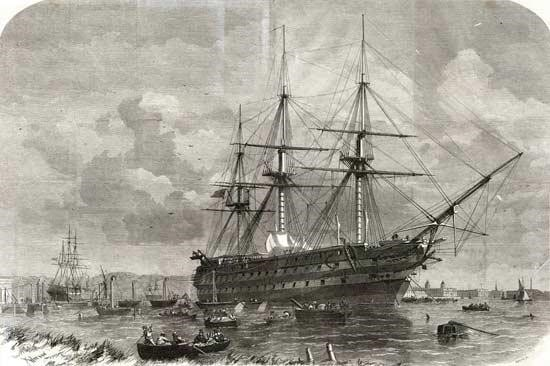
The first working connection was short-lived. It failed after just a few weeks, and for years, attempts to establish a lasting connection were unsuccessful.
In 1866, however, the cable ship Great Eastern laid a new cable between Ireland and Newfoundland. From then on, a reliable transatlantic telegraph connection was in operation.
It is difficult for us today to appreciate the scale of this change.
Previously, the speed of news travelling from the other side of the Atlantic had been determined by the speed of ships – and by the weather.
An event in Europe might not become known in America until days or weeks later.
Once the telegraph cable was working, the same information no longer had to cross the ocean in the same way a person did.
Space remained just as vast, yet for information, it had shrunk – in time.
DONE
Eleven years after the first transatlantic cable, another important event took place in the history of a different network.
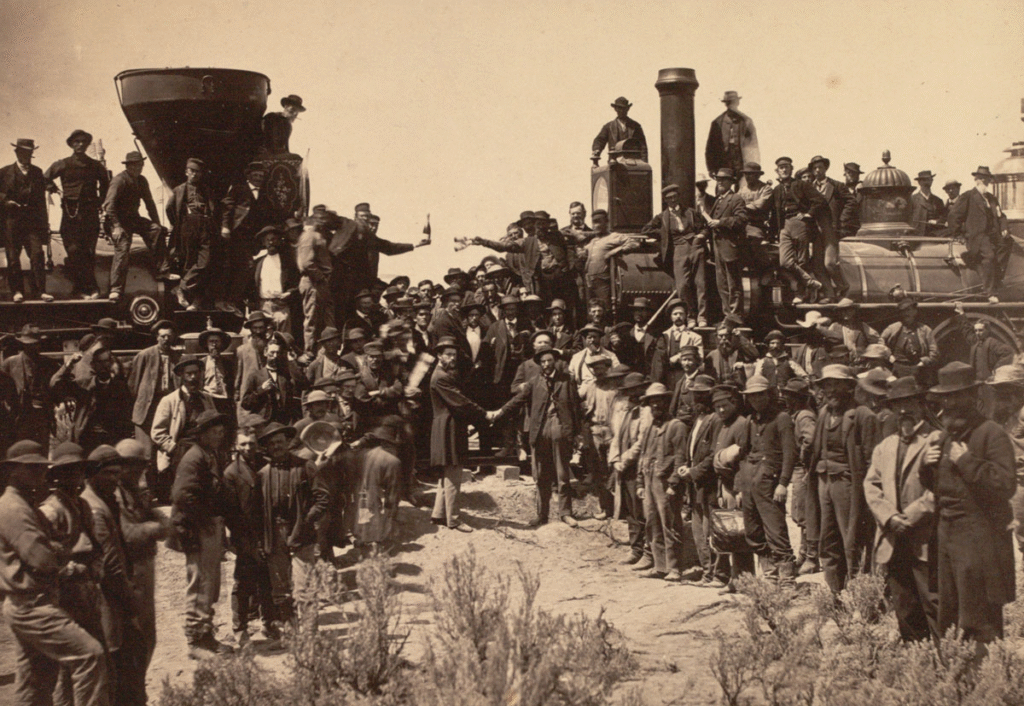
On May 10, 1869, the Union Pacific railroad, advancing from the east, met the Central Pacific railroad, approaching from the west, at Promontory Summit in Utah.
The first American transcontinental railroad had been completed.
We have already explored this event in our article about the historical integration of space. Now let’s look at what happened from the perspective of information.
During the ceremony, an ordinary iron railroad spike and a hammer were connected to the transcontinental telegraph network.
When the hammer touched the spike, it closed the electrical circuit, and the signal was transmitted to other parts of the country. People elsewhere could follow the hammer blows almost live.
When the work was completed, Western Union telegraph operator W. N. Shilling sent out a message:
D-O-N-E.
Done.
In this single scene, two different forms of integration came together.
One network now allowed trains, people, and goods to travel across the continent.
Through the other, the news of this achievement travelled almost instantly.
Moreover, the information network had preceded the transport network: the first transcontinental telegraph had already been completed in 1861.
By the time the railroad tracks met, the two coasts of the continent had been connected through communication for eight years.
From then on, the physical and information networks spanning geographical space became increasingly intertwined.
Not a Single Line – Information Networks
A single telegraph line was not enough to create a global information system.
Transmitting messages quickly was only part of the challenge. Separate systems also had to become interconnected.
Something similar had already happened in transportation.
When Nellie Bly set off to travel around the world in 1889, there was no single global transport system that picked her up in New York and dropped her off at the same place seventy-two days later.
Trains, steamships, ports, and local transport systems passed her from one to another.
The planet became traversable because connections between smaller networks had developed to the point where they formed a continuous system.
The same process was beginning to unfold in the history of information.
Local telegraph lines were connected into national systems. National networks were linked by lines crossing entire continents. Continents were connected by submarine cables.
Increasingly, the question was no longer simply whether a fast connection existed between two points, but whether one system could pass information on to the next.
Expanding Possibilities
The telephone brought another important transformation.
The telegraph was based primarily on the encoded transmission of letters. The telephone, by contrast, converted sound itself into an electrical signal.
A person at the other end no longer received a message written down by a telegraph operator. They heard the other person’s voice.
Radio introduced another form of organisation.
In wired systems, communication typically took place between specific points. A radio broadcast, however, could reach a great many receivers simultaneously, without requiring a separate wire to every listener.
This introduced a new form of information transmission across space: broadcasting.
Television added moving images to the process, while communications satellites made it possible for such signals to travel between continents almost instantly.
On July 23, 1962, the Telstar satellite enabled a live transatlantic television broadcast.
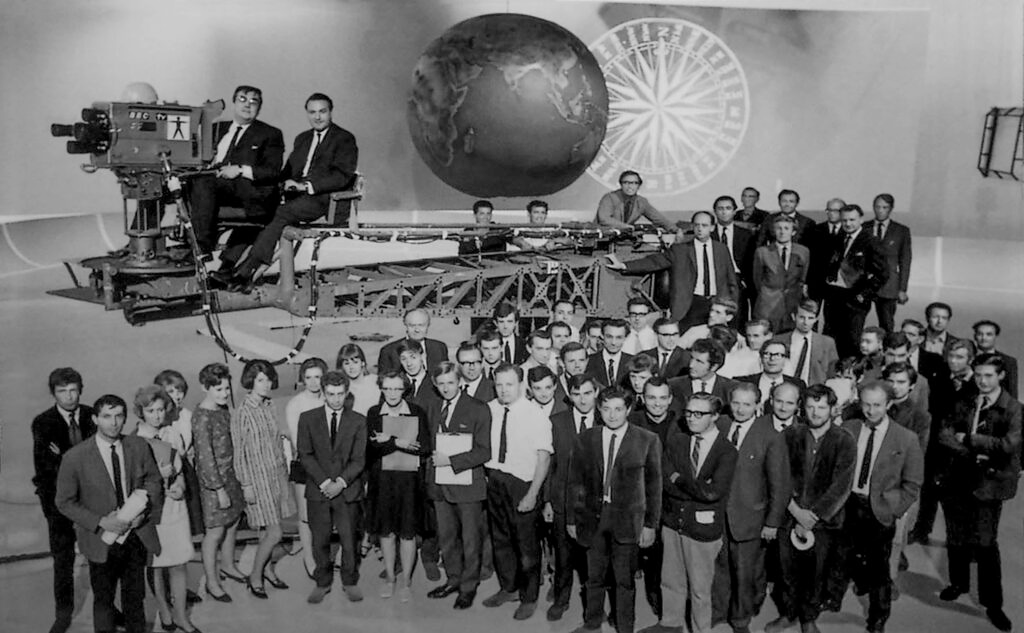
Five years later, on June 25, 1967, a programme called Our World connected live television feeds from several continents.
Millions of people in different parts of the world watched essentially the same programme at the same time.
It was a huge undertaking that required meticulous planning. And it was something that connected people around the world through a shared experience.
This brought another change in what distance meant.
In the age of letters, information about an event taking place far away reached us days or weeks later.
With the telegraph, we could learn about it minutes or hours later.
With satellite television, we could actually see it almost as it happened.
The informational present experienced by people living in different parts of the Earth began to overlap across increasingly large areas.
A Network of Networks
We tend to think of the internet as the next great invention in the history of communication.
But from the perspective of our story, perhaps something else about it is even more interesting.
By the end of 1969, the first version of ARPANET connected four computers. In itself, it was just another network – tiny by today’s standards.
(By the standards of the time, however, it was a major breakthrough.)
Over the following years, a more complex problem emerged.
It was no longer enough to connect computers to one another. Different networks, operating according to different principles, also had to be connected.
There were wired packet-switched systems, radio networks, and satellite connections.
Among those working on this problem were Robert Kahn and Vint Cerf, two American computer scientists whose work eventually led to the development of one of the foundations of the internet: the TCP/IP protocol suite.
The point was not to make every network identical, but to enable them to pass information to one another.
Ultimately, this became one of the internet’s fundamental principles.
Separate networks can remain independent while exchanging information through shared protocols.
Among Kahn’s original principles was the idea that individual networks should not have to change their internal operation in order to connect, and that there should be no need for a single global operating centre.
From this perspective, even the word internet is rather precise: inter-network, meaning between networks.
It was not a single enormous network that swallowed up all the smaller ones. Rather, many different networks became capable of passing information between themselves.
And, strangely enough, this brings us back to the same point we reached during Nellie Bly’s journey.
She was not carried around the Earth by a single system, either. Different systems passed her from one to another, across land and sea, by rail and by ship.
In much the same way, data and information are passed between smaller and larger systems through UTP cables, optical fibres, and radio waves.
Part of the Same Process
There is another intriguing difference between television and the internet.
A global television broadcast can create a shared moment of information. Hundreds of millions of people can watch the same thing at once.
In itself, this is a kind of shared collective experience. People have something to write and talk about afterwards. Everyone knows what everyone else is referring to.
There have been several such moments in the history of television: Olympic broadcasts, the Live Aid concerts, or – in a very different way – the experience of 9/11.
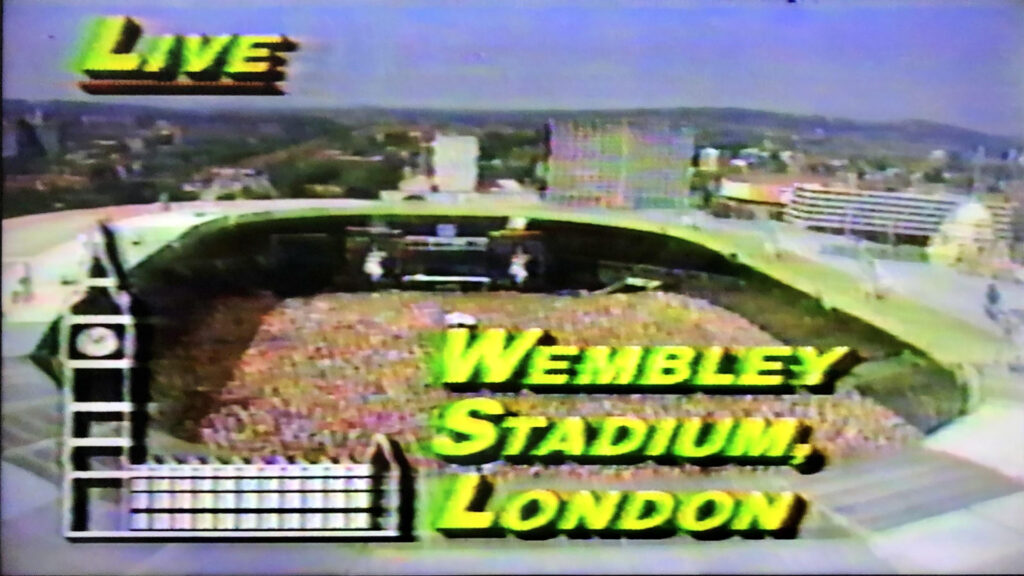
But people sitting in front of their television screens generally remain viewers.
In networked communication, by contrast, people can become active participants in the process themselves.
An event can be broadcast live and made available through a network almost immediately.
Others can share it, comment on it, add new information, fact-check it, distort it, or place it in a different context.
These new versions can then spread through further networks, where even more people can respond to them.
Information no longer simply travels from point A to point B. It changes as it flows.
It encounters other information, gains strength, fades into the background, transforms, and acquires new meanings.
Information environments that were once largely separated from one another have become increasingly directly connected.
Today, an event, image, idea, or statement can become part of the information environment of people living thousands of kilometres apart in a remarkably short time.
What Flows Through the Network
All of this sounds wonderful – but it does not automatically produce positive consequences.
The information system itself is a framework that is constantly changing, and it does not distinguish between truth and falsehood.
A research finding, a weather report, a family photograph, propaganda, a bank transaction, blackmail, a request for help, a scam, or a cat video can all travel through the same fibre-optic cable.

Integration itself merely allows information to travel farther, faster, and between more systems.
But what that information actually is – well, that’s another question.
It is true that news of a major discovery can spread more quickly. But so can a mistake or a lie.
A local political event can immediately affect public life in other countries.
A local video that goes viral can become a global phenomenon at any moment – for five minutes.
The network does not select what flows through it. It simply connects the points.
When Information Became Connected
Of course, our increasing ability to send messages faster and across ever-greater distances has played a major role in the history of information.
But an even more profound turning point was the gradual separation of information from the movement of the physical objects that had previously carried it.
Then, fast communication lines became interconnected systems.
Finally, the separate systems themselves became increasingly capable of exchanging information with one another.
The nineteenth-century telegraph created an almost instantaneous connection between two distant points.
On the twenty-first-century internet, networks comprising billions of devices continuously pass information between one another.
The coming together of information therefore means more than the fact that we can now talk to someone on the other side of the Earth.
It means that information processes which were once largely separate have increasingly become parts of the same planetary system.
So far, we have followed three stories.
First, the story of space: how local transport systems became interconnected, forming a network that could be used on a planetary scale.
Then, the story of time: how local times that had previously operated independently had to be synchronised to make these networks function.
And now, the story of information: how distant locations became capable of influencing one another ever more rapidly.
From here, the next question almost asks itself.
Are we really looking at three separate stories? Or are they three different aspects of the same transformation?
Sources and Further Reading
Library of Congress: First Transatlantic Telegraph Cable Sent
The history of the first transatlantic telegraph cable in 1858, the exchange of messages between Queen Victoria and President James Buchanan, and contemporary documents and maps.
Library of Congress – Read the article
The Henry Ford: Galvanometer Used to Receive Queen Victoria’s Message to President James Buchanan Over the First Transatlantic Cable, 1858
The 98-word telegram sent by Queen Victoria and its transmission time of approximately 16.5 hours. Museum documentation of the original instrument used to receive the message.
The Henry Ford – View the museum collection
Smithsonian Institution Libraries: The Underwater Web – The Chappe Semaphore
Claude Chappe’s optical semaphore system, developed in 1792, the operation of its relay towers, and long-distance signalling before the electric telegraph.
Smithsonian Institution Libraries – Read the article
Institution of Engineering and Technology: The Transatlantic Telegraph Cables 1865–1866
The problems with the first transatlantic cable, the attempt made in 1865, the establishment of a lasting connection in 1866, and the role of the Great Eastern. It also provides a useful comparison of how the speed of news changed between the two sides of the Atlantic.
Institution of Engineering and Technology – Read the article
U.S. National Park Service: The Transcontinental Telegraph
The completion of the first American transcontinental telegraph line in 1861, and how the information connection preceded the transcontinental railroad.
National Park Service – Read the article
U.S. National Park Service: Four Special Spikes – Golden Spike National Historical Park
A detailed account of the events at Promontory Summit on May 10, 1869, including the hammer and railroad spike connected to the telegraph circuit, and the “D-O-N-E” message announcing the completion of the transcontinental railroad.
National Park Service – Read the article
NASA: Telstar Opened Era of Global Satellite Television
The history of the Telstar 1 communications satellite and the first live transatlantic television connections established in 1962.
European Broadcasting Union: 100 Years of Media Technology Advanced by Public Service Media
The history of the 1962 Telstar broadcast and the 1967 Our World programme. The latter was the first live worldwide satellite television programme connecting broadcasts from several continents.
European Broadcasting Union – Explore the timeline
European Broadcasting Union: The Technical History of Eurovision
The technical background of the Our World broadcast on June 25, 1967: a global live television system created with communications satellites, more than a million kilometres of connections, and thousands of people working together.
European Broadcasting Union – Read the study (PDF)
Barry M. Leiner, Vinton G. Cerf, David D. Clark, Robert E. Kahn, et al.: A Brief History of the Internet
Internet Society, 1997.
A particularly valuable overview of the history of the internet, written in part by the people who developed it. From ARPANET’s original four-computer network to the work of Robert Kahn and Vint Cerf, it explains the principle of open-architecture networking: different networks can become interconnected while retaining their own internal operation.
Internet Society – Read the complete article
Vint Cerf: A Brief History of the Internet & Related Networks
A historical overview written by one of the internet’s creators. Particularly relevant to the Internetting project launched in 1973, whose explicit aim was to connect different packet-switched networks.
Internet Society – Read the article
Computer History Museum: Internet History – 1970s
The challenges of connecting ARPANET, the packet radio network PRNET, and the satellite network SATNET, as well as the work by Kahn and Cerf that led to the development of TCP. It illustrates why the internet became a network of networks rather than simply one larger network.