The Incal is space opera, psychedelic trip, cosmic-spiritual initiation and pop-cultural cornerstone all at once. It is the phoenix born from the creative minds of two extraordinary artists, rising from the ashes of a production that collapsed in on itself.
The Creators and the Dune Adaptation That Never Happened
By now, many people probably know that long before the Dune films and series that actually made it to the screen, there was another attempt – one that has since become one of the most famous unmade productions in film history. This was back in the 1970s, shortly before the world-shaping current of the Star Wars universe began to spread.
It is difficult today to imagine what might have happened if Jodorowsky’s adaptation of Dune had somehow been completed and, instead of an interstellar fairy tale, the intrigue- and philosophy-filled universe of Arrakis had taken the leading role in popular culture. If the film had succeeded – and had actually been watchable and popular – could it have changed the way we think and the way we see the world? Quite possibly.
The chances, however, were never particularly good. Alejandro Jodorowsky, who has always been something of a visionary first and a filmmaker second, imagined a film on an enormous scale – too enormous for Hollywood financiers to trust that their investment would ever come back. The missing element may simply have been the bridge between the gigantic vision and the realities of the market.
Jodorowsky had already made divisive films such as El Topo (1970) and The Holy Mountain (1973), the latter produced through Allen Klein’s ABKCO with financial backing connected to John Lennon and Yoko Ono. In 1975, he began working on Dune. We now know a great deal about what might have been, thanks in part to the documentary Jodorowsky’s Dune.
This would not have been a conventional adaptation. Jodorowsky imagined something closer to a mystical initiation film, in which spice and political manoeuvring would have been secondary to Paul Atreides’ inner transformation. He cast his own son, Brontis, as Paul and subjected him to years of training – stage work, martial arts and meditation – so that his protagonist would be physically and spiritually “awakened”.
Around him, Jodorowsky imagined some of the biggest names of the era. Orson Welles was to play Baron Harkonnen, Geraldine Chaplin Lady Jessica, Mick Jagger Feyd-Rautha and Alain Delon Duncan Idaho. Salvador Dalí agreed to play the Emperor, reportedly for an absurdly high fee tied to his screen time. Pink Floyd were approached for the music, H. R. Giger was brought in for design work, and the storyboard was created by comic artist Jean Giraud, better known as Mœbius.
By the time the project collapsed, Jodorowsky and Mœbius had produced roughly 3,000 drawings together.
It is easy to imagine what it does to someone when they spend years pouring everything they have into the great work of their life, treating it almost as a sacred mission, only to be told that the entire thing is cancelled. The historical importance of the mere possibility of the film is visible in the fact that, although it was never made, people still talk about it and still draw inspiration from it.
At the same time, it is also understandable why nobody was willing to finance an uncontrollable, ten- or twelve-hour vision with a runaway budget and a director who was not particularly interested in compromise.
The project collapsed partly under the weight of its own brilliance and excess.
Into the World of Comics
The failure of Dune pushed both creators in new directions. For Jodorowsky, the film had never been merely a production. It was almost – or perhaps not even almost – a sacred mission, and when it was cancelled, an entire worldview seemed to collapse along with the project. Mœbius appears to have experienced the ending somewhat less dramatically: what remained with him was the creative energy awakened during the storyboard work, suddenly left without an object.
Even so, The Incal did not begin simply as a substitute for the abandoned film. It became something more like a strange point of release. Jodorowsky realised that comics allowed him to construct the same kind of cosmic initiation narrative without the limits of producers, budgets and film shoots. The grandiose urge toward revelation that had failed with Dune gradually transformed into a more personal, playful and ironic – but no less insane – spiritual story.

Something similar happened on the visual side for Mœbius. The monumentality developed during Dune loosened into a lighter, more fluid and airy visual language in The Incal. It feels as though both artists relaxed after escaping the strain and constraints of the failed film, and began creating much more freely: a strange universe with a multilayered story, an inner journey and an extraordinarily colourful visual language.
The Incal
The story follows the cosmic initiation of John Difool, an unlucky, rather pathetic private detective whose name refers to the Fool of the Tarot. He is not exactly the heroic type who sets out to fulfil a mission. He is swept into a chain of events that will determine the fate of the universe, sometimes becoming almost a supporting character in his own life, at other times finding himself at the centre of intrigues and events affecting millions of lives – and usually having very little idea how he got there.
It begins with Difool being beaten up and thrown from one of the upper levels of an enormously stratified city into the depths below. Not the easiest position from which to make a comeback.

During what initially appears to be a minor case, he more or less accidentally comes into possession of the Light Incal – though later it becomes clear that accidents are not really the point here. The Incal is an object possessing cosmic intelligence, but it is also much more than that: one pole of the forces maintaining the balance of the universe.
Naturally, plenty of others want it. Before long, Difool is being hunted by Technopriests, mutant factions, political forces, galactic powers and various other unpleasant organisations. As he flees, life throws a collection of companions into his path and they gradually become a team, ranging from his cynical bird-like friend Deepo and the warrior woman Tanatah to the Metabaron.

The story moves like a spiral: from urban chaos into cosmic spaces, from political satire into spiritual initiation. Difool repeatedly falls back into his own weaknesses, rises again, falls apart and reassembles himself – occasionally quite literally. It is less a traditional “save the world” story than the journey of a broken-down man towards understanding. The change set in motion by the Incal becomes a complex process that eventually reorganises every character involved – and the world itself.
By the end, the story has expanded so far that it becomes difficult to tell whether the hero is saving the universe, or the universe is saving him.

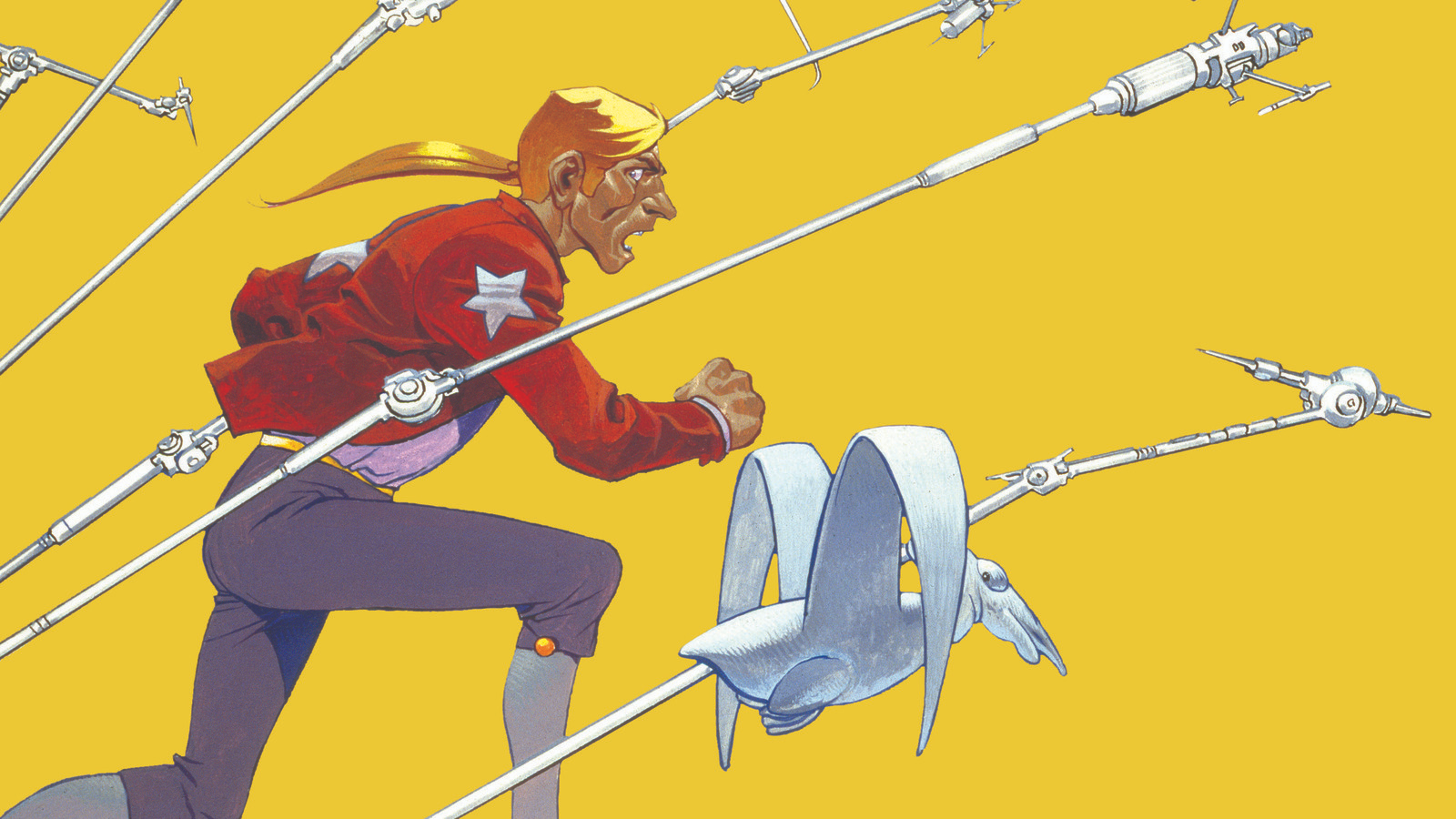
The visual world and symbolism of The Incal are not simply decoration surrounding the story. Mœbius’ choices as an artist and Jodorowsky’s spiritual-grotesque dramaturgy constantly complement one another. There are even accounts of moments when Mœbius’ drawings came first and Jodorowsky adapted the story to them.
The spiritual journey in The Incal, the attempt to see beneath the surface of things, is not really a conventional character arc in which someone simply becomes better or worse. The characters’ awareness expands through what happens to them, whether they are passive victims of events or active participants in them.
The visual world supports this throughout. Spaces can be absurdly vast, sometimes literally cosmic, and at other times painfully cramped, almost swallowing the characters whole. They constantly remind us how insignificant Difool and his companions are and how fragile they would be on their own. The vertical structure of the city itself mirrors its social hierarchy.
Our protagonist is constantly falling, floating, descending or climbing upward depending on where he is in his inner journey. The great confrontations can also be read as visual metaphors for internal conflicts. Image and story continually intertwine to create the experience.

At the same time, there is a peculiar gentleness in Mœbius’ drawings and panels, even when they depict chaos and destruction on an enormous scale. The colours are psychedelic without becoming aggressive, playful without ever becoming frivolous. The experience can even feel meditative, particularly if the reader allows themselves to sink deeply into its world and story.
And although it is entirely possible to become lost among the oddities of its psychedelic universe, the story is definitely going somewhere, even when it seems there can be no way back from where it has taken us.
Toward a transformation larger than the universe itself.
The Jodoverse and Its Influence
The Incal was only the beginning. Its story and world were rich enough to produce numerous branches, and that is exactly what happened. The Metabarons received their own series – with Castaka later telling the story of their origins – and so did the Technopriests. Then there is Megalex, centred on a dystopian, partly biomechanical techno-city. A prequel explored Difool’s younger years, while several alternative continuations of The Incal followed. Mœbius did not draw all of these later works.

Today, The Incal is more than a cult comic. It is one of those foundational works whose traces seem to vibrate through everything from cyberpunk cityscapes to space-fantasy aesthetics. Echoes can be found in the city design of The Fifth Element – Mœbius was himself involved in the film’s development – and in later cyberpunk cinema, from Blade Runner to Tron: Legacy. They can even be felt in the imagery of Nausicaä of the Valley of the Wind: Mœbius and Hayao Miyazaki openly admired one another’s work.
There are echoes in the spirituality of The Fountain as well, and in games such as No Man’s Sky or Metal Gear Solid. Hideo Kojima has long been an admirer of Mœbius’ work.
So The Incal is not merely a comic. It is a universe that has quietly but permanently worked its way into the fabric of popular culture.
And to bring the story full circle – something that would not exactly be alien to The Incal itself – perhaps we can even say that its influence can be felt in Denis Villeneuve’s Dune films. There are visual solutions that seem familiar from the comic: enormous spaces, minimalist techno-organic environments and similar ideas. It is tempting to imagine that storyboard artists drew something from the Jodorowsky–Mœbius Dune book or from The Incal itself.
That, however, is speculation rather than something we can establish with certainty.
But it is a nice thought.
Will There Ever Be an Incal Movie?
A film adaptation has been announced more than once. Humanoids – the English-language name of the original publisher, Les Humanoïdes Associés, and the holder of the comic rights – officially announced Taika Waititi as director, with Waititi, Jemaine Clement and Peter Warren attached to the screenplay. Jodorowsky himself gave the project his blessing.
At the time this article was written, however, there was still no clear public indication of when – or whether – the film would actually move forward. Waititi had plenty of other commitments, and the project remained one of those adaptations that everyone knew existed somewhere in development but nobody could confidently place on a calendar.
Hopefully it will still happen within our lifetimes. If it does not, we can always open the comics.

The original publisher is Humanoids.