How did the world become connected in space, time, and information? From Kant to Hegel, from global networks to emergence: how do we collectively shape a world that, in turn, shapes us?
In our previous three articles, we took a rather long journey.
First, we travelled around the world (quite a long journey in itself), exploring how the planet gradually transformed from a collection of separate places into an increasingly interconnected system that people could travel around.
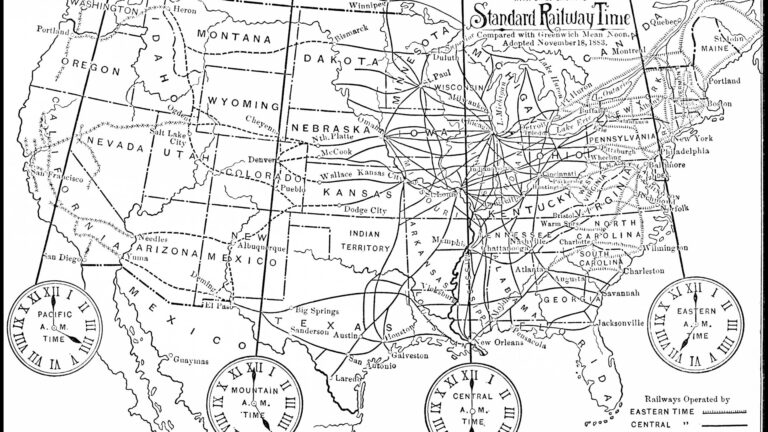
Then we turned our attention to time, examining how local times had to be synchronised so that increasingly large transport and communication networks could operate together.
Finally, we followed the journey of information, exploring how its speed of transmission became increasingly independent of the speed of the object or living being that had previously carried it.
These began as three separate stories. Now we’re going to put them side by side.
For one thing, something similar may have happened in all three. For another, it is even possible that we have been examining three different perspectives on one and the same phenomenon.
And if that is the case, it might be worth finding out what that phenomenon actually is.
A word of warning: we will probably venture into philosophy along the way. But don’t let that put you off. We’ll do our best to explain everything in plain, everyday language.
A Larger System of Smaller Systems
In our story about space, local railways, roads, shipping routes, ports, and stations did not merge into one gigantic transport company. They remained separate systems, but became connected to one another at an increasing number of points.
Nellie Bly was able to travel around the Earth in 72 days because one system could pass her on to the next. She “just” had to get the timetables right…
Something similar happened with time.
Nobody installed a single world clock somewhere in Greenwich and instructed everyone to obediently synchronise their pocket watches, wristwatches, tower clocks, and cuckoo clocks with it.
Instead, common reference points and standards emerged, allowing different places and systems to coordinate their own operations. Separate local times gradually became part of a coordinated global timekeeping system.
We saw the same thing happen with information.
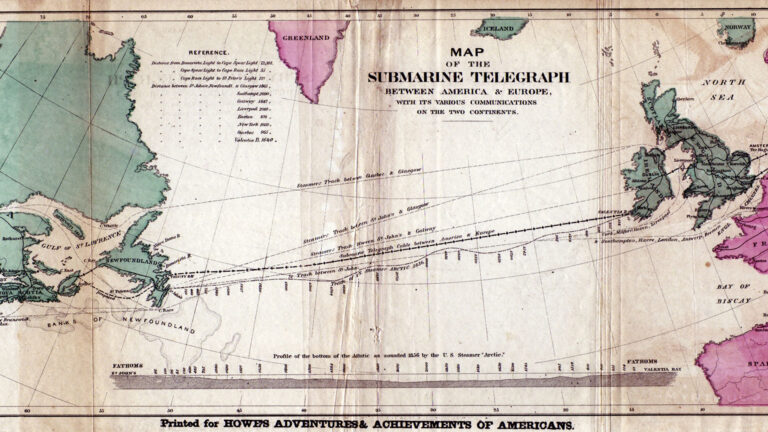
Telegraph networks were connected to other telegraph networks. Later, telephone, radio, and satellite systems were developed, and eventually the internet emerged—a system whose very name refers to networks interconnected with one another.
The important thing was not that every network had to be identical, but that the different networks that had emerged could pass something from one to another.
There is a common pattern here.
Creating a global system does not necessarily require one enormous system spanning the entire world. It may be enough for smaller systems to become accessible to one another.
And that is a little more interesting than simply saying that, somehow, everything has become much faster over the past two centuries.
Places, local times, and information environments that previously operated relatively independently became less and less able to remain separate.
The Earth stayed exactly the same size, but an increasingly dense web of connections developed across it.
Of course, not uniformly, and not for everyone.
Long-distance transport routes are still more accessible from major cities than from isolated villages. Internet access is far from evenly distributed, and political, economic, and technological barriers can still separate parts of the world.
So a “global system” does not mean that every point is equally well connected. It simply means that connections can now extend across the entire planet.
Before we go any further, though, we need to talk a little about Kant.
Forms of Intuition and Other Strange Things
In his Critique of Pure Reason, published in 1781, Immanuel Kant described space and time as the a priori forms of human intuition.
At first glance, that sounds exactly like the kind of sentence that makes people suddenly remember they have something terribly urgent to do somewhere else.
But let’s try to put it more simply—while acknowledging that there are experts who could explain all of this more precisely and in much greater detail than we can.
Kant was not claiming that space and time are two peculiar things floating around somewhere in the world, or simply existing as objects in their own right.
Rather, his point was that, for human beings, everything we experience already appears within a spatial and temporal framework.
We simply cannot experience or imagine anything without space and time being involved.
Imagine a… well, what exactly?
A cube? A point? A tree? A smell? An event?
Whatever we come up with, it already appears in our minds within space and time.
Moreover, space and time are not things we once learned about the world. They are more like conditions—the conditions that make it possible for us to experience the world in the first place.
A priori here means “prior to experience”.
In other words, these conditions are already in place before we have any experience, and without them, we could not experience anything at all.
(Some researchers in the modern study of consciousness also suggest that, besides space and time, something else is necessary for experience—something that may be even more fundamental than either of them.
And that something is consciousness itself, without which experience would not even be possible. Nor could we speak of space or time, because there would be nowhere, nothing, and no one with which or through whom to experience them.
But we won’t go into that now. Perhaps another time—or perhaps we’ll leave it to people far more qualified than ourselves to explore this line of thought in greater detail.)
Of course, we don’t want to drift into attributing claims to Kant that he never actually made.
The railways certainly did not integrate space as an a priori form of intuition, and time zones did not transform humanity’s a priori experience of time.
What humanity built and coordinated over the course of history was human activity within space and time.
We made something shared out of what had previously been separate.
We built routes, reference points, networks large and small, maps, time standards, timetables, and similar systems.
Perhaps it would be more accurate to say that humanity did not unite space and time, but instead placed itself within a shared space and a shared time.
More or less.
London’s noon became connected to seven o’clock in the morning in New York.
A departure from Tokyo could be coordinated with an arrival in Budapest.
Distant locations were no longer related to one another in space and time merely in some theoretical sense. Ordinary human activities could now be organised around those relationships.
And with this development, together with the integration of information networks, a new perspective also emerged—or at least began to emerge—among human beings:
The entire Earth is our home, not merely the part of it we can see with our own eyes.
While we’re on the subject of Kant, there is another idea of his that may be particularly interesting to us.
It might sound a little complicated at first, too, but we’ll do everything we can to make it understandable.
For the countless separate stimuli we perceive, and the representations of them that form in our minds, to become a single, coherent experience, we must somehow connect them.
Kant discusses this through the problems of synthesis and the unity of consciousness: different representations must be capable of belonging to the same experiencing subject.
Put more simply, our brains do not merely collect separate impressions. They connect them so that they become a unified experience.
And for that to happen, there must, naturally, be someone in whom those impressions come together.
And this is where we’re going to venture, very cautiously, into an analogy.
As far as we currently know, humanity does not have a single shared “I think”.
We cannot claim that eight billion people together form one gigantic consciousness, with thoughts and a will of its own.
Even if that were the case, we would hardly be in a position to establish it with certainty. We would necessarily be part of it ourselves, making it rather difficult to observe from the outside.
However, over the course of history, we have created something that did not previously exist in this form: systems through which one person’s experience can become part of another person’s experience.
We do not have to be in the same place, or even be there at the same time.
Increasingly, we do not even have to belong to the same community or culture, or speak the same language.
Nevertheless, the actions and experiences of any human being can potentially affect those of any other person on the planet.
At least in principle.
And this is not something given a priori. It is something we ourselves have created over time.
The Third Layer
So, in philosophical terms, it would not make much sense to simply place “information” alongside space and time, as though Kant had accidentally forgotten to list the internet as a third a priori form of intuition.
We occupy space, and it is within space that we locate everything we know.
Things happen to us in time.
Communication systems, meanwhile, allow something that happened at one particular place and time to enter the experiential world of people elsewhere.
For example, a message sent from London in 1858 reached America in sixteen and a half hours.
In 1967, millions of people on several continents watched the television programme Our World at the same time.
Today, an event recorded on a phone camera can appear within minutes on the phones and screens—and become part of the information environments—of people living thousands of kilometres apart.
They can react to it, forward it, transform it, or build something entirely new from it.
This does not necessarily mean that we will develop a shared consciousness.
But we can become aware of more and more of what is happening in the world, and other people’s experiences can increasingly become part of our own lives.
And this is where Hegel enters the picture…
Hegel and the Feedback Effect
We don’t want to oversimplify Hegel and his work, either.
It would be easy to describe him as the man who sent some vague World Spirit travelling through history to mysteriously realise itself…
But the situation is rather more interesting than that.
For Hegel, the individual and individual consciousness do not exist in isolation.
They exist within a social and historical environment created through other people’s actions, institutions, and relationships.
One way to understand the concept of “objective spirit” is as the world of these enduring social patterns and institutions.
Individuals shape them, but at the same time, they are born into a world that has already been shaped by them.
This is a familiar idea from the perspective of Worldinterflow.
We create a transport system, which then changes where we can live and work.
We establish a standardised timekeeping system, which then determines when we have to go to work, when the train leaves, and when a video conference begins.
We create the internet, and then the next generation grows up in a world where the internet is no longer an invention but part of the environment—one that fundamentally shapes their actions, decisions, and ways of thinking.
The medium shapes what flows through it.
What flows through it, in turn, shapes the medium.
A river shapes its bed, and the changing riverbed redirects the water.
Of course, Hegel did not predict the internet. But he took very seriously the idea that the historical world created by human beings acts back upon the very people who created it.
And we seem to be seeing something rather similar at work here.
A Network of Networks
Modern network science has increasingly turned its attention to the study of so-called multilayer networks.
The reason is simple: complex systems in the real world rarely operate as a single network.
Different networks are connected to one another, and the dependencies between them can produce behaviours that could not be adequately understood by examining any one of the networks in isolation.
Our three stories certainly do not constitute a complete mathematical network model, but it is interesting to look at them from this perspective.
There is a mobility layer, through which people and objects move.
There is a coordination layer, which allows processes taking place in distant locations to be synchronised in time.
And there is an information layer, through which signals, news, knowledge, instructions, images, lies, music, and (of course) cat videos travel.
These layers developed together, in connection with one another.
Faster transport made more precise time coordination necessary, and communication networks were used to achieve that coordination.
Transport operations became increasingly dependent on information systems, while information systems themselves require physical cables, power supplies, factories, ships, and data centres.
The layers became intertwined.
So the end result is not three separate global networks, but a shared system of many networks that are interconnected with one another.
We’re All Individuals
We came across a particularly interesting detail in the history of the internet.
One of the foundational documents describing the internet’s architecture states quite openly that heterogeneity is inevitable, and the system must therefore support it.
Different machines, networks, and technologies can all be part of the same internet without operating in the same way internally.
For them to communicate, however, they need protocols that both sides can understand.
This is a technical design principle, but it’s hard to resist drawing a cautious analogy involving human beings…
And, well, we’re not going to resist.
The integration of human society does not necessarily require every person to be the same. Quite the opposite.
We can be different, with different languages, cultures, histories, ways of thinking, and goals, while still being capable of connecting with one another.
If humanity is increasingly operating within a shared system, it is worth asking how different people and communities can connect with one another while preserving their individual characteristics.
…All right, of course a shared language is not TCP/IP, just as a human being is neither a router nor a computer. There is no point in stretching the analogy until it hands in its resignation.
But one element of the underlying process is similar: communication does not require identical participants, but some kind of mutually understandable protocol or interface.
That might be a language everyone understands.
If not, it could be translation.
It might be a shared system of scientific notation, units of measurement, standards, a legal framework, musical notation, or even a simple, familiar hand gesture.
All right, we probably won’t solve humanity’s social problems with better protocols…
But let’s not throw the analogy away entirely.
Our previous three stories show, at the very least, that integration does not necessarily mean uniformity. Everything does not have to become identical for connections to exist between different parts.
The world’s transport system became global without all its local systems becoming the same.
The internet became global without all its networks becoming the same.
It is therefore possible to have a unified system in which the individual parts retain their differences.
Perhaps compatibility is a more important characteristic than sameness.
When Something Appears That Nobody Planned
Our old acquaintance, emergence, makes another appearance.
We already encountered it in our article about the mosh pit.
A crowd has no central controller. Nobody calculates every participant’s movements in advance. Yet recognisable patterns can emerge at the level of the entire system: vortices, flows, areas of increasing density, and waves.
No individual person is a vortex.
The vortex emerges from the interactions between them.
The concept of emergence has several philosophically distinct interpretations, so we should avoid throwing it around like a magic word.
Here, we use it to refer to higher-level patterns that arise from interactions between components, are not present in the individual components themselves, and are best described at the level of the system.
While we’re on the subject, connecting different networks can also produce phenomena that we could not understand by examining either network separately.
Take a city’s road network, for example.
That is a physical network. A navigation app adds an information layer on top of it.
If a large number of drivers follow the same app and are directed towards the same alternative route during a traffic jam, the result may, in some cases, be that the alternative route becomes congested while the previously blocked road clears up.
A driver who doesn’t use the app might be travelling along quite happily through an area where there should theoretically be a traffic jam (although they have no idea about that), while the drivers who took the alternative route are inching along in frustration through a narrow one-way street.
In such a case, the phenomenon cannot be understood by examining only the roads or only the app.
The two together form the system.
And from here, a few slightly more serious questions arise.
What happens when billions of people, companies, institutions, machines, and algorithms operate within such a dense network of connections that they are constantly reacting to one another?
Can system-level processes emerge that none of the participants planned?
In fact, we already have plenty of everyday examples of this.
Nobody centrally coordinates when a particular expression becomes fashionable, or why that particular expression becomes popular at that particular moment.
No single person decides what makes a video go viral.
Often, it is difficult even to reconstruct afterwards how something became popular in the first place.
As we’ve already mentioned, traffic jams are generally not something anyone deliberately sets out to create.
Nor does a market panic necessarily occur because one person planned it.
The local decisions of many participants can combine to produce a recognisable process at a higher level.
From this perspective, perhaps the truly bold question is not whether some kind of “global consciousness” might emerge, but something along these lines:
Is it possible that emergent processes are already developing at the level of interconnected humanity—processes that nobody designed, yet which shape the entire system?
The Planetary Idea
Over the past few centuries, other people have arrived at similarly large-scale questions—not just us and Hegel.
(It feels pretty cool to mention ourselves and Hegel in the same sentence.)
One example is the concept of the noosphere: the idea that human thought and activity can become planetary in scale.
Several thinkers have explored this possibility from different perspectives.
Pierre Teilhard de Chardin’s interpretation took a more spiritual direction, while Vladimir Vernadsky particularly emphasised the geological significance of humanity and science in transforming the biosphere.
And there have been other approaches as well.
Today, we know that human activity can indeed have effects on a planetary scale.
But this still does not imply the existence of a planetary mind.
A system can be a system without being conscious.
(Unless someone becomes conscious of the fact that the system exists…)
A city does not necessarily have a personality simply because it contains roads, communication channels, people, and recurring patterns.
Likewise, a mosh pit does not have thoughts of its own, yet things happen within it that do not exist at the level of the individual participants.
Perhaps the Decisive Change Is Feedback
Let’s imagine how a piece of news might have spread a few hundred years ago.
Something happens somewhere. Someone hears about it and tells another person, who travels somewhere else and passes it on, and so forth.
The information travels along a chain of intermediaries.
It may change along the way, affect the people who encounter it, and travel through a very long chain indeed.
But its movement is essentially one-directional—or, at least, feedback could travel back to the point of origin only much more slowly and with greater difficulty.
In a globally interconnected world, however, the loop can easily close.
Something happens somewhere, and information about it can reach distant parts of the world almost instantly.
People react to it.
Their reactions trigger decisions and further events, which generate new information.
That information can then travel back to the place where the original process began and change how it develops from that point onwards.
If news spreads that there is a fuel shortage, even though petrol is actually available, people may rush to fill their tanks and create a genuine shortage—which may then affect the person who started spreading the news.
A social media post quickly receives a few likes. The algorithm responds by showing it to more people, resulting in even more reactions, which in turn cause even more people to see it—regardless of why it received that initial burst of likes.
A supporting character in a film becomes a meme, grows more popular than the main characters, the studio naturally hears about it, and before you know it, a spin-off is in production.
The process increasingly loops back on itself.
Information does not merely flow. Feedback is created.
Of course, feedback loops existed long before modern communication networks.
The histories of trade, warfare, epidemics, religions, and cultural fashions are full of them.
What has changed is the speed, density, and geographical reach of the feedback loops that can occur.
From this perspective, we might even say—as a conclusion, not as a measurable historical law—that the speed of historical feedback has increased.
A local event can become a factor in a distant decision in an increasingly short time, and that distant decision can then have consequences for the original location.
Gradually, the sentence with which we introduced Worldinterflow begins to carry more weight:
Currents meet, interact, reinforce, weaken, and shape one another.
And along the way, we have discovered that the environment in which these encounters take place has itself become planetary in scale.
There Are Some Rather Unpleasant Consequences, Too
Based on everything we’ve seen so far, it would be easy—and rather cheerful—to conclude that everything is wonderful.
We’ve connected the world, everyone now knows everything, we all understand one another, and world peace has arrived.
Unfortunately, somebody seems to have forgotten to switch that particular feature on.
Probably humanity.
Just because information reaches somewhere does not mean it is true, useful, or important.
Communication networks can transmit facts, but they can also transmit mistakes and deliberately false claims.
We already saw this in the previous article.
For example, a study published in Science in 2018 analysed approximately 126,000 news stories that spread on Twitter between 2006 and 2017 and had been classified as true or false by fact-checking organisations.
Within the dataset examined, false news spread farther, faster, more deeply, and more broadly than true news.
This does not, of course, mean that “lies always spread faster than the truth” in every communication system.
It does, however, illustrate that success in spreading and factual accuracy are two separate characteristics.
Meanwhile, the sheer volume of information has created another problem.
A study by the University of California, San Diego estimated that in 2008, the average American consumed approximately 100,000 words and 34 gigabytes of information per day, excluding information consumed at work.
(This does not mean that people memorised 34 gigabytes of knowledge. The estimate refers to the volume of data contained in the media they consumed.)
A decade and a half later, researchers were already pointing out that we are exposed to more information each day than we are capable of processing.
Information overload may be associated with problems involving attention, emotions, and decision-making.
In the past, one of the great questions was how to obtain information.
Today, another question is at least as important:
How do we select the information we actually need from an almost limitless supply?
The bottleneck has partly shifted from the transmission of information to human attention.
(More precisely, to the focus of our attention. We’re planning a separate article about how attention works.)
And wherever attention becomes a resource, competition for it emerges.
Online information systems are artificial systems operated by people and algorithms, and their behaviour can be manipulated.
YouTube, for example, has a specific policy prohibiting the artificial inflation of views, likes, and subscriber counts.
Facebook, meanwhile, has spent years attempting to identify and reduce the visibility of posts designed to artificially provoke reactions from users.
The very fact that such rules are necessary shows that, when visibility is determined partly by reactions within a network, there is an incentive to manufacture those reactions artificially.
The network, then, does not simply carry information.
Information about how the network itself works also flows back into the network, and people attempt to use it to influence what happens next.
Which, of course, is another feedback loop.
Connection Also Creates Vulnerability
There is another unpleasant characteristic of interconnected systems.
When systems depend on one another, they can do more than support each other. They can also pass failures from one to another.
Research into interdependent networks has long examined how cascading failures can spread from one system to the next.
In classic models, for example, a failure in an electrical power network may affect a communication system, whose subsequent failure may further disrupt the operation of the electrical network.
The very connections that bring us together can therefore also create shared vulnerabilities.
Transport networks do not move only people and goods. They can move armies, too.
Communication networks do not carry only knowledge. They carry lies as well.
Financial systems do not merely facilitate investment. They can also transmit economic disturbances from one participant to another.
Moreover, the more systems we connect, the more routes become available for the consequences of an event to spread.
Worldinterflow does not carry only pleasant things.
The same information or event, as part of the same process, can have very different consequences for different people.
What creates a new opportunity in one place may cause difficulties elsewhere.
One Network, Separate Worlds
One of the remarkable things about the 1967 television programme Our World was that large audiences on several continents watched the same programme at approximately the same moment.
It was a shared information event.
The following day, people were probably talking about the same thing on buses, in schools, and in pubs.
Today’s internet is technically far more integrated than that system, yet our experiences are not necessarily more shared.
Quite the opposite, in fact.
We are connected to the same worldwide network, but we do not see the same things.
We follow different people, different algorithms select content for us, we read in different languages, and we belong to different communities.
The same event may reach us accompanied by different images, different commentary, different background information, and different meanings.
From the vast quantity of information available, different information bubbles form around us.
This is why it is worth distinguishing between several things.
Shared infrastructure is not the same as shared information.
Shared information is not the same as shared interpretation.
And even a shared experience does not necessarily produce a sense of unity.
We may be more closely connected technologically than ever before, while feeling, on a human level, that we have never been so far apart.
There is no contradiction between the two.
Perhaps they are simply two consequences of the same system.
(We ask our readers to bear with us for just a little longer, because now we’re getting to the really exciting part—the threads are finally beginning to come together.)
When the System Acts Back upon Itself
Let’s return to emergence for a moment.
In a mosh pit, a shared pattern—such as a vortex—can emerge from the movements of many individuals.
But once the vortex has formed, it also influences the movements of the individual participants.
New arrivals enter an already established pattern of movement, while their own movements continue to reshape it.
An emergent phenomenon, therefore, is not necessarily the final result of a process.
It can itself become the starting point for further processes.
This is hardly a new invention, of course.
A community’s customs emerge from the actions of its members, and subsequent generations grow up adapting to those customs.
The members of a community shape its culture, and the culture shapes the members of the community.
But our previous three articles have traced precisely how such interactions have become increasingly independent of geographical location.
A process developing in one place can reach and transform an increasing number of other processes, while their consequences can return to the original location ever more rapidly.
With the integration of space, time, and information, it is not only the number and speed of connections that have increased. The possibility of mutual influence has become planetary in scale.
When Success Changes the Rules of the Next Game
Let’s take a more everyday example.
A film is released in cinemas or on a streaming platform.
The audience responds: people watch it, rate it, talk about it, and perhaps even turn it into memes.
Their reactions reach the filmmakers and distributors, who make further decisions based on that feedback.
If, for example, a particular type of film attracts unexpectedly large audiences, other studios may begin developing similar stories.
But in doing so, they are no longer merely responding to the success of an earlier film.
They are also changing which films audiences will be able to choose from next time.
The audience then responds to those new films, triggering further decisions.
Over time, trends may emerge to which filmmakers and viewers alike adapt, even though nobody originally planned them.
And here comes an interesting twist.
Studios are not necessarily trying to change the whole of film culture.
They are concerned with the success of individual productions, the return on their investments, or keeping their businesses running.
If a sequel to a familiar story appears to be a more predictable investment than a completely new idea, that may influence their decisions.
If simpler content that can be produced quickly is capable of attracting a substantial audience in the competition for attention, producing such content may become economically attractive.
Or, if it is cheaper to make a large number of smaller productions and only a few of them need to succeed, studios may well move in that direction.
The process can thus become self-reinforcing.
More and more content competes for our attention, while creators search for new ways to succeed in that competition.
This may lead to the increasingly frequent reuse of established formulas—but it may also produce previously unimaginable creative collaborations and entirely new genres.
So we cannot claim that feedback necessarily pushes culture in one particular direction.
What is interesting, however, is that the way the system operates shapes not only what people choose, but also what they will have to choose from next time.
And this goes far beyond films.
When Everyone Is Just Doing Their Own Thing
The kind of process we have just seen in the film industry may also occur in other fields.
Participants in different systems generally focus primarily on their own opportunities and goals, rather than on the entire system of which they are part.
A company, for example, may be able to manufacture and sell its products more cheaply while polluting the environment in the process.
What represents a profit for the company may represent a loss for other people and the natural world.
And over time, the changed environment may affect the economy in return: the availability of resources, production possibilities, prices, and human decisions.
The loop closes here, too.
Moreover, such interactions do not necessarily occur in the same place or at the same time as the decisions that set them in motion.
Some feedback loops operate within minutes, while others become noticeable only years or decades later.
As different systems become more closely connected, a change in one area can affect the operation of an increasing number of other areas.
The economy affects the environment, while environmental changes affect the economy.
Economic processes shape technological development, and new technologies change the possibilities for production, communication, and social cooperation.
These many separate processes are not moving towards a single shared goal, yet they increasingly become conditions for one another’s operation.
And something interesting follows from this.
Humanity’s collective activities can set global processes in motion that later shape our lives and opportunities—without anyone having planned them in advance.
This does not require a shared will or central coordination.
It does not even require the participants to want the same things.
It is enough for the processes arising from their decisions to influence the decisions they make next.
From that point onwards, the question is no longer simply how we shape the world.
It is also how the world we have collectively created shapes us.
When the System Gathers Information About Itself
Of course, humanity does not merely participate in these processes. We can also observe them.
We can gather information about how we operate, examine the interactions between different systems, and try to understand the relationships underlying the phenomena we observe.
Consider climate research, for example.
Measurements taken at different locations around the Earth, satellite data, and computer models allow us to investigate relationships that no single person could understand through their own direct experience alone.
And the information produced by this research can feed back into human decision-making.
Our knowledge of the climate may influence how we generate energy, what technologies we develop, how we build our cities, and what economic decisions we make.
These decisions then affect the environment, whose changing conditions we can continue to measure and investigate.
This creates yet another opportunity for feedback.
Earlier, we discussed how processes emerging from many separate human actions can influence people’s subsequent actions.
Now let’s take that idea one step further.
We can also use what we learn about our own behaviour to change the way we operate.
Rather than merely adapting to emerging processes, we can try to identify the interactions that produce them and then consciously modify the conditions under which they arise.
Naturally, this does not mean that we are capable of understanding or controlling the entire system.
No single person knows all the economic, social, cultural, and environmental processes taking place around the world.
Researchers, too, can uncover only certain relationships, and even the best models cannot predict every consequence.
The entire system that constitutes our world is remarkably varied and extraordinarily complex.
Not to mention that our observations are themselves part of the system.
The observer, therefore, does not necessarily stand outside what they are observing.
Information about Worldinterflow is itself part of Worldinterflow.
A System Tries to Understand Itself
And perhaps this is where we arrive at the conclusion towards which our previous three stories have been leading.
The development of global transport, time-coordination, and communication networks did more than make it possible for increasing numbers of people to connect with one another.
It created interconnected systems within which global processes can emerge from the many separate actions of human beings.
These processes affect people in return, changing the possibilities available to them when they act again.
Humanity, however, need not merely experience or participate in these processes.
We can also gather information about them, recognise certain relationships, and use the knowledge we gain to try to change the way we ourselves operate.
It is as though the system is becoming capable of observing an increasingly large part of its own operation and feeding the results of those observations back into its own development.
We are still not claiming that humanity has become a single consciousness, or that the global system possesses a will of its own.
Observations are still made by people, research groups, and institutions—who, moreover, do not always agree with one another.
Rather, the point is that humanity is becoming increasingly capable of observing and understanding its own collective functioning, and of using the knowledge gained in this way to shape it.
And this brings us back to the ideas of Kant and Hegel.
With Kant, we examined the fundamental framework of human experience.
With Hegel, we considered how people shape their shared historical world, which then acts back upon them.
Now, we seem to be seeing that same mutual shaping at work through connections on a planetary scale.
The question, then, is no longer simply how we shape the world.
It is also how we can use our knowledge of our own collective functioning to continue shaping ourselves—and our world.
So Where Do We Go from Here?
We cannot predict where all of this will lead.
But as the world becomes more interconnected, the consequences of our decisions are increasingly less likely to remain confined to the place and time in which we make them.
The effects of a local economic decision may appear on the other side of the world.
A process set in motion today may shape other people’s lives decades, or even centuries, later.
And those consequences may eventually affect us in return—or people who have not even been born yet.
If we consider only our immediate interests and the results we can observe in the short term, we may set in motion or reinforce collective processes that lead to very different outcomes in the longer term than those we originally intended.
And if everyone focuses exclusively on their own immediate surroundings, the operation of the entire system may drift in a direction that nobody actually planned.
But what happens if our thinking follows the same spatial and temporal transformation that our world has already undergone?
What if, before making a decision, we ask not only what its consequences will be for us here and now, but also what effects it might have elsewhere, in other people’s lives, or even decades into the future?
Of course, we don’t have to calculate the future of the entire planet before every decision we make.
Psychohistory still belongs to the realm of science fiction.
But we can try to look beyond our immediate interests and take into account more distant relationships about which we can now obtain information.
And this is where our previous three stories truly come together.
Transport networks made it possible for us to physically reach distant parts of the world.
The synchronisation of time allowed us to organise our activities in different places within a shared system.
Communication networks, meanwhile, gave us a tool through which we can learn about the distant consequences of our own actions and take other people’s experiences into account.
With the integration of space and time, the potential reach of our actions expanded.
The integration of information gives us the opportunity to expand the reach of our thinking to match.
Perhaps this is where one of the most interesting possibilities of global thinking lies.
Not merely in being able to see the entire planet as one interconnected system, but in being able to consider the more distant parts of that system, and its longer-term functioning, when making our decisions.
What we choose to do with that possibility is another story.
And that story, too, will probably have some entirely unexpected consequences.
Sources and Further Reading
Immanuel Kant: Critique of Pure Reason (Kritik der reinen Vernunft)
1781; second, revised edition: 1787.
On space and time as a priori forms of intuition, and the conditions that make unified human experience possible.
Project Gutenberg – Read the complete work in English
Andrew Janiak: Kant’s Views on Space and Time
Stanford Encyclopedia of Philosophy.
An examination of Kant’s conception of space and time in the history of philosophy, and the meaning of a priori forms of intuition.
Stanford Encyclopedia of Philosophy – Read the article
Paul Redding: Georg Wilhelm Friedrich Hegel
Stanford Encyclopedia of Philosophy.
On Hegel’s concept of spirit, the interactions between individuals and their social and historical environment, and the concept of objective spirit.
Stanford Encyclopedia of Philosophy – Read the article
Timothy O’Connor: Emergent Properties
Stanford Encyclopedia of Philosophy.
On different interpretations of emergence, system-level properties arising from interactions between components, and the philosophical questions surrounding their effects on those components.
Stanford Encyclopedia of Philosophy – Read the article
Stefano Boccaletti et al.: The Structure and Dynamics of Multilayer Networks
Physics Reports, 2014.
On the operation of multilayer networks, the connections between different networks, and the system-level phenomena that may emerge from those connections.
PubMed Central – Read the complete study
Brian Carpenter (ed.): Architectural Principles of the Internet – RFC 1958
Internet Architecture Board, 1996.
On the fundamental principles of internet architecture, particularly how networks with different internal structures can communicate through shared protocols.
RFC Editor – Read the complete document
Sergey V. Buldyrev et al.: Catastrophic Cascade of Failures in Interdependent Networks
Nature, 2010.
On cascading failures in interdependent networks and the vulnerabilities that can arise when different systems become interconnected.
Masoud Mansoury et al.: Feedback Loop and Bias Amplification in Recommender Systems
Proceedings of the 29th ACM International Conference on Information & Knowledge Management, 2020.
On feedback loops between recommendation systems and user behaviour, and how these can amplify the advantage of already popular content.
ACM Digital Library – Read the study
Soroush Vosoughi, Deb Roy, Sinan Aral: The Spread of True and False News Online
Science, 2018.
On differences in the online spread of true and false news, based on an analysis of more than 100,000 news stories circulating on Twitter.
Roger E. Bohn, James E. Short: How Much Information? 2009 Report on American Consumers
University of California, San Diego, 2009.
On the volume of media consumed by Americans. The researchers estimated that in 2008, the average person consumed approximately 100,500 words and 34 gigabytes of media data per day, excluding information consumed at work.
Read the complete report (PDF)
Janusz A. Hołyst et al.: Protect Our Environment from Information Overload
Nature Human Behaviour, 2024.
On information overload, the limits of human attention, and how the information environment affects human thinking and decision-making.
Nature Human Behaviour – Read the article
IPCC: Climate Change 2023 – Synthesis Report
Intergovernmental Panel on Climate Change, 2023.
On the global climatic effects of human activity, interactions between natural and social systems, and the scientific observation of planetary-scale processes.