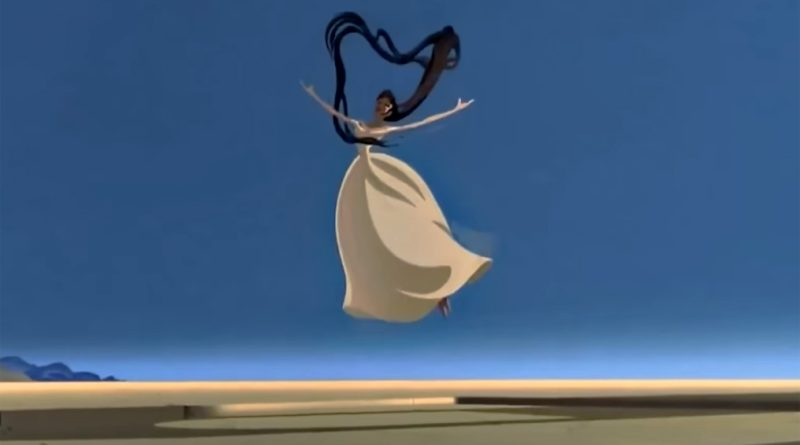
Dalí and Disney’s unfinished film spent decades scattered across drawings, memories and archives, before being brought back to life by a new generation of artists.
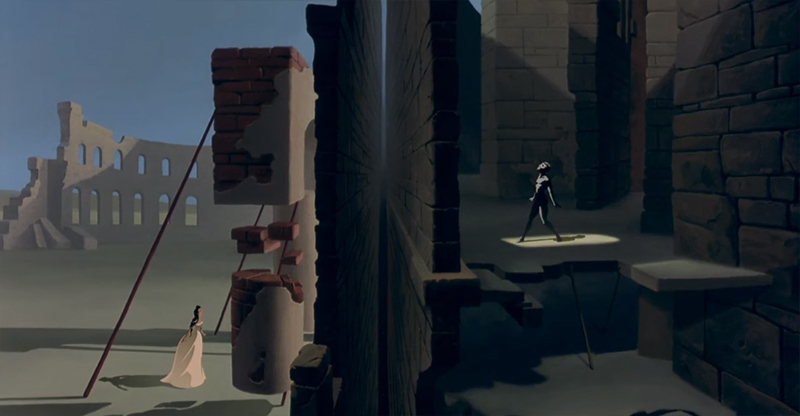
On June 2, 2003, the audience at the Annecy International Animation Film Festival saw a “new”, never-before-seen Disney short. On screen, a young woman wandered through the landscapes of Salvador Dalí: shadows turned into bells, ants became cyclists, a stone statue transformed into a living body, and objects flowed into one another as though no solid boundaries had ever existed between them.
The film had begun taking shape more than half a century earlier. Of its original creators, Salvador Dalí had died in 1989 and Walt Disney in 1966. Yet Destino was not a lost film that had simply been rediscovered in the depths of an archive. It had never existed as a finished film in the first place. What remained were drawings, paintings, story sketches, notes, memories and a few seconds of test animation. A new group of artists used these fragments to create a film in a different era, with different technical tools.
The story of Destino, then, is about much more than the unusual collaboration between Dalí and Disney. It shows what can happen to a work when the process of creating it is interrupted, but the information accumulated within it does not disappear. Instead, it becomes dispersed across different carriers – only to come together again decades later and re-enter the flow.
Dalí and Disney – Two Very Different, Yet Strangely Similar Characters
Salvador Dalí and Walt Disney might seem almost like opposites. One was the most famous figure of European Surrealism; the other was one of the defining architects of American mass-culture animation. Dalí’s paintings often resist any single clear interpretation, while Disney’s studio built accessible stories, recognisable characters and precisely organised, carefully planned visual worlds.
Behind those differences, however, lay a shared interest. Both were fascinated by how technology could make visible things that ordinary perception could not reach. Disney explored new possibilities in sound, colour, cameras and animation. Dalí was interested in photography, film, optical illusions, dream imagery and the transformation of objects. Both also understood that in the modern public sphere, it is not only works that circulate, but creative personalities and the stories surrounding them.
And both made an effort to make their own personalities visible through their work, alongside the stories they were telling.
Their careers had already briefly intersected in 1936 at the Museum of Modern Art in New York, at the exhibition Fantastic Art, Dada, Surrealism, where Dalí’s work appeared alongside images from Disney animations.
Surrealia
Dalí was a master of surrealist painting. But it is worth remembering that cartoons are inherently surreal as well: they are detached from ordinary reality. We may take that for granted today, largely because many of us grew up with them, but one of animation’s possibilities has always been its ability to show us things that simply cannot exist in the physical world.
For a start, animated films were only two-dimensional in the 1940s, while our world has at least three dimensions. Their colours do not necessarily resemble the colours of reality, nor do their forms. Their characters are distorted, and the laws of physics do not affect them as they affect us. The only real limit is the animator’s imagination. An inanimate object can be given a personality and made to move or dance. Anything can transform into anything else; separate things can blend into one another.
And, if the artist wants, dreamlike scenes can be dreamed onto the screen.
In Walt Disney’s early work, he still placed relatively few restrictions on his own imagination – which could be slightly dark, slightly nightmarish. Films could include sequences such as “Pink Elephants on Parade” in Dumbo (1941):
…or a screaming, fleeing-through-the-forest horror sequence in Snow White and the Seven Dwarfs (1937).
Disney probably would not have described himself as a Surrealist.
Dalí, however, did.
Dalí did far more than paint and sculpt. He was also an accomplished designer – he created, for example, the famous Chupa Chups logo – and he used almost every medium available in his era, including cinema.
He co-wrote Luis Buñuel’s Un Chien Andalou and, according to the story, attended its premiere with stones in his pockets in case the audience reacted violently. He also designed sets and nightmare imagery for films by Fritz Lang and Alfred Hitchcock.
Dalí regarded animation as an ideal medium for bringing his art to life.
In a letter to André Breton, one of the founders of Surrealism, he wrote:
“I have come to Hollywood and am in contact with the three great American Surrealists – the Marx Brothers, Cecil B. DeMille, and Walt Disney.”
Their personal connection began after Disney read Dalí’s autobiography, The Secret Life of Salvador Dalí. Disney sent his own copy to the artist, asking for an autograph and suggesting the possibility of a collaboration. The war delayed any joint project, but in 1945 Disney eventually invited Dalí to design a musical animated short.
The planned film was based on Destino, a ballad by Mexican songwriter Armando Domínguez, with English lyrics by Ray Gilbert and performed by Dora Luz. Dalí was already captivated by the title itself – destino means “destiny” or “fate”.
According to the Gala–Salvador Dalí Foundation’s interpretation, the story centres on the love between a dancer and Chronos, the personification of time. The two move towards one another while time, waiting and a constantly transforming world repeatedly keep them apart.
From a Song to Images, from Images to Movement
Dalí officially began working at Disney’s Burbank studio in January 1946. We do not know how much he asked to be paid. Disney revealed only this:
“He was expensive.”
Their descriptions of what the film was actually about differed – just a little.
Dalí called it:
“A magical exposition of the problem of life in the labyrinth of time.”
Disney described it as:
“Just a simple story of a girl in search of her real love.”
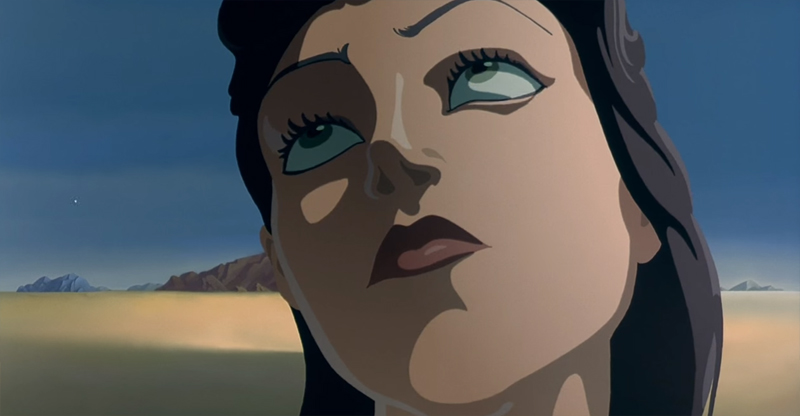
The original contract was for two months, but development continued. According to surviving records, they worked together for around three months. Dalí collaborated with Disney artists including John Hench and Bob Cormack, creating images, scene sketches, paintings and story treatments while considering both animated and live-action solutions.
The collaboration did not simply involve Dalí handing over paintings for the studio to make move. The participants had to create a shared visual language. Which must have been a rather extraordinary challenge.
In Dalí’s paintings, a female body can simultaneously be a landscape, a statue or a shadow. The features of a face can suddenly rearrange themselves into objects, while objects can combine to form a face. Space does not necessarily follow the laws of the physical world; it follows the associations of dreams.
Animation appears almost perfectly suited to this – except that these transformations now had to be organised in time. The filmmakers had to decide what would emerge from what, how one form would transform into another, and how the viewer’s attention would be carried onwards to the next image.
Dalí’s motifs thus entered Disney’s animation system. Animation, in return, gave Dalí’s imagery a new property: it could show the process of transformation itself.
The Work Ends
The collaboration was not without tension.
According to The Walt Disney Family Museum, as the work progressed it became increasingly clear that Dalí and Disney thought differently about storytelling. Disney was looking for a dramatic progression that audiences could follow, while Dalí thought in visual connections that did not necessarily obey conventional narrative logic.
Financial circumstances certainly played a role as well. Disney’s company was $4.3 million in debt and could no longer afford to employ Dalí – who, judging not only from Disney’s comment but also from his later involvement in Alejandro Jodorowsky’s unrealised Dune project, did not work cheaply. The company was also losing interest in the kind of short-form package films for which Destino had originally been intended.
There were rumours that clashing egos may have contributed as well – that in a sense the two major artists held up a mirror to one another, and mirrors do not only show us the parts of ourselves we like.
Disney later addressed the issue in correspondence with one of his biographers:
“I consider [Dalí] a friend, a very swell guy and a person whom I thoroughly enjoyed working with. Our association with him was a happy one for all concerned. It was certainly no fault of Dali’s that the project we were working on was not completed – it was a case of policy changes within our distribution plans.”
The work gradually came to a halt; The Walt Disney Family Museum places the end of the process around 1948. Dalí and Disney’s relationship, however, continued. They kept meeting and discussed other possible films together, including Don Quixote and El Cid, although neither project was ultimately realised.
When a Work Becomes Scattered
At this point, around 1948, Destino ceased to exist as a single continuous creative process. It never became a film that could be shown, but neither did it disappear completely. The information belonging to the work spread across different places and different carriers.
Dalí had created 22 paintings and 135 storyboard images.
Hench had made story sketches.
Written treatments and notes survived.
The song remained, around which the images had been developed.
There was a short animation test.
And various materials remained both in the Disney studio collection and with Dalí, eventually becoming part of his foundation’s holdings.
And, of course, the memories of the people who had participated in the project also preserved information accumulated during the work.
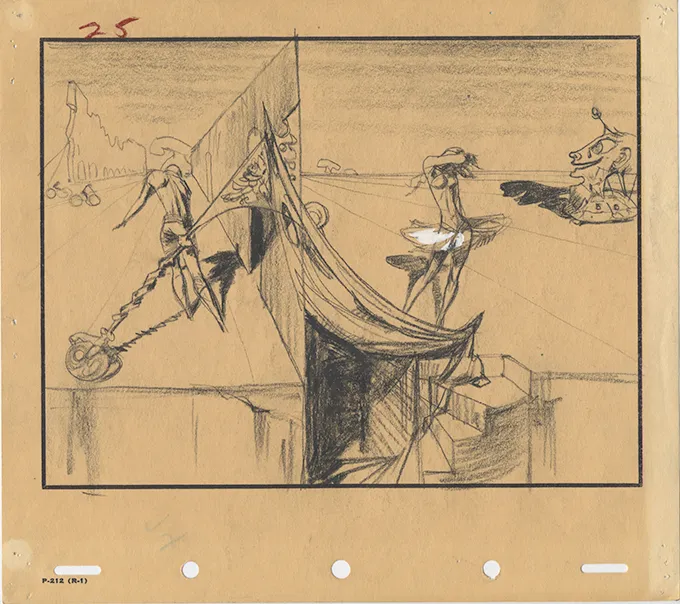
The Gala–Salvador Dalí Foundation holds, among other things, an oil painting, a watercolour, preparatory drawings and photographs documenting the creative process. Disney retained additional paintings, story sketches and an animation test of approximately 15–18 seconds made by John Hench. When work on the film later resumed, around 150 usable images and designs were available, while other material had meanwhile disappeared or entered private collections.
So Destino became scattered.
And that is not merely a poetic way of putting it. It literally became dispersed: it lost its shared space and its active creative process. None of the surviving pieces contained the entire film by itself.
The paintings preserved colours, forms and fragments of the visual world, but did not necessarily tell anyone how those forms were supposed to move. The sketches preserved relationships and sequences, but did not constitute a completely final story in every detail.
The animation test demonstrated one possible form of movement, but only for a few seconds. The participants’ memories could help with interpretation, but memories fade over time – and, if individual memory can itself be understood as a flow of information, those memories also transformed.
During this period, the film both existed and did not exist. There was no finished work that anyone could watch, yet something remained present in the relationships between the surviving fragments.
Perhaps we could say that it survived as a possibility: a pattern from which, under the right circumstances, a creative process could begin again.
Its fragmentation also made it vulnerable. Something preserved only in a person’s memory can disappear with that person. A lost drawing can no longer be passed on. Whether an archive survives depends on institutional decisions, funding, organisation and attention – in other words, it is affected by other information flows as well.
Destino did not survive the decades as some unchanged spirit capable of protecting and preserving itself. Some of the information that had constituted it survived.
Some of it was probably lost forever.
Fifty Years of Nothing – Or Was It?
The story of Destino is often told as though the abandoned film simply sat on a shelf for nearly sixty years until Roy E. Disney happened to discover it and decided that it might be worth finishing.
Reality was more complicated.
For a long time, the project certainly made no progress towards becoming an actual film. But the information connected to it continued to take part in other flows.
Dalí’s images continued circulating through art history and popular culture. His reputation rose and fell; his motifs resurfaced, were transmitted, disappeared and resurfaced again. Disney’s visual language of animation continued to develop and influence how generations imagined and represented things. Surrealism became embedded in film, advertising, music videos and animation.
The encounter between Dalí and Disney itself also became a cultural story: an example of how much more permeable the boundary between high art and the entertainment industry can be than we often assume.
Meanwhile, John Hench, one of the original collaborators, continued working for Disney. When the project resurfaced decades later, the new team could rely not only on documents, but also on a living participant in the original creative process.
This created an especially important bridge. Hench’s memory connected the work of the 1940s to the artists of the 2000s.
In the meantime, the work itself had acquired a different meaning. In the 1940s, it might have become one segment of a planned musical feature. By the turn of the millennium, it had become an art-historical rarity, a legendary unfinished collaboration, and part of Disney’s own institutional history.
Time had not merely carried the material farther away from its original creators. It had changed – and in a certain sense increased – its cultural value.
The Scattered Pieces Meet Again
Roy E. Disney, Walt Disney’s nephew, began taking a serious interest in Destino again in the late 1990s, around the time of Fantasia 2000. The task of completing the project was entrusted to Disney’s French studio. Dominique Monféry became director, Baker Bloodworth producer, and around twenty-five artists worked on the film.
Monféry initially did not want the job.
His concern was understandable: how do you finish a film by Dalí and Disney when neither Dalí nor Disney is there to tell you what they wanted to see?
The surviving material did not amount to a complete screenplay and finished visual concept simply waiting to be executed. The team had to interpret the relationships between the drawings, arrange fragments into sequences, give movement to static images, and connect surviving motifs with newly created scenes.
Monféry repeatedly reworked the original storyboard sequences, while the filmmakers also made use of Hench’s advice and documents associated with Dalí.
The team worked primarily with traditional hand-drawn animation in order to preserve the visual character of the 1940s, but computer technology was used in certain scenes. Three-dimensional tools helped create spatial camera movements and the rotation of some objects. Digital technology was not introduced as a spectacle in itself, but as a new tool for realising an older visual idea.
The filmmakers also abandoned the conventional outlines around characters so that the figures would fit more naturally into Dalí’s forms built from light and shadow.
Transformation became one of the film’s most important devices. One image does not simply disappear so that another can replace it. It directly transforms into the next.
The technique can also be read as a metaphor for the history of the film itself. Just as the images flow into one another, Destino itself changed form: from song into drawing, from drawing into plan, from plan into archival material and memory – and finally back into moving images.
Who Made Destino?
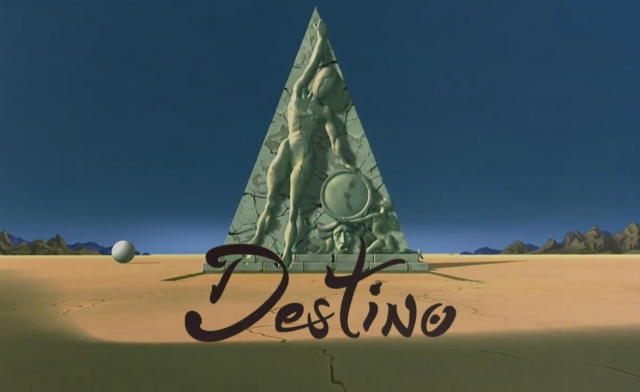
The credits of the 2003 Destino carry the names Dalí and Disney – and they are certainly exciting names to place at the beginning of a short film – but the finished work cannot really be considered the work of those two men alone.
John Hench and Bob Cormack helped shape the original visual system. Roy E. Disney initiated the new production. Dominique Monféry, Baker Bloodworth and the staff of the Paris studio transformed the surviving material into an actual film.
That does not diminish the importance of Dalí or Disney.
Instead, it shows how many human and institutional connections may be involved in the creation of a work.
And there is another interesting question: when exactly was Destino made?
There is no single moment in the history of this film that we can point to and say: this is when it came into existence.
Its creation stretched across different eras. A Mexican song travelled to Hollywood. Dalí’s visual thinking met the animation expertise of the Disney studio. Their collaboration stopped, and the material became scattered. Archives and people preserved parts of it. Memories changed.
A later group of artists created connections between the fragments again, while adding their own decisions and technical possibilities that had emerged in the meantime.
Throughout that entire process, the film was continuously being born.
Why Was It Eventually Completed?
There is no single answer that explains everything. Many similar projects remain unfinished forever. Destino became a film because of a chain of decisions, encounters and favourable circumstances.
Enough of the original material had to survive. Had different fragments survived, a different film would almost certainly have emerged.
Institutions had to preserve the materials for decades. If even one of those institutions had disappeared, burned down or lost its collections, either a different result would have emerged – or there might have been no film at all.
It also mattered that John Hench was still able to provide a direct connection between the original and the new creative processes. Without him, a link to the original creators would have been lost.
A decision-maker was needed: Roy E. Disney, who saw the project not merely as an archival curiosity but as a film that could actually be completed.
A new group of artists was needed, willing to take responsibility for interpreting the surviving material.
And they needed technical tools capable of turning Dalí’s complex transformations of space and form into animation.
The film finally premiered at Annecy on June 2, 2003, before appearing at festivals and in limited theatrical distribution. It was nominated for the Academy Award for Best Animated Short Film at the 2004 Oscars. It did not win; the award went to Adam Elliot’s Harvie Krumpet.
The Work as a Flow System
It is easy to think of a work of art as a closed object: a book, film, image or piece of music with an author, a date of creation and a final form. At some point it came into existence, and from then on it simply is what it is.
The story of Destino suggests something else.
The information that constituted the work was distributed among people, images, sounds, documents, technologies and institutions. Some parts disappeared, while others survived. The meaning of the surviving elements changed along the way: something that had once been a working sketch later became a historical document, then material for a new film.
The carriers of information were not passive storage devices. Each preserved, selected and transformed information in a different way.
The song gave the images rhythm in time. The drawings preserved forms and colours. The animation test demonstrated one possible direction for movement. Hench’s memory created a personal link between two creative eras. Archives prevented the fragments from becoming completely disconnected from one another. The new animators made decisions and created connections even where the original plans no longer provided a clear answer.
Across the roughly sixty-year history of Destino, then, it was not one unchanged work travelling through time. Different pieces of information continued moving onwards, partly separated from one another.
When they eventually met again, they were already being shaped by a new historical and technological environment. Their encounter produced a film that simultaneously carries ideas from the 1940s and decisions made in the 2000s.
Destino did not defeat time.
It became connected to it.
Much like the dancer and Chronos in the film, it was less a matter of overcoming one another than overcoming the obstacles between them so that they could finally meet.
Time transformed the film, scattered it, gave it new meanings, and eventually created the conditions in which other people could connect its pieces again.
Sources and Further Reading
The Walt Disney Family Museum: Walt Disney Treasures – Salvador Dalí
The Walt Disney Family Museum, 2024.
On the relationship between Dalí and Disney, the beginning of their collaboration and the end of work on Destino.
The Walt Disney Family Museum – full article
The Walt Disney Family Museum: Disney and Dalí – Architects of the Imagination
Exhibition background material, 2015.
On the parallel creative paths of Dalí and Disney, their interest in technology, and their collaboration.
The Walt Disney Family Museum – exhibition background
Fundació Gala–Salvador Dalí: Dalí + Disney = Destino
Fundació Gala–Salvador Dalí, 2010.
On the original material preserved by the Foundation, the song, the characters and the 1946 creative process.
Fundació Gala–Salvador Dalí – full background article
Bill Desowitz: Channeling Dalí to Make “Destino”
Animation World Network, September 29, 2003.
On the visual, narrative and technical solutions used in the 2003 film, including accounts from Dominique Monféry and other members of the production.
Animation World Network – full article
Bill Desowitz: Disney/Dali’s Completed “Destino” Kicks Off Annecy Fest
Animation World Network, May 31, 2003.
On the revival of the project, Roy E. Disney’s role, the surviving material and the Annecy premiere.
Animation World Network – full article
Kendra Mayfield: Disney Animates Dalí’s Flick
Wired, September 12, 2003.
On the surviving drawings, John Hench’s contribution, and the combination of traditional and digital animation.
Academy of Motion Picture Arts and Sciences: The 76th Academy Awards
Oscars.org, 2004.
The official record of Destino’s Academy Award nomination and the result of the category.
Oscars.org – the 2004 ceremony
D23 – Walt Disney Archives: Destino Premieres at Annecy International Film Festival
D23, Disney Archives.
On the film’s world premiere on June 2, 2003.
Destino: Egy Salvador Dalí – Walt Disney animációs film története
jammer.hu
The original, somewhat more subjective and less Worldinterflow-oriented version of this article.