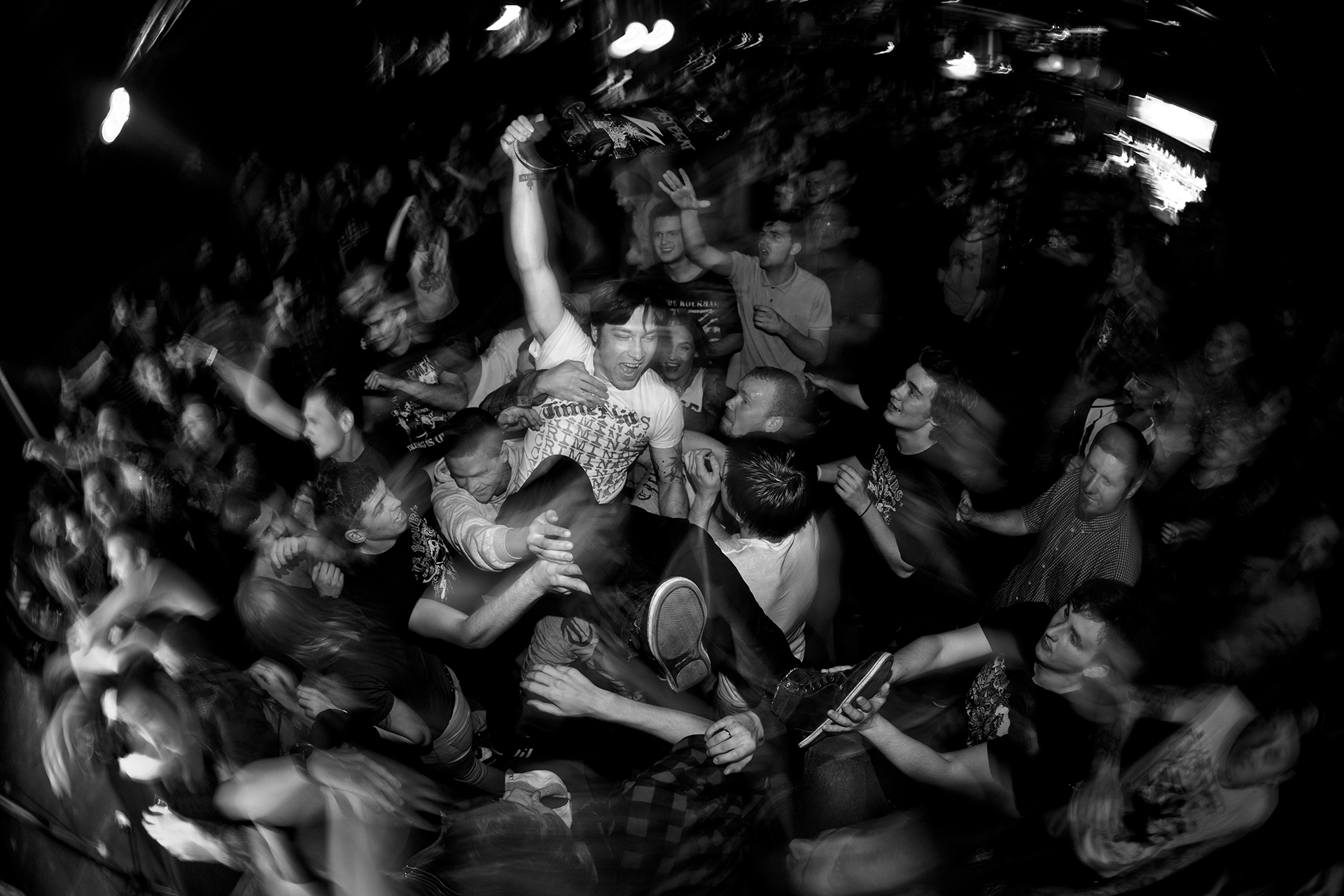
From the outside, a mosh pit may look like a chaotic mass brawl. In reality, it is a communal space operating according to its own rules. What happens when people temporarily enter a different system of rules?
Terms
Pogo: A form of dance associated primarily with early punk culture, in which people mostly jump vertically in place, usually with their feet together or close to each other. It can be regarded as one of the direct movement-culture predecessors of the mosh pit.
Cambridge Dictionary
Mosh pit: A more or less clearly defined area within a concert audience where participants move intensely and usually unpredictably, colliding with, pushing and redirecting one another. The term refers both to the space itself and to the form of collective movement that develops within it.
Cambridge Dictionary
Circle pit: A more organised version of a mosh pit in which many participants run or move in the same direction around a circle, creating a vortex-like formation in the crowd.
https://meetings-archive.aps.org/mar/2013/w44/10/
Slam dancing: An intense form of dancing associated with punk and hardcore concerts, in which participants use energetic, flailing movements and deliberately collide with or push one another. The term was used mainly for early forms of moshing in the 1970s and 1980s, and its meaning partly overlaps with what later became known simply as moshing.
https://www.merriam-webster.com/dictionary/slam%20dance
For a long time at a concert, everyone remains more or less in their own place. They watch the stage, nod to the beat, jump around, perhaps move within a small area. Then somewhere in the audience, a gap opens up. A few people step inside, start moving faster, collide with one another, bounce away and change direction. The people around them move back, the space expands, and the number of interactions and collisions begins to increase.
A few moments later, something exists that did not exist before.
A mosh pit.
From the outside, it can look like an uncontrolled mass brawl. People run into each other, push and shove, and occasionally fall over. From the inside, however, something quite different is happening. The participants – at least most of the time – do not see one another as opponents. They jump and shove around freely in a strange moving mass. A collision is not necessarily an attack here. It can be an experienced movement, a connection, or in a certain sense an impulse being passed onwards.
Those inside are, ultimately, all shaping the same shared event.
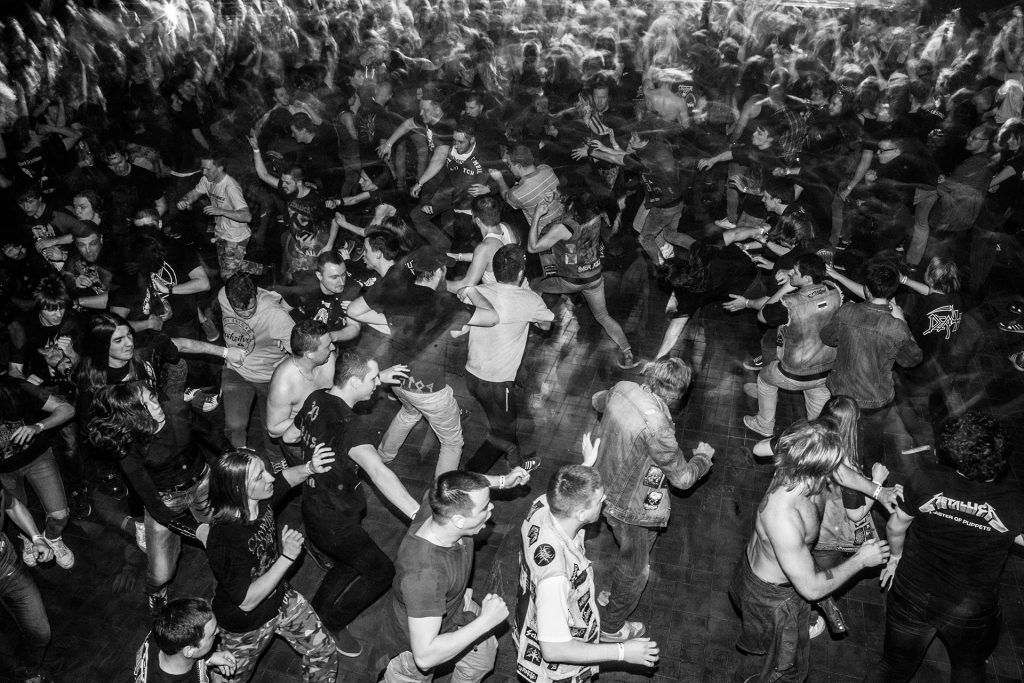
At first glance, a mosh pit is complete chaos. Experiencing it from inside can often feel that way too. But from a little farther away, something else becomes visible: order emerges among people who have no leader, no shared plan and, in most cases, do not even know one another.
We first came across the phenomenon through a post on the Facebook page of the Hungarian magazine 4BRO.hu. From there, we began looking further, because the chaos forming in the middle of a concert raises a much broader question:
How can the movements of many separate individuals form a larger system that none of them designed, yet all of them become part of?
When Music Passes Through People
The direct cultural predecessors of modern moshing can be found among the movement styles of punk concerts in the 1970s. Pogoing, based largely on simple jumping, was followed by slam dancing in the American hardcore punk scene, gradually developing into a more intense style involving physical collisions. From the 1980s onwards, this form of movement – which is neither quite dancing nor quite anything else – spread beyond different branches of punk into metal concerts as well, developing new variations along the way.
Its history cannot be traced back to a single inventor or concert – or at least we have not found one. It is probably closer to the truth to say that it was shaped by several musical scenes, interacting audiences and movement cultures.
That history is already an information flow.
Someone sees a movement, adopts it, passes it on and modifies it. With different music, a different audience or a different physical space, it appears in a slightly different form. Something that began as a completely spontaneous and uninhibited reaction at one concert later becomes a recognisable cultural form.
Often, nobody explicitly explains to a newcomer how they are supposed to behave. (“Listen, mate, this is a mosh pit. We’re going in there now, and this is exactly what you’re supposed to do…”)
Instead, they watch the others, enter the system, perceive its feedback and learn its rules while moving. It is also possible that some of these rules do not need to be learned at all, because they reflect instinctive – in other words, biologically embedded – forms of behaviour.
The information is transformed several times during the process. If we begin our investigation only at the point where the band plays music – without asking how that music itself came into existence, what it developed from, what transformations it has undergone and so on – then our story begins with music coming from the speakers.
Its physical component, the sound wave, reaches the ear and the body. The nervous system perceives rhythm, speed, tension and emphasis. This creates an impulse to move.
If the person who feels that impulse actually moves – rather than suppressing it as they might under other circumstances, for example in the street or at work – their moving body comes into contact with other people who, let us assume, are also moving. They redirect them, transfer some of their momentum, move together and so on. The other people’s reactions then act back on them.
In simplified form, the process looks something like this:
sound → perception → movement → collision → collective pattern → new individual movement
The music, then, does not stop with the listener.
It passes through them and continues in the body of the next person.
Disordered Gas and Human Vortices
In 2013, Jesse Silverberg, Matthew Bierbaum, James Sethna and Itai Cohen of Cornell University published a study on collective movement in mosh pits and circle pits. They analysed publicly available concert videos and then created a simplified agent-based computer model.
They identified two characteristic states.
In a conventional mosh pit, participants move in a disordered way, collide with one another and are then redirected. In one of the recordings analysed, the distribution of people’s movement speeds resembled the velocity distribution of particles in a two-dimensional equilibrium gas.
(A “two-dimensional gas” means that the particles’ movement is restricted to a plane: they have two spatial coordinates and two velocity components. One example might be particles moving in a very thin layer, or a granular “gas” moving across a flat surface.)
The circle pit, by contrast, appeared as an organised, vortex-like form of collective movement. The researchers were able to reproduce it with the same agent-based model when they increased the tendency of individuals to align their movement with those around them.
In other words, the same model generated a circle pit under different conditions. When individuals aligned themselves more strongly with nearby moving participants, the disordered collisions developed into organised circular motion.
Naturally, none of this means that people actually behave like gas particles.
The physical model deliberately omitted everything that makes a human being human: musical taste, emotions, cultural knowledge, fear, trust, moral decisions – and, indeed, the simple fact that a person is not a gas particle. Especially not a simulated one.
The purpose of the study was simply to examine what kinds of collective movement can arise from a few simple local interactions.
The model contained active and passive participants. Active agents moved independently, repelled one another when they collided, aligned their motion to some extent with nearby agents, and were also redirected by random influences. Passive agents moved less and formed a boundary around the active group.
From these relatively simple conditions, both the disordered gas-like pit and the organised vortex emerged in the simulation. No individual participant received an instruction to create a larger formation. Everyone responded only to their immediate surroundings, yet the system as a whole developed a recognisable structure.
This is emergence.
More Is Happening Than Anyone Is Doing Individually
We call a phenomenon emergent when it arises from interactions between the components of a system, but a property of the system as a whole cannot simply be reduced to the independent properties of one of its components.
One person can run, jump, push or change direction. But one person cannot form a mosh pit alone. Not because they lack the strength, but because the defining feature of the pit exists in the relationships between the participants, not within any single participant.
The same applies to a vortex. A single water molecule does not form a vortex in the sense that the water in a river or a drain does. The vortex arises from the relative movement of many particles. Remove the relationships between them, and the vortex itself disappears.
In the case of a mosh pit, moreover, the components can perceive the system they are creating and react to it.
When someone enters the pit, they are not moving through empty space. They perceive which way others are moving, how dense the crowd is, where a push may come from, where a gap has opened and where circular motion has begun to form. Through their own movement they shape the system, while the system continuously shapes them in return.
The participants therefore create something that subsequently becomes a new condition for them.
Individual movements create the pit, and the pit that has formed then defines the possible movements of the individuals.
This feedback is what makes the phenomenon particularly interesting. The system is built out of individual actions, while at the same time becoming their constantly changing environment.
How Does the Circle Come to Life?
Imagine that a few people in a pit begin running in roughly the same direction. People nearby move aside or join them. Those arriving afterwards encounter a direction of movement that already exists – or perhaps simply a gap in the crowd into which their bodies can fit – so following it requires less effort than moving in another direction.
Meanwhile, the more passive audience surrounding them forms a boundary, redirecting participants who drift outwards back towards the centre.
Every new person who joins reinforces the direction. Individual choices gradually become a shared path, and the shared path increasingly makes it likely that the next person will move in the same direction.
A small initial deviation is amplified.
In a real circle pit, however, cultural knowledge plays a role alongside physical dynamics. Experienced concertgoers recognise what is beginning to happen. They know what it means when several people start running in a circle, or when a performer encourages the audience to begin circular movement. The existence of a familiar pattern can accelerate and stabilise the formation of the system.
The phenomenon is therefore both spontaneous and learned.
A physical system forming in the present meets information arriving from the past.
The circle is not merely movement. It is a transmitted cultural form, recreated – and occasionally modified – every time it appears.
Those Who Stay Outside Shape It Too
One of the most interesting results of the Cornell model was the separation between active and passive participants. Active agents moved in the central area, while passive ones remained around them and formed something resembling a wall.
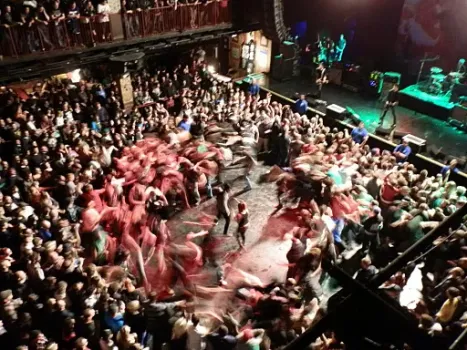
In a real pit, the people standing around its edge often perform a similar role. They absorb or redirect outward movement, maintain the shape of the pit and separate the intense zone from the rest of the concert audience. They also make entry and exit possible: a person passes through this wall to enter the movement, or uses it for support when trying to leave.
The pit therefore does not consist only of the people colliding in the centre. Those who appear to remain outside are also part of the system.
In other words, a flow is shaped not only by what moves through it, but also by whatever contains, redirects, slows or reverses it.
The shape of a river is determined not only by the water but also by its bed. The shape of a pit is determined not only by the moving people but also by the crowd surrounding them. Remove that boundary, and the central system would spread out, take on a different form, or disappear entirely.
Passivity, therefore, does not mean having no effect. Someone who does not directly participate in the flow may still create one of the conditions that make it possible.
From the perspective of Worldinterflow, it is worth asking to what extent this applies to information flows in general.
A Different System of Rules
Inside a mosh pit, movements become acceptable that would usually signal conflict in everyday life. Pushing a stranger in the street would generally be considered an attack. In the pit, the same movement is part of the shared game.
If someone fell over in the street, many people might hesitate, assess what was happening or simply continue walking. In most pits, a person who falls is immediately helped back up. Someone who appears unwell, injured or simply exhausted is quickly helped towards the edge.
So the pit is not a place where rules disappear.
A different system of rules comes into effect.
In ordinary social space, predictable movement, physical distance and respect for personal boundaries allow large numbers of strangers to use the same space safely. Social distance forms a kind of bubble around the individual, into which we are reluctant to allow people we do not trust.
The pit is organised around a different task. Intensity, contact, risk and collective movement become central, and this requires different norms.
Collisions are allowed; deliberately injuring someone is not. (People behaving aggressively are often pushed out of the pit.)
You can take risks, but you have to pay attention to the condition of those around you. (Even in very wild pits, there is often a certain degree of care in the way people collide.)
Someone who falls must be helped up, and someone trying to leave must be allowed to do so. (We look after one another.)
And the choice of those standing outside the pit must be respected. (We do not drag someone into the middle who has not chosen to go in.)
The authors of the Cornell study also mention the instruction regularly heard at concerts: if you see someone fall in the mosh pit, pick them back up. They interpret this as a simple local rule that can influence the safety of the larger crowd.
We do not know precisely where this rule originated. Our assumption is that it may have become one of the pit’s fundamental norms because without it the system would not remain sustainable for very long. If falling were extremely dangerous, and everyone who reached the ground were trampled, fewer people would be willing to surrender themselves to the movement.
A participant can give up complete control over their own balance for a moment only if they trust the community to support them when necessary.
But we have also seen people apply this unwritten rule who had never heard that such a rule existed. So it is possible that the behaviour is simply instinctive. One of our group falls to the ground; naturally, we protect them, because they are one of us.
This may be true when we are not inside the pit completely lost in our own heads – which also happens, sometimes resulting in injury or even tragedy – but instead experience ourselves as components of a larger mass.
The other person is just as much a part of that mass as we are. Protecting them then becomes natural.
(We will not go into stage diving or the wall of death here – where the crowd splits into two halves at the instruction of a member of the band and then, on command, charges towards the opposite side. These are also real movement forms at certain concerts, but they present a somewhat different picture from an ordinary mosh pit.)
Why Leave Everyday Order at All?
Everyone occasionally enjoys suspending the ordinary rules of everyday life. We have many ways of doing this, and going to concerts, dancing or dissolving into a crowd are only a few among countless possibilities.
We do not do this because everyday order works badly. In a certain sense, we may do it precisely because that order does its job so consistently.
Ordinary social space keeps bodies apart, regulates touch, directs movement along predictable paths and dampens strong physical reactions. There are enormous advantages to this. Without it, life in a large city, public transport or even a crowded shop would become a constant series of conflicts.
But this order leaves relatively little room for intense, immediate and reciprocal physical connection. We live among large numbers of people while trying, whenever possible, not to touch them. We constantly perceive one another while maintaining invisible boundaries.
Which is not necessarily all that natural either.
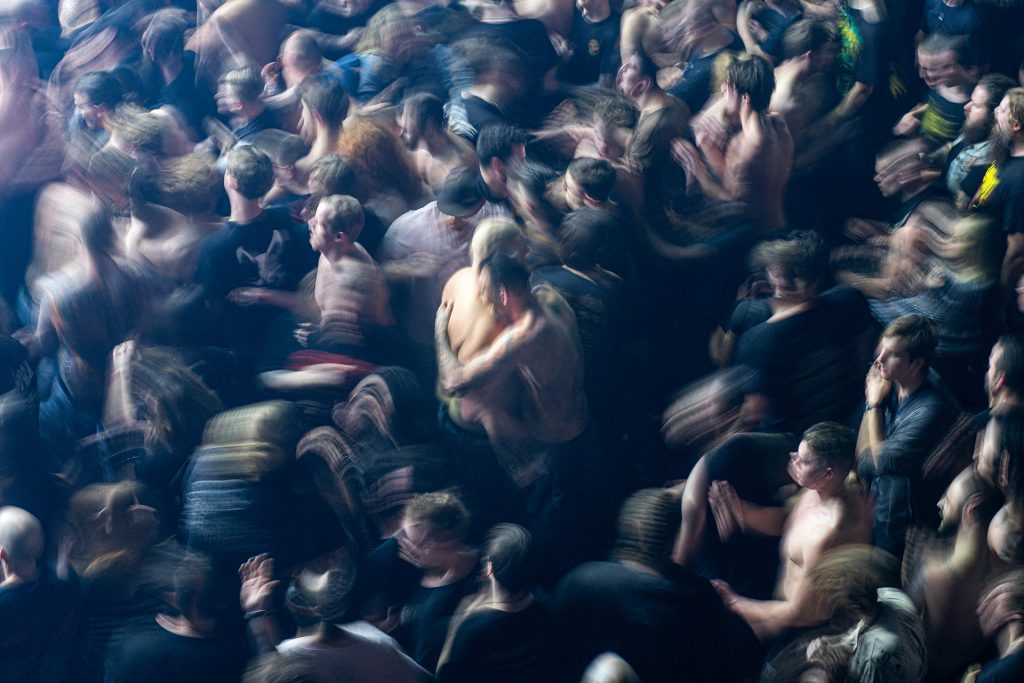
Within a separate space, the mosh pit temporarily rewrites this rule system. Anyone who enters accepts that their movement will shape the movement of others, and that anyone else may touch them in return. They receive pushes, pass momentum onwards, support others, move aside and drift.
The individual is no longer simply standing inside a crowd. Their body becomes one of the media through which the movement of the crowd is transmitted.
Everyday rules allow us to live next to one another.
For a short period, the rules of the pit allow us to move through one another – to move together while physically touching.
Touch and Distance
Both physical contact and the need for personal space are part of human social behaviour.
Physical proximity, grooming, play and other forms of bodily contact play important roles in the social relationships of other primates. Biologically speaking, we are primates ourselves. Touch also communicates emotions and relationships between humans, and we have a natural need for it – even if we believe we need absolutely none of it and would be perfectly happy sitting as far away from everyone as possible, alone in a room in a house behind a computer.
At the same time, just as with other primates, unwanted proximity can feel threatening or unpleasant. Regulation of personal space partly relies on automatic neural processes, while the desired distance depends on the relationship, environment and meaning of the situation.
So this is not simply a case of artificial rules of civilisation completely suppressing some natural desire for contact. Humans are capable both of seeking closeness and of maintaining distance. The social situation – and ultimately the individual – determines which of the two is appropriate.
What makes the mosh pit unusual is that direct bodily contact becomes completely acceptable even between strangers. The touch is rarely gentle or intimate. It appears instead as pressure, collision, resistance and loss of balance.
Yet it is still communication.
Through their own body, a participant perceives where the group is moving, how much force another person is carrying, when someone needs to be supported and when a path has opened for movement.
We might even say that the music becomes tangible.
It is not the drums or bass directly creating the vortex, but the way the participants’ bodies translate the music into movement and then pass that movement onwards to one another.
An Ancient Ritual in Modern Form?
The mosh pit is a modern phenomenon, so we cannot claim that it is the direct descendant of some ancient ritual. But the basic situation is old. For thousands of years, people have created separate spaces in which music, rhythm and collective movement temporarily establish different rules, while individual reactions organise themselves into a shared state.
In that sense, we might say that the need to which the mosh pit responds is ancient.
In ancient Greek stories and artistic representations connected to Dionysus, the Maenads enter ecstatic states while dancing to music and song. Much of what we know about them comes from mythology and art, so these depictions should not be treated as precise descriptions of actual rituals. They do nevertheless show that Greek culture recognised ritual situations in which the ordinary rules of behaviour and self-control could temporarily be transformed.
The connection to the mosh pit lies not in the specific movements but in the process: participants adopt one another’s rhythm, reinforce it through their own reactions, and are then affected in return by the collective state they have created.
A similar interaction has been observed in the fire-walking ritual at San Pedro Manrique in Spain. Researchers found that changes in the heart rates of fire-walkers and spectators closely connected to them became partly synchronised. The shared state was not limited to those performing the central act of the ritual: through emotional relationships and shared attention, it extended to people standing around them as well.
This is reminiscent of the people standing at the edge of a mosh pit. They may not be running or colliding, yet their presence and reactions still help shape the system as a whole.
In different forms of the Sufi dhikr, repeated religious formulas may be combined with collective singing, breathing, swaying or other rhythmic movement – sometimes even circular movement resembling a circle pit. The best-known whirling practice, the Mevlevi Sema, is far more regulated and serves a very different purpose from a mosh pit, yet there is a similarity in its underlying structure: the individual body becomes part of a larger musical and movement process.
The participant sustains the ritual, while the already established ritual order simultaneously shapes the participant’s movements.
Émile Durkheim used the term collective effervescence for heightened communal states of this kind. Participants respond not only to music or ritual but also to one another’s excitement. A shout provokes another shout, a movement triggers another movement, and the intensifying collective state produces increasingly intense individual reactions.
The same feedback can operate in a mosh pit: the movement of a few people encourages others to join, while the growing pit further intensifies the experience of those already inside it.
Collective effervescence and synchronisation can, however, have a darker side as well.
A shared rhythm can connect people moving together, while also drawing a boundary around them. It can intensify the experience of “us” while separating those outside more sharply. Research suggests that synchronised movement can, under certain conditions, increase conformity, compliance and willingness to follow the majority, while reducing the likelihood of individual deviation and critical dissent.
In the case of a mosh pit, we can currently describe this only as a possible consequence. Shared movement and physical connection may strengthen trust between participants – strangers smiling at one another at the end of a song in an arena – while also defining who belongs to the inner circle, who understands the unspoken rules, and who remains outside.
The same process that creates solidarity on the inside may therefore create separation towards the outside, as well as pressure to conform within the group.
Emergence, in this sense, does not merely produce a new pattern of movement. A new collective identity can emerge as well, with its own rules, boundaries – “us” versus “them” – and expectations.
The connection between ancient rituals and the mosh pit is therefore not one of historical descent. It may be better understood as a shared human possibility, perhaps even a general human need.
Through music, rhythm, movement and mutual attention, we are capable of creating a system that becomes more than the sum of our individual reactions – and of allowing ourselves to dissolve into it.
That system can liberate us and connect us.
But it can also carry along the very people who created it.
The Mosh Pit as a Temporary Living Organism
We often say that a coordinated group moves like a single organism. It is a useful metaphor, but of course it is not literally true.
As far as we know, a mosh pit has no central nervous system, single will or independent consciousness.
Yet it does have properties that appear only at the level of the system as a whole.
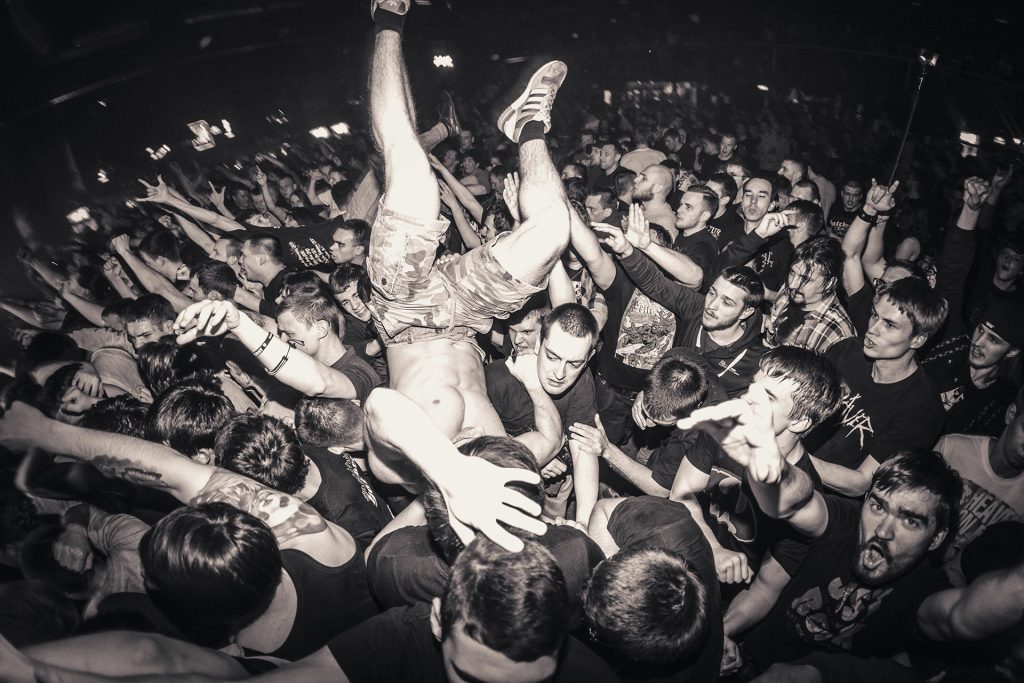
It can have a shape, direction, speed and density. It can expand, contract, cool down, accelerate or organise itself into a vortex. No individual participant possesses any of these properties alone, yet they emerge from the local decisions and collisions of individuals.
The system can also persist while its participants continuously change. Someone leaves, another person takes their place, and the pit continues. Its components change while the movement pattern preserves itself for a time.
This is particularly important from the perspective of Worldinterflow.
Information patterns are often not identical with the people who happen to carry them at a particular moment. A story can survive even after every one of its narrators has been replaced. A language continues while generations come and go. A musical genre retains recognisable characteristics even as its creators, audiences and technical tools constantly change.
(Although we can also ask whether these things really remain the same, or whether people living several centuries ago understood a particular musical genre as something quite different from what we know by that name today.)
The mosh pit compresses the same process into a few minutes.
Moving people create a pattern. The pattern survives the departure of individual participants. New arrivals perceive it, adopt it and keep it going, while every person also modifies it slightly.
Information flows through the participants, but it is not contained in its entirety within any one of them.
Who Is Moving Whom?
When a pit first begins to form, it is easy to say that the people are moving.
A few minutes later, it seems equally reasonable to say that the pit is moving the people.
Both statements are true, but only partly.
The system could not exist without individuals. There is no independent crowd-creature directing them from outside. At the same time, the individual no longer moves completely independently. Once they are inside an established flow, their possible movements are shaped not only by their own decisions but also by the momentum, density and structure of the surrounding system.
Cause and effect begin to turn into one another. People create the movement pattern; the movement pattern creates new conditions for people; the people react to those conditions and continue reshaping the pattern.
There is no single starting point or controller.
There is a continuous cycle.
This is why the mosh pit is much more than an unusual concert custom. On a small scale, it shows how social and cultural systems may function: people create them through their actions, and the systems subsequently act back upon the people who created them.
A social norm, a fashion trend, an economic process, a political movement or even a language may work in a similar way. None can exist without human actions, yet each can become a force that defines which actions are possible or likely for the individuals within it.
In the middle of a concert hall, all of this becomes directly visible.
Sources and Further Reading
Jesse L. Silverberg, Matthew Bierbaum, James P. Sethna, Itai Cohen: Collective Motion of Humans in Mosh and Circle Pits at Heavy Metal Concerts
Physical Review Letters, 2013.
An analysis and model of the disordered, gas-like collective movement of mosh pits and the organised, vortex-like movement of circle pits.
Cornell University – full paper
American Physical Society – DOI page
William Tsitsos: Rules of Rebellion: Slamdancing, Moshing, and the American Alternative Scene
Popular Music, Cambridge University Press, 1999.
On the subcultural rules, historical development and social meaning of moshing.
Daniel Suer: Dance Practices in Metal
In: The Cambridge Companion to Metal Music, Cambridge University Press, 2023.
A cultural overview of movement and dance practices associated with metal music.
Michele J. Gelfand et al.: The Cultural Evolutionary Trade-off of Ritualistic Synchrony
Philosophical Transactions of the Royal Society B, 2020.
An overview of shared rhythmic behaviour, group cohesion and their possible positive and negative consequences.
Ivana Konvalinka et al.: Synchronized Arousal between Performers and Related Spectators in a Fire-walking Ritual
Proceedings of the National Academy of Sciences, 2011.
A study of physiological synchronisation between participants and spectators during a collective ritual.
The Metropolitan Museum of Art: Marble Relief with a Dancing Maenad
On the artistic and mythological background of the ecstatic dancing of the Maenads associated with Dionysus.
The Metropolitan Museum of Art
UNESCO: Mevlevi Sema Ceremony
On the history and cultural structure of the Mevlevi order’s whirling ceremony accompanied by music.
UNESCO Intangible Cultural Heritage
Émile Durkheim: The Elementary Forms of the Religious Life
A foundational work on the community-forming role of ritual and the concept of collective effervescence.
Project Gutenberg – complete English text
Dirk Helbing, Anders Johansson, Habib Zein Al-Abideen: Dynamics of Crowd Disasters: An Empirical Study
Physical Review E, 2007.
On dangerous movement patterns in extremely dense crowds that can override individual control.
American Physical Society – full paper
Sarah McIntyre et al.: Affective Touch Communication in Close Adult Relationships
On the role of touch in emotional and social communication.
Michael Graziano et al.: Threat Detection in Nearby Space Mobilizes Human Ventral Premotor Cortex, Intraparietal Sulcus, and Amygdala
On the neural mechanisms of nearby-space perception, threat detection and personal space.
Daniel M. T. Fessler, Colin Holbrook: Marching into Battle: Synchronized Walking Diminishes the Conceptualized Formidability of an Antagonist in Men
Biology Letters, 2014.
The study found that after walking in synchrony, male participants perceived a potential opponent as smaller and less physically formidable, suggesting that collective movement may strengthen the perceived power of one’s own group.
Scott S. Wiltermuth, Chip Heath: Synchrony and Cooperation
Psychological Science, 2009.
Experiments examining how synchronous movement and shared rhythm can increase cooperation and feelings of social connection.
Scott S. Wiltermuth: Synchronous Activity Boosts Compliance with Requests to Aggress
Journal of Experimental Social Psychology, 2012.
A study in which synchronous activity increased participants’ willingness, in a particular experimental situation, to comply with a request to behave aggressively.