Oswald was remarkably successful for a rabbit who only existed on paper. But then he disappeared for almost a century. Now Disney is bringing him back in a new Disney+ series.
Oswald the Lucky Rabbit is older than Mickey Mouse. Next year, he’ll turn exactly 100. To celebrate, Disney is making a miniseries starring the long-eared character. And there’s a rather peculiar story behind why he’s so much less famous than that particular mouse.
Before Mickey
In the mid-1920s, Walt Disney’s studio was still a long way from the vast empire we know today. But they weren’t complete beginners, either. By then, they had already produced 56 episodes of Alice Comedies, a series that combined live-action and animated characters on screen.
Their next big opportunity came in the form of a new animated series for Universal.
The star was a rabbit: Oswald the Lucky Rabbit.
Alongside Walt Disney, Ub Iwerks, one of Disney’s most important animators and creative partners at the time, played a key role in developing the character.
The first completed Oswald cartoon, Poor Papa, failed to impress the people who had commissioned it, so the character was redesigned. Audiences finally met him in Trolley Troubles, released on September 5, 1927.
The film was a success, and Disney’s team produced a total of 26 Oswald shorts during 1927 and 1928. The rabbit was a hit. Audiences loved him.
And that’s when the trouble began.
Beyond the Rabbit
In 1928, Disney travelled to New York to renegotiate the financial terms of the series. A producer and distributor named Charles Mintz acted as an intermediary between Universal and the creators.
During the negotiations, Disney discovered that he and his team weren’t exactly in a strong bargaining position.
The rights to Oswald did not belong to Walt Disney. They belonged to Universal. And to make matters worse, Mintz had already reached agreements with a significant number of Disney’s animators, who would continue working on the Oswald cartoons for him instead.
So Disney lost not only his successful rabbit, but also much of his studio’s workforce.
Ub Iwerks, however, stayed.
Legend has it that Walt came up with his new character, Mickey Mouse, on the train journey home from New York to Los Angeles. It’s a great story, although the exact details should be treated with some caution. Over the decades, the story of Mickey’s creation has itself become something of a legend.
What is well documented, however, is that after losing Oswald, Disney and Iwerks immediately began developing a new character, one whose rights they would retain.
They had learned their lesson. And they weren’t giving up.
The new character was a mouse. After all, they didn’t want to stray too far from black-and-white cartoon rodents.
Ub Iwerks animated much of the early Mickey Mouse material. He worked almost single-handedly on Plane Crazy, for example, while the studio was still completing its final Oswald cartoons under the terms of its contract.
Then, at the end of 1928, the sound cartoon Steamboat Willie was released, and the mouse set off on his journey to worldwide fame.
The rabbit, however, did not.
Whatever Happened to the Rabbit?
Oswald didn’t disappear just because Disney lost him.
For a while, Mintz’s company continued producing the cartoons, largely with the artists who had left Disney to work for him. Later, Universal took production into its own hands.
In the 1930s, Walter Lantz took charge of the animation department, and new Oswald cartoons continued to be made under his supervision for many years. Meanwhile, the character himself underwent a striking transformation: the original long-eared black rabbit gradually became a rounder, much cuter cartoon character.
But eventually, other characters took centre stage at the studio, including Woody Woodpecker, and Oswald slowly faded from public memory.
While Mickey became one of the world’s most recognisable pop culture icons, his predecessor was largely reduced to a curiosity in the history of animation.
Then came 2006.
A Rabbit for a Sports Commentator
This is where the story takes its most wonderfully absurd turn.
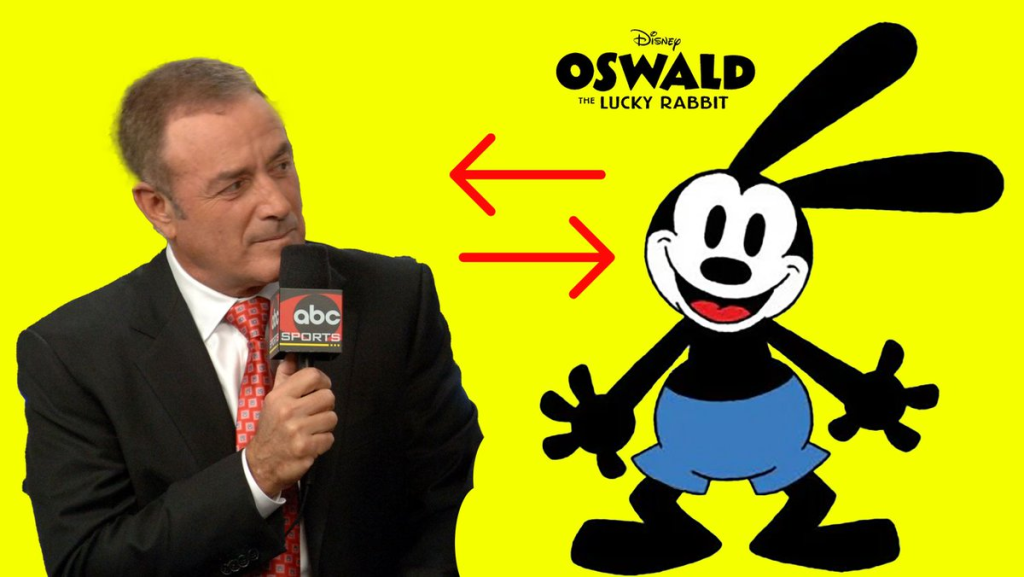
ABC and ESPN, both owned by Disney, had a contract with Al Michaels, one of the best-known commentators in American sports television. Michaels was a voice practically every American television viewer recognised.
Among other things, he had called the legendary USA–Soviet Union hockey game at the 1980 Winter Olympics, known as the “Miracle on Ice”.
But Michaels wanted to move to NBC so he could continue commentating on NFL games alongside John Madden.
As it happened, NBC was owned by NBCUniversal, the same company that held the rights to Oswald.
Bob Iger, who had recently become Disney’s CEO, spotted an opportunity.
As part of a much larger sports rights agreement reached in February 2006, NBCUniversal transferred the rights to Oswald, along with the rights associated with the original Walt Disney-produced cartoons, back to Disney.
In return, Disney released Michaels from his contract, allowing him to move to NBC.
So, to put it simply, after nearly eighty years, Disney got Walt Disney’s long-lost cartoon rabbit back in exchange for an American football commentator.
Of course, the deal involved considerably more than that. It also included various sports broadcasting and usage rights, including Olympic highlights and other sports content.
But Oswald really was part of the deal.
Michaels himself joked that one day he would end up being a trivia question.
He was right.
Oswald Comes Home
Disney gradually began bringing Oswald back into the spotlight.
He appeared in games and video games, and in 2022, Walt Disney Animation Studios produced a new, one-minute, hand-drawn animated short featuring the character.
It was the first new Oswald cartoon made by Disney’s animation studio since 1928.
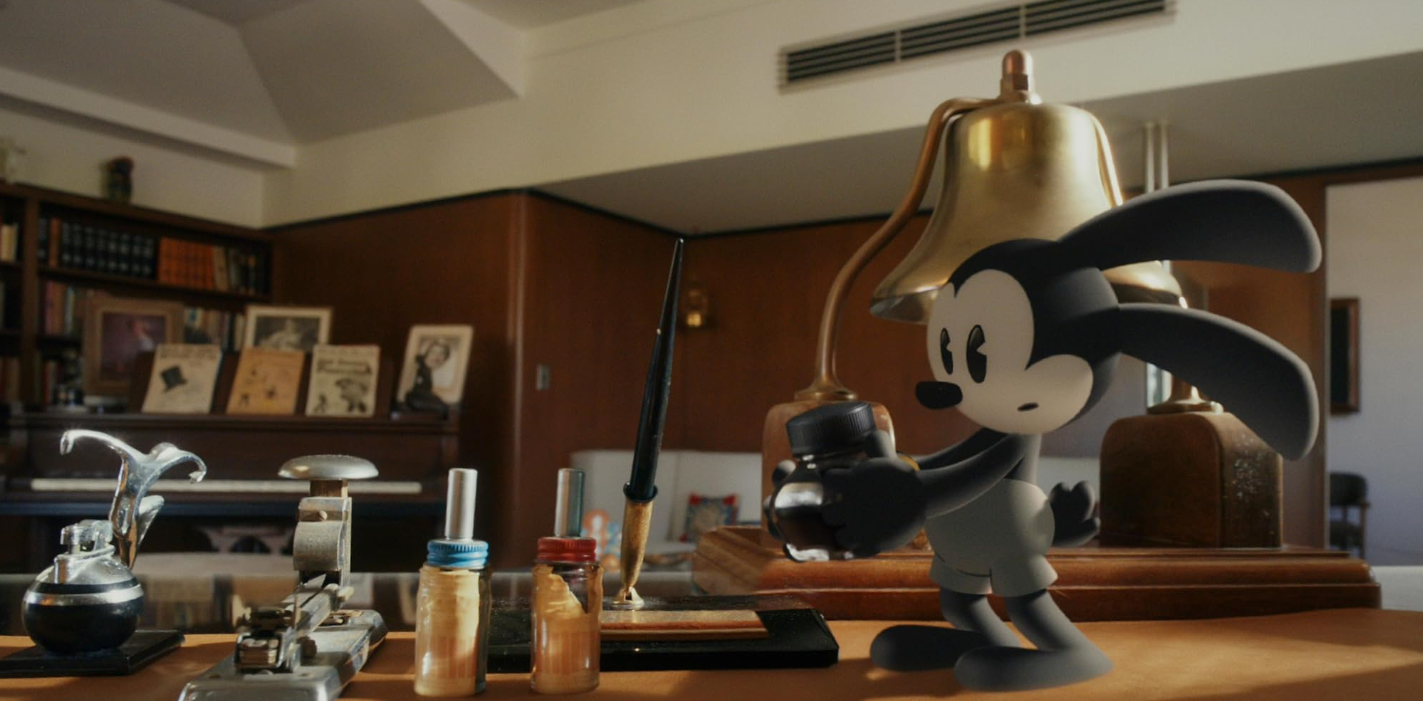
And in 2027, he’ll get his very own miniseries from Jon Favreau – exactly one hundred years after Trolley Troubles introduced him to cinema audiences.
According to the story, an earthquake frees the cartoon character, who has been trapped since the 1920s. A group of children then tries to help him find his way around the modern world.
The three-part miniseries, combining live action and animation, is set to arrive on Disney+ in February 2027.
There’s something distinctly Disney-like about the whole story.
A character is created. He becomes successful. Then he’s lost. That loss contributes to the creation of one of the most famous cartoon characters of all time.
And almost eight decades later, through a thoroughly unlikely business deal, he returns to the studio where he was originally created.
Then, at the age of one hundred, he gets another starring role.
Apart from David Attenborough and Dick Van Dyke, not many can say the same.
Incidentally, Oswald isn’t the only Disney creation to return to the studio’s drawing board decades later.
Destino, the film Salvador Dalí and Walt Disney began working on together in the 1940s but never finished, was finally completed in 2003.
You can read its extraordinary story here.
Oswald’s story, however, is even stranger.
Because if Walt Disney hadn’t lost his lucky rabbit in 1928, there’s a good chance that mouse ears wouldn’t be the world’s most recognisable silhouette today.